
- Which payment methods suit your basket
- What Twint and card cost at CHF 10, 100 and 500
- What the Twint application via Stripe requires
- When invoice or PostFinance Pay belong too
What is mobile payment – and how much of it does a Swiss shop need?
Mobile payment means paying on the smartphone, and what a Swiss shop mainly needs from it is Twint: respondents pick it most often for small amounts, and at Stripe and Shopify it costs less than the card. In the Swiss Payment Monitor 1/2026 by the University of St.Gallen and ZHAW, respondents were asked how they would pay CHF 10 at a well-known Swiss retailer: 52.4% named Twint, 18.4% the credit card.
The study counts payment apps with a bank account such as Twint, wallets with a card behind them such as Apple Pay and Google Pay, and payments inside apps such as SBB Mobile as mobile payment. In the payment diary kept by 1,173 people in November 2025, Twint accounts for 67% of online mobile payments and SBB Mobile for 20.9%, with Apple Pay far behind.
The study itself explains part of the gap. Apple Pay, Samsung Pay and Google Pay are not accepted in many Swiss online shops, while Twint is accepted by almost 80 percent of merchants, according to a non-representative survey of 87 companies from 2024. The 67 percent therefore also show which buttons shops offer at their checkout.
For you as a merchant, a different distinction counts. Twint is a payment app with a bank account and its own rate; depending on the bank, a credit card can be stored too. Apple Pay and Google Pay, by contrast, are your card payment with a button of its own. One big question becomes two small ones: Twint yes or no, and whether your card payment shows the Apple Pay button.
What does Twint cost merchants – and what do Apple Pay and Google Pay cost?
Online, Twint costs between 1.25% plus 18 cents and 1.9% plus 30 cents per payment at the providers compared. Apple Pay and Google Pay cost as much as a Swiss card at Stripe and as much as Visa and Mastercard at Payrexx. Per order, with the standard rates of 6 November 2026, it looks like this, in francs and without monthly fees:
| Rate | CHF 10 | CHF 100 | CHF 500 | |
|---|---|---|---|---|
| Twint, Stripe | 1.9% + 0.30 | 0.49 | 2.20 | 9.80 |
| Swiss card, also Apple Pay and Google Pay, Stripe | 2.9% + 0.30 | 0.59 | 3.20 | 14.80 |
| Twint, Shopify Basic | 1.75% + 0.30 | 0.475 | 2.05 | 9.05 |
| Card, Shopify Basic | 2.95% + 0.30 | 0.595 | 3.25 | 15.05 |
| Twint, Payrexx Free | 1.30% + 0.30 | 0.43 | 1.60 | 6.80 |
| Twint, Payrexx Standard and Premium | 1.25% + 0.18 | 0.305 | 1.43 | 6.43 |
| PostFinance Pay, Payrexx Free and Standard | 1.90% + 0.20 | 0.39 | 2.10 | 9.70 |
| QR bill, Payrexx Standard and Premium | 0.50% | 0.05 | 0.50 | 2.50 |
Half cents are not rounded. Shopify Basic also costs CHF 29 a month, CHF 21 with annual payment; Stripe charges neither a setup fee nor a monthly fee. For Payrexx, the monthly amount of the plans could not be read off the price page, which is why it is missing here. For external payment providers, Shopify lists an additional transaction fee, 2% on Basic.
An example shows how hard the 30 cents per payment hit on small orders. Suppose someone orders coffee from you for CHF 10 and pays with Twint through Stripe. Stripe keeps 49 cents, 30 of them the fixed fee; with the card it would be 59 cents. That is 4.9 and 5.9 percent, more than double the rates of 1.9 and 2.9 percent. On an order of CHF 500 it is CHF 9.80 and CHF 14.80, just under 2 and 3 percent. A coffee shop therefore does the math differently from a bike shop.
Through Payrexx Standard, at 1.25% and 18 cents fixed, the same coffee order costs a good 30 cents. At CHF 500 it is CHF 3.37 less than through Stripe, in each case before any monthly fee.
The Twint figures through Stripe apply only to shops that sell to private customers in francs, because that is the only case for which Stripe offers Twint. For business customers, card and invoice remain.
Are Apple Pay and Google Pay worth adding?
Few people pay with them online so far, but at Stripe and Payrexx they cost the same rate as the card: whether they are worth it is decided mainly by the effort of setting them up. In online business, Apple Pay accounts for 3.4% of mobile payments according to the Swiss Payment Monitor; a year earlier it was 5.5%. The study does not report Google Pay separately there.
At Stripe, Apple Pay appears in Payment Links and in the hosted checkout without additional setup. If the checkout is built directly into the website, the domain must be registered with Stripe for Apple Pay, including the www variant and subdomains. Google Pay is activated in the payment method settings and appears in the checkout without additional code, but the domain must be registered with Stripe for that. HTTPS is required as well, and for Chrome on Android an additional server setting, and you accept Google's terms of use.
How do you get Twint into your online shop?
Through your shop's payment provider, or directly through the Twint merchant portal if you integrate Twint without a provider. Depending on the platform, the route looks like this:
- Shopify lists Twint as its own fee line in the Shopify Payments plans.
- In WooCommerce and Shopware, Twint reaches the shop through the plugin of a payment provider such as Payrexx, or through Twint's own plugin with Express Checkout, where the app transmits the amount and the delivery address. When WooCommerce suits a shop is covered in a separate article.
- Wix offers Twint through the provider PEND, only in Switzerland and in francs. The Wix and PEND accounts must use the same currency, and the PEND account must be approved and verified for payouts.
- With Payrexx, Twint is activated in the settings. According to Payrexx, it is already enabled for Swiss merchants; only verification of the account is required.
Through Stripe, the application asks for these points on your website:
Until the requirements are checked, Twint shows as “pending” in the Stripe account. Stripe does not say how long that takes, and the account can be reviewed even after activation. Per payment, CHF 0.50 to CHF 5,000 is possible, refunds up to 180 days.
Can you use Twint on a Squarespace website?
In our assessment, not as a built-in payment method: Twint does not appear on Squarespace's help pages on payment providers. Listed through Stripe are, among others, Visa, Mastercard, Klarna, and Apple Pay and Google Pay on supported devices. A missing entry on the help page does not prove “it does not work”, but Squarespace has not confirmed the opposite either.
Our CMS Check recommends a suitable content management system for a website or shop based on your answers. Anyone who sells through the site gets the question “Do you need TWINT?” there. If the answer is yes, Squarespace drops out; together with the question about data location, it is one of the questions that take systems out of the running altogether. With Squarespace it is therefore worth settling the payment question before choosing the system. When Squarespace otherwise fits well is covered in the article Squarespace for SMEs.
Do SMEs also need invoice, card or PostFinance?
Yes, as soon as amounts rise or businesses order from you. In the Swiss Payment Monitor survey, only 9% would pay by invoice at a well-known Swiss retailer for CHF 10. At CHF 1,000 it is 35.8%, almost as many as with the credit card (35.3%), and Twint falls to 13.3%. In the payment diary, stores and online combined, above CHF 500 the credit card reaches 30% and invoice 21.7%.
The QR bill has the lowest fee in the table above: through Payrexx it costs 0.50 to 0.60% without a fixed fee. What your own invoicing and open invoices cost is not included.
At Weinbau Wetli, a family business from Männedorf on Lake Zurich, we built the website on Squarespace and adapted the checkout so that customers can order on invoice. Squarespace does not offer this out of the box. More in the case study Website for a winery.
PostFinance Pay replaces PostFinance Card and E-Finance in online retail and is coming to shops step by step until the end of 2026. Customers need the PostFinance app for it. Through Payrexx it costs 1.90% plus 20 cents, 1.50% plus 20 cents on the Premium plan. Anyone who has so far offered PostFinance Card will find its successor in it.
What are the disadvantages of mobile payment for merchants – and what is not proven?
The most noticeable disadvantage is the fees on small amounts. What is not proven is how many additional orders Twint, Apple Pay or an Express Checkout bring in Switzerland.
The level of Twint's fees is disputed. The trade association Swiss Retail Federation considers them too high and demands alignment with the debit card. Its report relies on information from members: small, independent merchants such as farm shops typically pay 1.3% per transaction, according to it, larger businesses 0.59% on average; for the debit card it cites 0.33%, for the credit card 0.68%. Twint calls it “completely wrong and misleading” to present the terms of hand-picked merchants as representative. Often other payment providers set the fees, and overall Twint is cheaper than debit and credit cards in many constellations. On 24 August 2026 the Weko was observing the market; it had not opened an investigation.
How much the payment method weighs next to other reasons is shown by a survey from Baymard, though with customers from the USA. Excluding those who were only browsing, 40% there name extra costs as a reason for an abandoned purchase and 9% “too few payment methods”. The payment method is therefore one reason among several.
Which mobile payment system is best for your shop?
The best fit is the system that your platform supports, that is approved for your customers and that costs the least at your typical basket. Three questions settle it:
- How high is a typical basket? That decides which plan costs the least and whether invoice and credit card belong too.
- Do private customers or businesses order? For businesses, Twint through Stripe is not an option.
- Which platform does the shop run on? It determines the route to Twint and the rate.
Anyone who is only planning the shop can plan mobile payment right when choosing the system. The checklist “Choosing payment methods for the shop” to download sums up the three questions, the details for the Twint application via Stripe and the costs for CHF 10, 100 and 500 per provider, as of 6 November 2026.
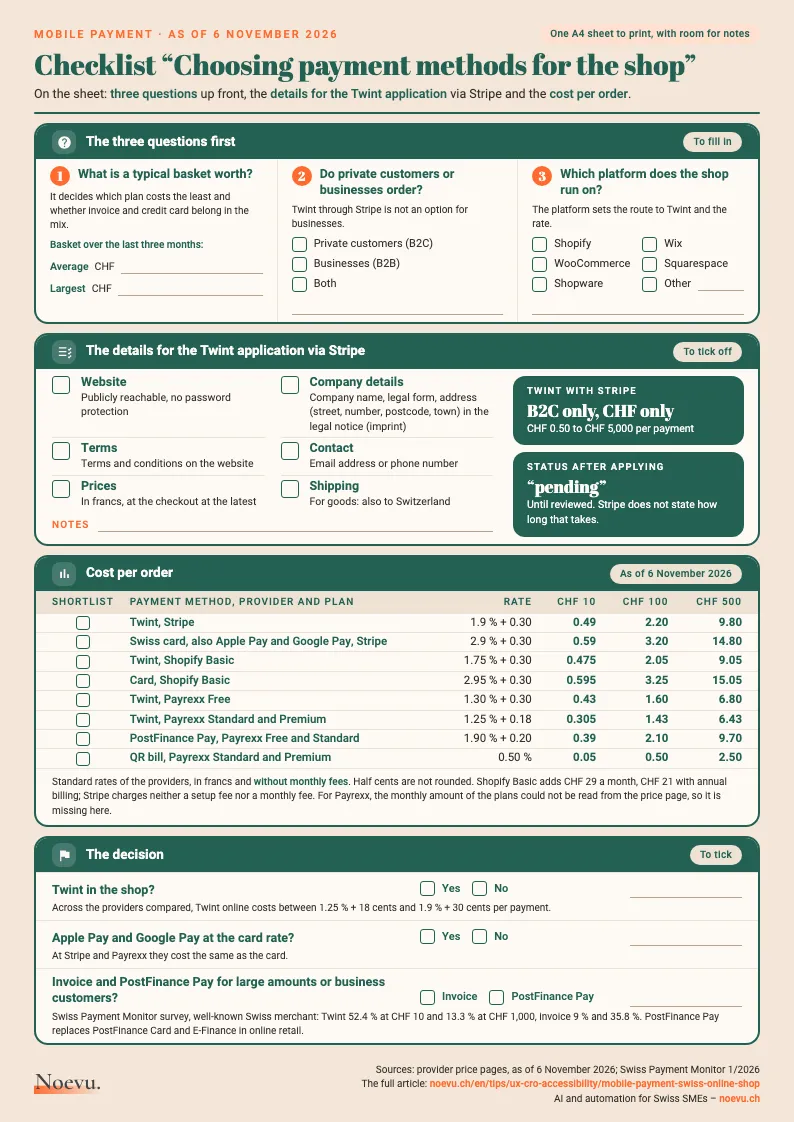
Checklist “Choosing payment methods for the shop”
One A4 sheet to print, with boxes to tick and space for notes. It holds three questions up front, the details for the Twint application via Stripe and a cost table per order. The costs apply to CHF 10, 100 and 500, as of 6 November 2026.
Thank you. Your download will start shortly.
Mobile payment sounds like apps and tech. For your shop it starts with a number: the amount that typically sits in the basket.

Not sure everything has been done right? Book a free, no-obligation online call and we'll take a professional look at your website.
Frequently Asked Questions
Can I use Twint without an online shop?
Yes. According to Luzerner Kantonalbank, you can collect payments with payment links from the Twint merchant portal even without your own online shop; the links go to customers by email, SMS or WhatsApp. Anyone who does not integrate Twint through a payment provider registers in the merchant portal, and the fee is charged by TWINT AG or by the payment provider, depending on the route.
What are the disadvantages of Google Wallet?
From a shop's point of view, this is about Google Pay as a payment method, and it is rarely used in Switzerland: in the Swiss Payment Monitor 1/2026, Google Pay accounts for 4.3% of all mobile payments, in stores and online combined, 0.6 percentage points fewer than in the half-year before. Through Stripe it costs as much as a Swiss card, but it requires a domain registered with Stripe, HTTPS and, for Chrome on Android, an additional server setting.