NGO websites live on donors, volunteers and clear impact communication. Build trust, show impact, simplify giving. Noevu builds websites for Swiss NGOs, foundations and associations with focus on measurable impact and frictionless donation paths.

Websites for NGOs that raise donations
Professional web design for NGOs, associations & foundations
No projects published in this industry yet.
What a great NGO website delivers
NGO websites have one purpose: to communicate the mission so clearly that donors, volunteers and supporters can act without friction. Yet many NGO sites speak in insider jargon, hide the donate function and fail at impact proof.
The strongest NGO sites have three traits: one-click donation with concrete impact reference ("CHF 50 = X weeks of school fees"), real impact stories with photos and numbers (anonymised where needed, always with consent), and transparency markers (ZEWO quality seal, annual reports linked directly, use of funds visible).
TWINT and mobile are not add-ons — they are the main channel
68.1 % of Swiss online donation volume in CHF flows through TWINT. 53.8 % of all online transactions happen on a smartphone. Building an NGO website in 2026 without a TWINT direct button and without a mobile-first donation flow loses the majority of the market before the first argument is read. A predefined amount, one tap, no account. That is the standard, not the premium feature.
The ZEWO 21 standards are a web mandate, not a PDF mandate
The ZEWO 21 standards require things that must be visible on the website itself: annual report and audited financial statement under Swiss GAAP FER 21 downloadable as PDF, current privacy policy, transparent board listing with conflict-of-interest disclosures, use of funds traceably shown. ZEWO-certified organisations or candidates need a website that delivers these points cleanly — otherwise recertification becomes a remediation project.
Recurring donations beat one-off donations — when you make them visible
Recurring donors are 2-3× more likely to increase their gift over time. They provide the planning stability that one-off donations cannot. Yet many Swiss NGO sites hide the recurring option or do not offer it at all. A clear monthly/annual toggle in the donation form, a sponsorship area with concrete framing ("CHF 30/month = one child, one year of schooling") and a donor portal for existing givers lift retention measurably.
Major donors need a dedicated area — discreet, deeper, personal
Donors above CHF 10,000/year want something different than the one-off giver: deeper impact reports, personal contact with the leadership, insight into strategic projects. A gated major-donor area on the website (login, named contact visible, exclusive updates) signals appreciation and supports relationship management — without cluttering the public site with insider content.
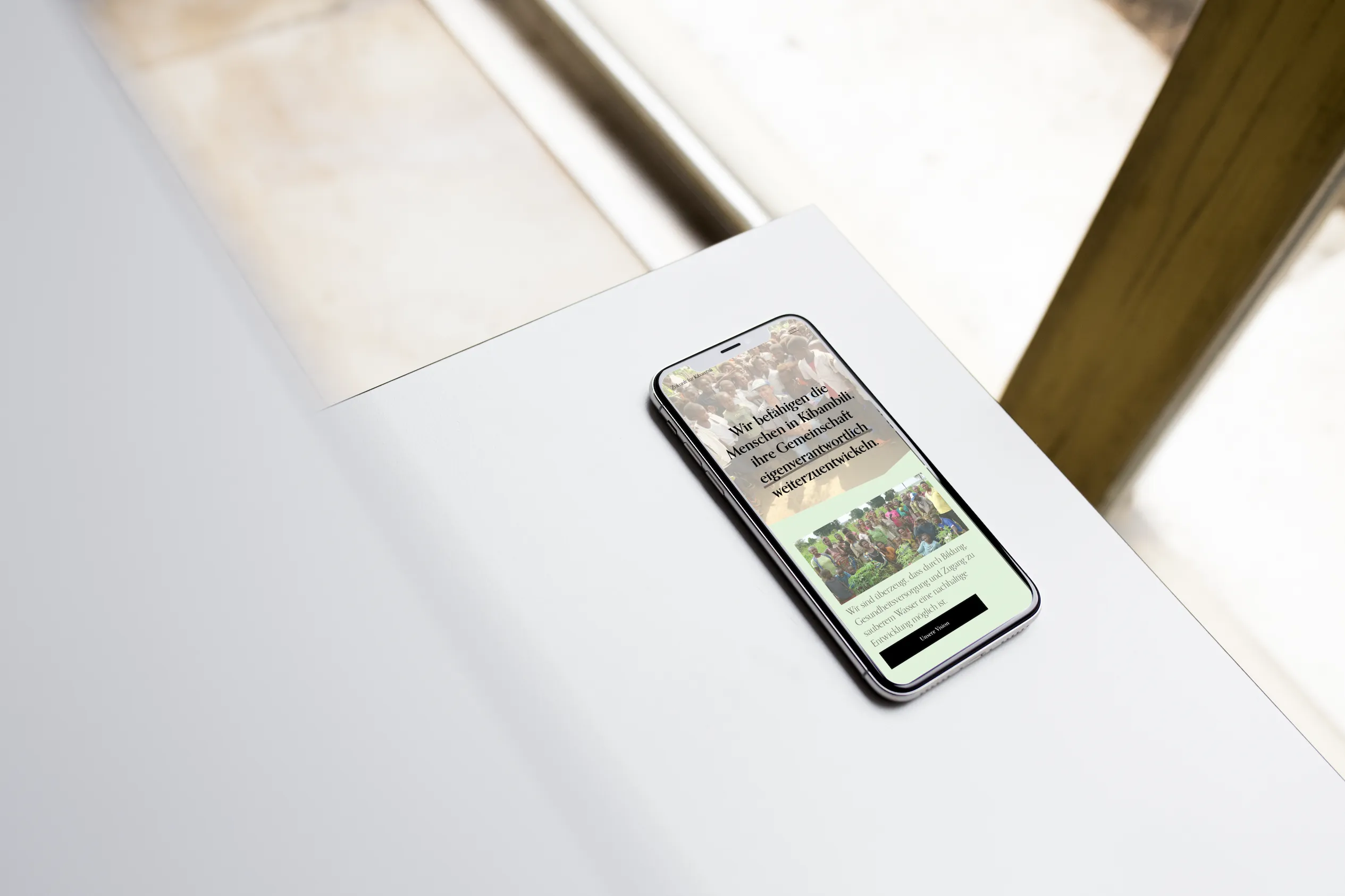
International NGOs need multilingualism — at minimum DE/EN, often FR/IT plus relevant project-country languages. Live example: Future for Kibambili with DE/EN/Swahili.
8 levers for a conversion-strong NGO website
What Swiss NGOs and foundations should get right on the website:
- One-click donation on every page: Donate button in the header, not hidden under "Get Involved". Cuts friction to a minimum. Stripe + TWINT + RaiseNow for Swiss compliance.
- TWINT direct button with predefined amounts: 68.1 % of online donation volume flows through TWINT. Predefined amounts (CHF 30 / 50 / 100) embedded in the QR code, one tap, no account. Mobile-first, because 53.8 % of donations happen on a smartphone.
- Recurring giving with Stripe Subscriptions: Recurring toggle (monthly/annual) in the main form, not hidden in a submenu. Stripe Subscriptions or RaiseNow Recurring for the Swiss market. Recurring donors deliver 2-3× higher lifetime value than one-off donors.
- Impact in numbers, not adjectives: "CHF 50 funds a school child for 1 month" beats "significant impact". Concrete, comparable, motivating.
- ZEWO compliance as a visible trust lever: ZEWO seal in the header or donation footer, annual report and FER 21 financials linked as PDF, board listing with conflict-of-interest disclosures public. These are not boilerplate items — they are active conversion drivers.
- Major-donor area with gated content: Login-protected area for donors above CHF 10,000/year: deeper reporting, exclusive project updates, named personal contact. Signals appreciation and keeps the public site free of insider content.
- Stories instead of statistics: One concrete person, with consent, with a real photo. Measurably lifts donation willingness over abstract figures.
- Multilingual for international impact: DE/EN is mandatory, often FR/IT + project-country languages. Structured translation workflow, correct hreflang SEO.
What does an NGO website cost in Switzerland?
An NGO website starts at CHF 5,500 — including donation integration, multilingual (DE/FR/EN), team/impact section and newsletter wiring.
Typical project investments:
- Small association / local NGO (8-10 pages, 2 languages): from CHF 5,500
- Mid-sized NGO with impact area + RaiseNow integration: CHF 8,500–13,000
- Foundation with multi-project overview, grants area, multi-editor: from CHF 14,000
NGO discounts and foundation funding options discussed before project start.
Swiss donation market — verified numbers
What the data on Swiss giving says — the foundation for any NGO website strategy:
CHF 2.25 bn
- Total Swiss donation volume 2024 (ZEWO donation statistics)
68.1 %
- TWINT share of online donation volume (RaiseNow Digital Fundraising Study 2025)
53.8 %
- Online donations made via mobile (RaiseNow Digital Fundraising Study 2025)
~500
- ZEWO-certified organisations (ZEWO)
CHF 33.50
- Average online donation (DACH) (RaiseNow Digital Fundraising Study 2025)
Impact areas + multilingualism for Swiss NGOs
International sponsorships (education, children, development cooperation)
Sponsorship NGOs live on the emotional bond between donor and a concrete person or project. Websites need a dedicated sponsorship flow (choose child/project → monthly amount → sign-up), regular updates from the project country, personal sponsorship stories with photos and consent. Multilingualism: DE/EN at minimum, often FR plus the language of the project country (Swahili, Portuguese, Spanish).
Local association work (neighbourhood, region, canton)
Local associations — neighbourhood club, family centre, sports club — live on membership and volunteer work, not primarily international donations. Websites need a membership form, event calendar, newsletter, simple donation option. Multilingualism often DE alone, in urban neighbourhoods DE/EN, in cantons FR/IT depending on the language region.
Education NGOs and foundations
Education organisations (scholarships, learning materials, schools) need clear project descriptions, impact reports with educational metrics (completion rates, attendance), scholar stories (anonymised or with consent), grant application forms. Multilingualism DE/EN/FR, for international scholarships also the languages of the target countries.
Environment and climate NGOs
Environment NGOs need data-driven impact communication (trees planted, hectares protected, CO₂ reduction), activation tools (petitions, actions), donation flows for specific projects. Multilingualism DE/EN/FR/IT for national reach. Climate-neutral hosting (Cloudflare green data centres, Vercel CO₂ reporting) is not a marketing gimmick here, it is credibility.
Sports and cultural associations
Sports and cultural associations need event calendars (matches, concerts, events), ticket integration (Eventbrite, RaiseNow Events), member and sponsorship areas, often season-bound content. Donations typically a patronage or supporter model rather than classic donation forms. Multilingualism DE alone in German-speaking Switzerland, DE/FR in bilingual cantons like Bern or Fribourg.
Self-help groups and patient organisations
Self-help organisations need protected areas (forum, group sessions, experience reports), low-threshold contact options, anonymity options, clear information on the condition/topic. Data protection under revFADP is more sensitive here than for classic NGOs. Multilingualism DE/FR/IT for national patient organisations, plus EN for migration communities.
What a NGO/association website shows to be ZEWO-compliant
ZEWO 21 standards: web-visible requirements
The 21 ZEWO standards require four elements that must be available directly on the website. ZEWO-certified organisations or candidates cannot push these points into the back office:
- Annual report downloadable as PDF, updated yearly, with impact reports and project details.
- Audited financial statement under Swiss GAAP FER 21, published within 6 months of fiscal year-end. At least 65 % of spending must go to programmes/purpose, at most 35 % administration.
- Transparent board listing with role, term length and conflict-of-interest disclosures. Plus leadership and org chart. ZEWO requires at least 5 independent board members with collective signing authority.
- Use of funds visually broken down (programme / fundraising / administration) — as a chart on the website, not hidden in a PDF.
revFADP: handling donor data correctly
The revised Swiss Federal Act on Data Protection (revFADP, in force since 1 September 2023) applies to every NGO processing donor data. Required: current privacy policy with clear purpose listing (donation processing, tax receipts, newsletter), data-processing agreements with RaiseNow / Stripe / Mailchimp, register of processing activities, 72-hour data breach notification.
Tax deductibility communicated correctly
Donations to charitable organisations are tax-deductible in Switzerland — up to 20 % of taxable income (federal), cantonally sometimes higher. The website must clearly show: 1) tax-exempt status (cantonal ruling), 2) how donors receive their tax receipt (automatic, manual, from which amount), 3) note on cantonal differences without replacing tax advice.
Federal Foundation Supervisory Authority for foundations
Classic foundations are supervised by the Federal Foundation Supervisory Authority (ESA) or a cantonal authority and registered in the Federal Foundation Register. A foundation website should transparently show foundation purpose (per statute), foundation board, supervisory authority and register entry (commercial register number). Foundation capital and use of proceeds belong in the annual report.
Common mistakes on NGO and association websites
What Swiss NGOs keep getting wrong on the website — and how to fix it:
- Donation function hidden under "Get Involved": The donate button belongs in the header, visible on every page, not two menu levels deep. Donors who have to search do not give.
- No TWINT in the donation form: 68.1 % of online donation volume flows through TWINT. A donation form without a TWINT direct button loses the majority of mobile donors — and 53.8 % of gifts happen on mobile.
- No recurring donation option offered: Recurring donors deliver 2-3× higher lifetime value than one-off donors. Offering only one-off gifts leaves planning stability and retention on the table.
- ZEWO seal not placed visibly: A quality seal hidden in the footer small print devalues itself. ZEWO belongs in the header or right next to the donate button — as an active trust lever, not a legal footnote.
- Annual reports as PDF download only: PDF-only forces an extra click and kills SEO. The headline impact numbers and use-of-funds breakdown belong on the website directly — the PDF download stays available as the formal ZEWO requirement.
- Insider jargon instead of clear impact statements: "Multidimensional capacity-building approach in vulnerable contexts" says nothing. "CHF 50 = one month of schooling for a child in Kibambili" says everything. Donors want to understand impact, not decode NGO vocabulary.
More reading on NGO marketing



Book your free consultation:
Vielen Dank! Wir melden uns in Kürze.
Common questions about NGO and association web design
How do I collect online donations on the website?
Three routes: 1) Stripe / TWINT direct integration for low-friction one-off gifts, 2) RaiseNow for Swiss NGOs (revFADP/QR-bill compliant), 3) external platforms like FundraisingBox or Donorbox. Key: one-click donation on home page, clear impact statement ("CHF 50 = X weeks of school fees") and transparent use of funds — example: Future for Kibambili.
How do I set up a recurring monthly donation?
Two clean routes: 1) Stripe Subscriptions integrated directly — flexible, low fees, but you manage donor data yourself (revFADP obligations). 2) RaiseNow Recurring or FundraisingBox — out-of-the-box with donor CRM, tax receipts, TWINT stop code for mobile cancellation. The recurring toggle belongs in the main form, not a submenu. Behind the scenes you need a donor-lifecycle track (onboarding mail, half-year impact update, annual tax receipt) — otherwise the donor cancels in year one.
Which ZEWO 21 standards must my website show?
The ZEWO 21 standards require four web-visible elements: 1) Annual report downloadable as PDF, updated yearly. 2) Audited financial statement under Swiss GAAP FER 21, published within 6 months of fiscal year-end. 3) Current privacy policy under revFADP, prominently linked. 4) Transparent board listing with role and conflict-of-interest disclosures, plus leadership and org chart. At least 65 % of spending must go to programmes/purpose — that belongs in the annual report and ideally visualised on the website (use-of-funds chart).
How does a major-donor area on the website work?
A major-donor area is a login-protected section for donors typically above CHF 10,000/year. Content: deeper impact reports (project-level breakdowns, financial KPIs), exclusive project updates before public communication, named contact from leadership visible with direct line, optional event invitations. Technically: a simple auth system (NextAuth, Lucia or CMS-native), content tiered by donor status. The area keeps the public website clean and signals to the major donor: you matter, not a donor number.
How do I show impact and transparency?
Impact storytelling beats every number. Real stories (with consent), concrete numbers with source, annual reports straight on the site, transparency seals (ZEWO for CH). Noevu integrates impact dashboards with real data — no whitewashing, traceable impact.
What does an NGO website cost in Switzerland?
An NGO website starts at CHF 5,500 — including donation integration, multilingual (DE/FR/EN), team/impact section and newsletter wiring. Foundations with multi-project overview run from CHF 8,500+. NGO discounts and funding options discussed before start.
Do I need multilingual coverage for an international NGO?
If you operate internationally (sponsorships, foreign projects): yes, at minimum DE/EN, often also FR/IT. Noevu uses structured translation workflows, hreflang SEO and culture-appropriate imagery per language. Live example with DE/EN/SW: Kibambili.
How long does it take from briefing to launch?
Typical Swiss SME projects go live in 6-12 weeks. Workshop and concept (2-3 weeks), design prototyping (2-3 weeks), implementation and content (2-4 weeks), QA and launch (1-2 weeks). Larger projects with multilingual scope, shop or government integration need 3-6 months. You receive a binding roadmap with milestones before start.
Can I edit the website myself after launch?
Yes. By default Noevu ships a website you can maintain yourself — usually on Squarespace (drag-and-drop) or a Headless CMS with visual editor (Sanity Studio, Payload, Strapi). At launch you receive video training and a written guide. If you would rather not invest time, Noevu can maintain the site under a service plan.
What happens after go-live? Maintenance, hosting, support?
Noevu offers a service plan from CHF 90/month — includes hosting (Vercel + Cloudflare CDN), automatic backups, security updates, performance monitoring and 2 support hours monthly. Without a plan the site keeps running — you keep full access and can switch providers any time (no vendor lock-in).
Does Noevu translate the website into multiple languages?
Yes. Multilingual sites in DE/FR/IT/EN (also PT, ES, AR, TR on request) are part of the standard repertoire. We use structured translation workflows with correct hreflang tags, locale-specific imagery and clean SEO per language. Translations can be done by your team or by Noevu via professional translators.
Who owns the website, code and content?
You do. Fully. Noevu delivers code, design files and content for unrestricted reuse — no licensing model, no "platform lock-in". If you ever switch agencies, everything goes with you. Hosting, domain and CMS accounts are in your name. This promise is part of every quote.