Wineries and farms sell origin, quality and story. Your site must convey wine, farm, family and values tangibly — and enable direct sales. Noevu builds websites for Swiss wineries, farm shops, agricultural businesses and agro brands.

Websites for wineries with direct sales
Professional web design for wineries & agriculture
No projects published in this industry yet.
What a great winery website delivers
Winery websites are sales tool and brand management at once. They must make origin, family history and quality aspiration visible — and at the same time enable direct sales, tasting booking and local discoverability.
Three levers decide digital success: on-site photo shoot (vineyard, cellar, family — no stock photos), direct-sales shop (Squarespace Commerce for ranges up to ~200 products, Stripe + Swiss Post integration) and online tasting booking (cuts phone load, lifts conversion).
Regional wine zones — from Valais to Three Lakes country
Switzerland has ten wine cantons, each with its own AOC regulation. Valais is the largest region at around 5,200 ha (Fendant, Heida, Cornalin), Vaud carries the Chasselas heritage in the UNESCO-protected Lavaux, the Bündner Herrschaft stands for premium Pinot Noir. Ticino lives off Merlot, Schaffhausen off Blauburgunder, Lake Zurich and the Three Lakes country (Lake Biel, Murten, Neuchâtel) serve growing wine-tourism markets. A website that clearly locates its region — with single-vineyard names, AOC references and regional tourism backlinks — ranks far better than generic wine sites.
Organic, Demeter, IP-Suisse — certification as a premium anchor
Around 500 ha of Swiss vineyards are organic-certified (Bio Suisse), of which roughly 25% are biodynamic under Demeter — about 80 Demeter wineries in Switzerland in total. IP-Suisse is widespread as an integrated-production standard. Premium-segment buyers actively search for these labels: a website that shows certification badges, growing philosophy and biodynamic calendar practice clearly sells the higher bottle prices. Standard wine sells on price alone.
Direct marketing — farm-shop boom over platform dependency
The number of Swiss farms doing direct sales grew 79% from 2010 to 2020 (to around 12,676 farms, SBV). Wine is the third-largest direct-marketing category after fruit/vegetables and eggs. Many farms rely on vomhof.ch or myfarm.ch — enough for visibility, but not for brand building, SEO control and higher margins. Your own website with shop, newsletter and seasonal shipping logic pulls you out of the platform trap.
Multilingualism + structured data
Swiss wineries reach significantly larger target markets with DE/FR/EN — Ticino operations also need IT. Structured data (Winery + Event Schema) brings tasting slots, farm-shop opening hours and address data directly into the Google SERP. Mobile-first is mandatory: around 76% of wine-shop visits come from smartphones — every extra second of load time costs about 20% conversion.
8 levers for a conversion-strong winery website
What Swiss wineries and farms should get right on the website:
- On-site photo shoot in vineyard and cellar: Your vines, your family, your work. Swiss wine sells origin — and origin needs real photos.
- Direct-sales shop with Swiss shipping: Squarespace Commerce + Swiss Post + Stripe. Direct margin beats any retail middleman.
- Online tasting booking: Guests prefer to book themselves over calling. Cuts phone load and provides booking data for email marketing.
- Storytelling across generations and method: Organic? Biodynamic? Demeter? Family history? That sells the premium price. Standard wine sells only price.
- Local SEO + tourism partners: Location-bound keywords, tourism-association links, gastronomy partnerships. Brings walk-in buyers and tasting bookings.
- AOC and single-vineyard communication as premium anchor: Vineyard names, AOC designation, must weight and vintage character clearly per product page. Whoever searches for "Heida Visperterminen" should find your wine — not the wholesaler.
- Seasonal shipping logic with summer pause: Wine does not tolerate 30°C in the postal van. Communicate a summer pause between July and August, actively promote autumn shipping after harvest, steer Christmas peaks with early-order discounts.
- 18+ age verification — legally compliant and UX-friendly: Modal before shop entry, session-cookie storage, checkout re-verification with date-of-birth field. Mandatory under Swiss alcohol law — but it must not break the purchase flow.
What does a winery website cost?
A winery site starts at CHF 5,500 — including on-site photo shoot in vineyard/cellar, multilingual setup, direct-sales shop and tasting booking.
Typical project investments:
- Small winery (8-10 pages, shop up to 30 products, 2 languages): from CHF 5,500
- Established winery with multi-brand, gastronomy, 3 languages: CHF 8,500–13,000
- Farm with farm shop, subscription model, seasonal store: from CHF 9,000
Fixed price after first call.
Swiss wine industry by the numbers
Market, direct sales and digital buyer behavior — the benchmarks a winery website must be built around.
2,500+
- Wine growers in Switzerland (INFOVIN)
14,432 ha
- Vineyard area Switzerland (2025) (INFOVIN 2025)
38.6%
- Swiss wine domestic market share (SwissWine)
12,676
- Farms with direct sales (+79% vs 2010) (SBV)
~80
- Demeter-certified wineries (Demeter CH)
Swiss wine regions + operation types in SEO
Valais — Saaser, Heida, Cornalin
Largest wine region of Switzerland at around 5,200 ha. Own SEO keywords per vineyard: Visperterminen (Heida), Sierre, Salgesch, Chamoson, Fully. AOC du Valais with precise vineyard designations is mandatory.
Vaud — Lavaux, Chablais, La Côte
Around 3,800 ha, Chasselas benchmark, UNESCO World Heritage Lavaux. SEO anchors: Dezaley, Calamin, Yvorne, Aigle. Tourism queries with high conversion potential.
Bündner Herrschaft — Pinot Noir premium
Around 400 ha, but Switzerland's highest price tier. Vineyards like Maienfeld, Jenins, Malans, Fläsch rank in their own right — vineyard-level SEO is the key lever here.
Ticino — Merlot
Around 1,100 ha, Merlot-dominated. Italian language mandatory — DE/FR/IT/EN as language setup. Sottoceneri and Sopraceneri as regional sub-anchors.
Schaffhausen — Blauburgunder
Around 500 ha, Blauburgunder/Pinot Noir, Hallau as branded vineyard. Wine tourism from Zurich and southern Germany — DE main, EN as bonus.
Lake Zurich and Zurich lowlands
Around 650 ha, urban wine tourism from Zurich. Vineyards like Stäfa, Meilen, Erlenbach. High walk-in potential thanks to suburban-train access.
Three Lakes country — Lake Biel, Murten, Neuchâtel
Growing region, often underestimated. Twann, La Neuveville, Cressier, Vully — vineyard-level SEO is under-competed here and easy to win.
Geneva — Mandement, Entre Arve et Rhône
Around 1,400 ha, urban proximity, experimental varieties. French mandatory, DE/EN as secondary.
Aargau and Baselbiet Riehen
Small but growing regions. SEO gap: little competition on vineyard keywords like Schinznach, Tegerfelden, Riehen, Maisprach.
Operation types — from family winery to natural wine
One dedicated landing section or about page per operation type: family winery (generational storytelling), farm shop with wine range (direct sales + food combination), organic and Demeter winery (certification storytelling, biodynamic calendar, growing philosophy), natural wine producer (minimal intervention, unsulfured, new buyer segment). Each type has its own search intent — a generic "About us" page forfeits these keywords.
What a winery website shows to stay legally and certification compliant
Alcohol law and youth protection (18+)
Swiss alcohol law prohibits selling distilled spirits to anyone under 18 and requires clear age verification for online wine sales too. Advertising must not target minors. On the website this includes: date-of-birth modal before shop entry, checkout verification with stored date of birth, clear minimum-age notices and no lifestyle advertising involving minors.
AOC — controlled designation of origin
AOC regulations are set cantonally in Switzerland (Valais, Vaud, Geneva, Ticino, Bündner Herrschaft, Schaffhausen, Lake Zurich, Aargau, Three Lakes country and others). The website may only use the AOC designation your operation is certified for — including the correct vineyard name, grape varieties and minimum must weight. Incorrect use triggers complaints.
Bio Suisse Knospe and Demeter brand guidelines
The Knospe (Bio Suisse) and Demeter trademarks may only be used by license holders. Logo usage, minimum spacing, color and background are defined in the brand guidelines. On the website, logos belong visibly in the header or product-detail page, plus the license number in the footer.
VAT — 2.5% direct sales vs 7.7% gastronomy
Direct sales of wine from the farm or online shop run on the reduced food rate of 2.5%. Once catering is added (tasting with food, gastronomy service), the standard rate of 7.7% applies (from 2026: 8.1%). Shipping wine and experience packages must be cleanly separated on the website, otherwise the ESTV will charge the higher rate against the entire range.
Food Information Ordinance (LIV)
Wine is legally a food product — labeling and online sale information are regulated under the Food Information Ordinance: alcohol content, grape variety, vintage, origin, producer, allergens (sulfites from 10 mg/l), nominal volume. These mandatory details belong clearly on every product page, not only on the bottle label.
Common mistakes on winery websites
What we keep seeing on Swiss wineries and farm shops — and resolve cleanly in every project:
- Stock photos instead of vineyard and cellar originals: Generic grape close-ups from image databases are immediately recognized by buyers. Real photos of your vineyard, your cellar and your family are the decisive trust lever.
- Generic shop without AOC and single-vineyard tagging: Whoever sells "Pinot Noir" instead of "Pinot Noir AOC Bündner Herrschaft, Schloss XY vineyard, vintage 2023" leaves SEO and premium-price potential on the table.
- No 18+ age verification: A simple "I am over 18" checkbox is legally vulnerable. A date-of-birth modal before shop entry plus checkout verification is the Swiss standard.
- No seasonal newsletter and no shipping logic: Wine buyers purchase around harvest, New Year and Christmas. Without a newsletter you miss the three most important order waves — and the cheapest reactivation of existing customers.
- Unclear shipping costs and delivery times: Hidden or ambiguous shipping costs break checkout conversions. Swiss Post, DPD, minimum order value for free shipping — all transparent on product and cart pages.
- Missing multilingual setup DE/FR/EN: Selling nationally requires at least DE/FR; Ticino additionally IT. EN for tourism and export. A single-language site forfeits half the Swiss market.
More reading on winery & agriculture marketing



Book your free consultation:
Vielen Dank! Wir melden uns in Kürze.
Common questions about winery & agriculture web design
Do I need an online shop for my winery?
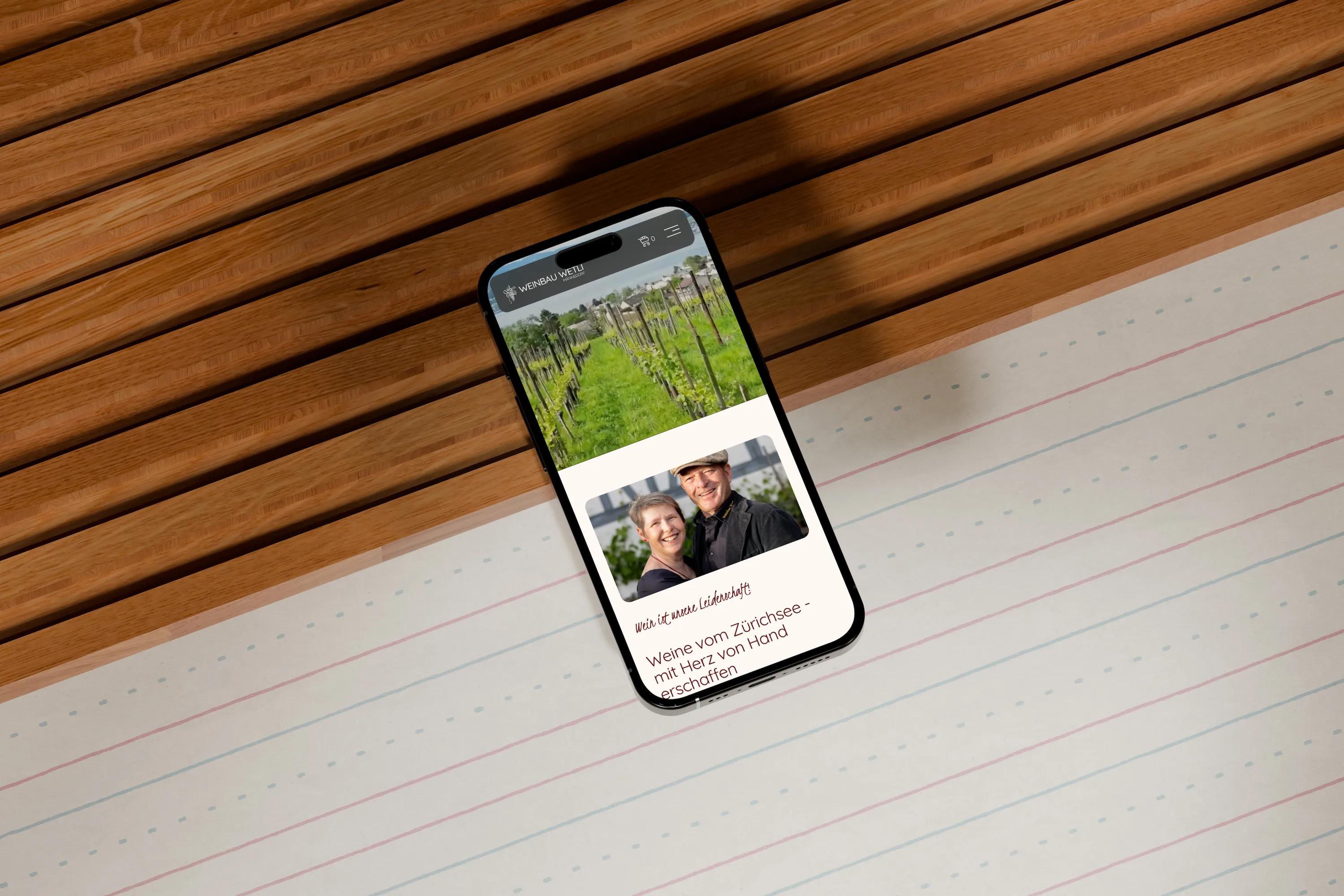
If you sell directly to end customers: yes — direct sales hold the highest margin. Squarespace Commerce covers ranges up to ~200 products and integrates payment and shipping logic (Swiss Post, DPD). Example: Weinbau Wetli with tasting booking and direct shipping.
How do I convey origin and story authentically?
Photo shoot in the vineyard, in the cellar, with family — not stock photos. Storytelling across generations, growing methods (organic? biodynamic? Demeter?), terroir facts. Noevu produces with Swiss photographers on site and keeps imagery tasteful and cliché-free.
How do guests find my tasting on Google?
Local SEO: Google Business Profile with photos + reviews, "wine tasting [region]" keywords, structured data (Winery + Event Schema), local backlinks (tourism associations, hospitality partners). Make tasting slots bookable online — a conversion lever.
What does a winery website cost?
A winery site starts at CHF 5,500 — including on-site photo shoot in vineyard/cellar, multilingual setup, direct-sales shop and tasting booking. Larger operations with multi-brand or gastronomy at CHF 8,500+. Fixed price after first call.
Which AOC designation may I use on my website?
Only the AOC designation your operation is certified for by the responsible canton. AOC (Appellation d'Origine Contrôlée) is regulated cantonally in Switzerland — Valais, Vaud, Geneva, Ticino, Schaffhausen, Bündner Herrschaft and others each have their own rules on grape varieties, minimum must weight and single vineyards. The AOC designation belongs clearly on every product page, along with vintage, vineyard and must weight. Incorrect or loose usage triggers complaints from cantonal wine controls.
How does 18+ age verification work in a legally compliant way?
Swiss alcohol law and food law prohibit selling alcoholic drinks to people under 18 — online and offline. On the website this means: a modal with date-of-birth entry before shop entry, result stored via session cookie. At checkout the date of birth is requested again with the address and stored. Swiss Post shipping additionally requires handover only to adults. A simple "I am over 18" checkbox is not enough — date-of-birth entry is the Swiss standard.
Which reduced VAT rate applies to direct sales?
For direct wine sales from the farm or via the online shop, the reduced VAT rate of 2.5% applies (food rate), as long as the wine is taken away or shipped unchilled and without on-site catering. Once catering is added — tasting with a cheese platter on site, gastronomy service — the standard rate of 7.7% applies (from 2026: 8.1%). On the website, you must cleanly separate shipping wine from tasting packages, otherwise the Federal Tax Administration will charge you the higher rate.
How long does it take from briefing to launch?
Typical Swiss SME projects go live in 6-12 weeks. Workshop and concept (2-3 weeks), design prototyping (2-3 weeks), implementation and content (2-4 weeks), QA and launch (1-2 weeks). Larger projects with multilingual scope, shop or government integration need 3-6 months. You receive a binding roadmap with milestones before start.
Can I edit the website myself after launch?
Yes. By default Noevu ships a website you can maintain yourself — usually on Squarespace (drag-and-drop) or a Headless CMS with visual editor (Sanity Studio, Payload, Strapi). At launch you receive video training and a written guide. If you would rather not invest time, Noevu can maintain the site under a service plan.
What happens after go-live? Maintenance, hosting, support?
Noevu offers a service plan from CHF 90/month — includes hosting (Vercel + Cloudflare CDN), automatic backups, security updates, performance monitoring and 2 support hours monthly. Without a plan the site keeps running — you keep full access and can switch providers any time (no vendor lock-in).
Does Noevu translate the website into multiple languages?
Yes. Multilingual sites in DE/FR/IT/EN (also PT, ES, AR, TR on request) are part of the standard repertoire. We use structured translation workflows with correct hreflang tags, locale-specific imagery and clean SEO per language. Translations can be done by your team or by Noevu via professional translators.
Who owns the website, code and content?
You do. Fully. Noevu delivers code, design files and content for unrestricted reuse — no licensing model, no "platform lock-in". If you ever switch agencies, everything goes with you. Hosting, domain and CMS accounts are in your name. This promise is part of every quote.