Consultants sell trust, not hours. Your site must clarify in 5 seconds: for whom, for what, with which results. Noevu builds conversion-strong presence for Swiss consulting boutiques, interim managers and strategy advisors.

Websites for business consulting with lead conversion
Professional web design for consulting & interim management
No projects published in this industry yet.
What a great consulting website delivers
Consulting websites sell trust in a market where almost every claim sounds interchangeable. "Strategic advice", "tailored solutions", "experienced team" — everyone says this. Differentiation happens through sharp positioning and traceable results.
The strongest consulting sites share three traits: sharp niche positioning (the one problem you are unambiguously the best choice for), real case studies with measurable results (anonymised is fine, fabricated is not), and low-friction lead capture (a Cal.com embed beats any contact form).
Which pages a consulting website actually needs
The minimum: home with three-sentence positioning, services ordered by client problem (not by method), methodology as a visible thinking process, about with credentials and teaching roles, case studies with numbers, and contact with a Cal.com embed. Six pages cover 80 percent of Swiss consulting boutiques.
Making methodology visible — the lever Big Four cannot pull
Boutiques can publish their frameworks without brand risk. A methodology page with a diagram, three real-mandate examples and a whitepaper download shows how you think — before anyone books. Decision-makers scan methodology before references.
International mandates: Zug, Geneva and the English landing page
Zug attracts crypto and holding mandates, Geneva international organisations, Basel pharma PE. These mandates come in English — your site must too. No full translation needed; one strategic EN landing page with cases and a daily-rate range covers the first impression.
Trust markers — logos, teaching roles, published articles, EXPERTsuisse membership, CMC certification — are the first thing decision-makers scan. They belong in the layout prominently, not buried in an "about" page.
8 levers for a conversion-strong consulting website
What actually generates leads for consulting firms — gathered from projects with interim managers, strategy consultancies and boutiques:
- Sharp positioning as the homepage headline: Three sentences, not three paragraphs: for which problem, with which method, with which result. Those who do not dare exclude an audience will not be picked either.
- Case studies with numbers, not adjectives: "Revenue +28% in 6 months" beats "significant increase". Anonymising is OK — fabricating is not. Three strong cases suffice.
- Cases on the homepage, not buried in a portfolio submenu: Industry benchmarks: moving cases from the submenu to the homepage produced +40% qualified inquiries in 60 days. Hidden cases are not read.
- Six-page structure beats mega-navigation: Home, services, methodology, about, cases, contact. That is enough for 80% of boutiques. Every extra page must serve a concrete search query.
- EXPERTsuisse membership and CMC visible in hero and footer: Certificates belong in the footer and the about hero — not on a hidden credentials page. Decision-makers scan association membership in under two seconds.
- Cal.com embed instead of a contact form: A direct booking saves the "we will be in touch" loop. Consulting leads prefer to book a slot over filling forms.
- Daily-rate range shown transparently: A range ("Mandates from CHF 1,500/day") qualifies inquiries before the discovery call and does not deter — it filters. Whoever balks at the rate was not a mandate anyway.
- Own content as a trust lever: Whitepapers, method briefs, LinkedIn newsletter. Make your thinking visible — decision-makers want to know how you think before they hire.
What does a consulting website cost in Switzerland?
A conversion-strong consulting site starts at CHF 5,500 — including strategy workshop, custom design, SEO foundation, lead form and CMS training.
Typical project investments:
- Solo consultant / interim manager (5-7 pages): from CHF 5,500
- Consulting boutique (10-15 pages, team, cases, insights): CHF 9,000–14,000
- Mid-size firm with method library, whitepaper funnel or newsletter integration: from CHF 16,000
We use Squarespace or a Headless CMS depending on content volume. Fixed price commitment before start.
The Swiss consulting market in numbers
A few numbers that explain why the website decides in this market:
USD 3.74B
- Swiss consulting market 2026 (Mordor Intelligence)
CHF 1,400–1,800
- Average interim manager daily rate (mc-executives.com)
75%
- B2B buyers judge credibility on website design (Stanford)
+40%
- qualified inquiries from cases on the homepage (kgwebdesigner.com)
6.2%
- average conversion rate, professional services B2B (Unbounce 2025)
Swiss consulting — regional focus by canton
Zurich
Financial services, insurance, industrial HQs. Language focus: German primary, English for international mandates. Densest Swiss competition — sharp positioning decides.
Zug
Holdings, crypto, international tax structuring. Language focus: English primary for PE and crypto, German for local SMEs. EN landing page mandatory.
Basel
Pharma, life sciences, chemicals. Language focus: English dominant (Roche, Novartis ecosystem), German for regional industry. Sector vocabulary signals fit.
Geneva
International organisations, private banks, commodities. Language focus: French and English required, German nice-to-have. UN, WTO and IO mandates expect EN first contact.
Bern
Federal administration, federally-linked entities, NGOs. Language focus: German primary, French for inter-departmental mandates. Public procurement experience as a differentiator.
Lausanne
EPFL spin-offs, medtech, fintech. Language focus: French and English, German optional. Tech literacy and startup scaling experience belong prominently in the profile.
What a consulting website professionally covers
EXPERTsuisse and CMC certification
ASCO merged into EXPERTsuisse in January 2023 (sub-brand "Consulting & Business Services"). The CMC (Certified Management Consultant) credential is awarded via the EXPERTsuisse commission — a trust marker that belongs in the hero and footer, not on a sub-page.
revDSG for B2B inquiries
Since September 2023, the revised Swiss data protection law applies. B2B contact forms also need a privacy statement, legal basis and retention period. A cookie banner alone does not cover this — the form pipeline must be documented separately.
Billing for international mandates
EU and UK mandates trigger VAT and reverse-charge questions. The Swiss tax authority expects clean per-mandate records — a short "How we bill" section noting Swiss law and EU reverse-charge prevents pre-kickoff back-and-forth.
Daily-rate transparency vs. Swiss price disclosure rules
The Swiss price disclosure rules apply to consumers, not B2B advisory. Daily rates may be shown openly — a range ("Mandates from CHF 1,500/day") qualifies inquiries without legal risk.
Common mistakes on consulting websites
Recurring patterns from reviews of Swiss consulting websites:
- Generic positioning: "We advise companies on strategy." Everyone says that. Sharpen: for whom, with what, with which result. Whoever excludes nothing will not be chosen either.
- Cases without numbers: "We successfully guided a company through transformation." Without industry, starting point and measurable result, it is not a case — it is a claim.
- Contact form instead of Cal.com embed: The form forces the "we will be in touch" loop. Direct booking qualifies instantly and shortens the lead path to one click.
- Hidden trust markers: CMC certificate, EXPERTsuisse membership, teaching roles, published articles — belong in the hero and footer, not in a hidden credentials list.
- "We help you" filler phrases: "We support you with…", "We help you to…". Interchangeable. Replace with concrete client-side problem statements, no self-reference.
- About page with bookshelf cliché: Studio photo in front of a bookshelf, generic CV text, no point of view. Instead: one photo in client context, one thesis per person, what they do better than others.
More reading on consulting marketing



Book your free consultation:
Vielen Dank! Wir melden uns in Kürze.
Common questions about consultancy web design
How do I position my consultancy on the website?
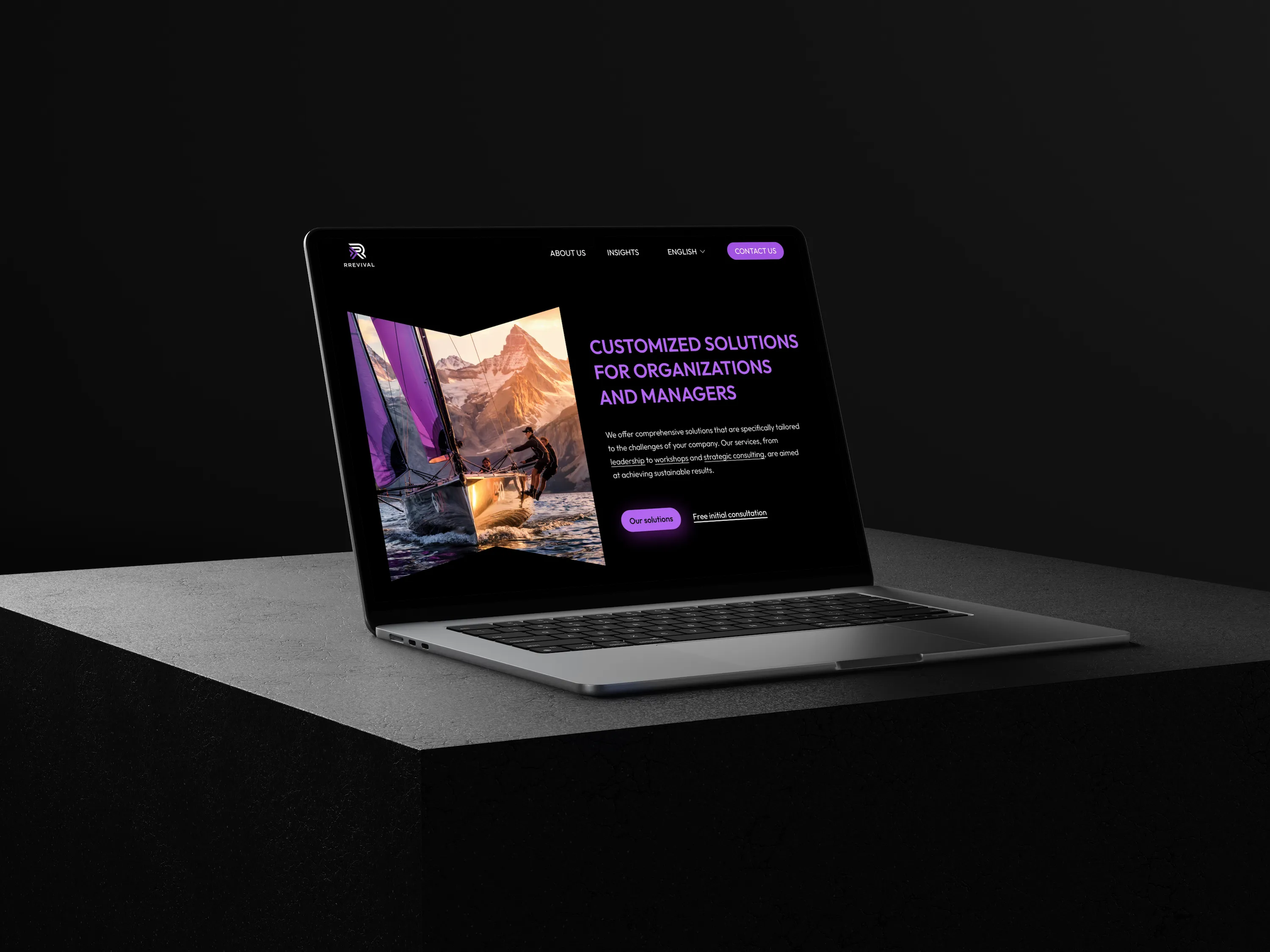
Sharp beats broad. Define: 1) which client problem you are unambiguously the best choice for, 2) with what method/experience, 3) with what measurable result. Three sentences on the home page, not three paragraphs. Example: Rrevival interim management.
Do I need case studies or are logos enough?
Both — logos build the first trust anchor (perceived in under a second), case studies convince decision-makers with concrete results. 3-5 anonymised cases with starting point, approach and result (in numbers) outperform 20 context-less logos.
Which pages does a consulting website actually need?
The minimum is six pages: home with three-sentence positioning, services ordered by client problem, methodology as a visible thinking process, about with credentials, case studies with numbers and contact with a Cal.com embed. That covers 80% of Swiss boutiques — every extra page must serve a concrete search query.
How do I show my methodology without giving away IP?
Publish the method, keep the application inside the mandate. A process diagram, three example projects with results, a whitepaper download with email capture — that makes your thinking visible without giving away the mandate value. Boutiques can do what the Big Four cannot, for brand-risk reasons.
What is EXPERTsuisse and should I show membership?
ASCO (Association of Management Consultants Switzerland) merged into EXPERTsuisse in January 2023 (sub-brand "Consulting & Business Services"). The CMC certificate is awarded via this body. Membership and CMC belong in the footer and the about hero — decision-makers scan association affiliation as a trust marker in under two seconds.
What does a consultancy website cost in Switzerland?
A conversion-strong consulting site starts at CHF 5,500 — including strategy workshop, custom design, SEO foundation, lead form and CMS training. We use Squarespace or Headless depending on content volume. Fixed price commitment before start.
How do I generate leads through the website?
Lead generation in consulting works via: 1) valuable content (whitepapers, method briefs), 2) clear CTA for first call (Cal.com embed beats forms — less friction), 3) trust markers (testimonials, logos, results), 4) retargeting for site visitors. Three lead channels rather than one.
How long does it take from briefing to launch?
Typical Swiss SME projects go live in 6-12 weeks. Workshop and concept (2-3 weeks), design prototyping (2-3 weeks), implementation and content (2-4 weeks), QA and launch (1-2 weeks). Larger projects with multilingual scope, shop or government integration need 3-6 months. You receive a binding roadmap with milestones before start.
Can I edit the website myself after launch?
Yes. By default Noevu ships a website you can maintain yourself — usually on Squarespace (drag-and-drop) or a Headless CMS with visual editor (Sanity Studio, Payload, Strapi). At launch you receive video training and a written guide. If you would rather not invest time, Noevu can maintain the site under a service plan.
What happens after go-live? Maintenance, hosting, support?
Noevu offers a service plan from CHF 90/month — includes hosting (Vercel + Cloudflare CDN), automatic backups, security updates, performance monitoring and 2 support hours monthly. Without a plan the site keeps running — you keep full access and can switch providers any time (no vendor lock-in).
Does Noevu translate the website into multiple languages?
Yes. Multilingual sites in DE/FR/IT/EN (also PT, ES, AR, TR on request) are part of the standard repertoire. We use structured translation workflows with correct hreflang tags, locale-specific imagery and clean SEO per language. Translations can be done by your team or by Noevu via professional translators.
Who owns the website, code and content?
You do. Fully. Noevu delivers code, design files and content for unrestricted reuse — no licensing model, no "platform lock-in". If you ever switch agencies, everything goes with you. Hosting, domain and CMS accounts are in your name. This promise is part of every quote.