Trust, clarity, accessibility — health and social sites must remove barriers. Multilingualism, accessibility and sensitive data handling are mandatory. Noevu builds websites for Swiss social enterprises, care institutions, foundations and health providers.

Websites for social enterprises — accessible & multilingual
Professional web design for social enterprises, care & foundations
No projects published in this industry yet.
What a great health & social website delivers
Health and social sites address people in often difficult life situations — they must not create friction. People seeking care, counselling or support have no patience for clunky menus, cookie-banner pressure or inaccessible forms.
Three requirements are non-negotiable: accessibility per WCAG 2.2 AA (usable for people with disabilities, elderly users and language-restricted users), multilingual reach (DE/FR/IT plus migrant languages like EN, AR, TR), and sensitive data handling (no US cloud, no invasive tracking, hosting CH/EU).
BehiG revision June 2025: what changed
The Swiss Equality for Disabled Persons Act (BehiG) was revised in June 2025. Public bodies are now bound immediately; private providers offering services to the general public follow in 2027. Care homes, foundations and social enterprises building or relaunching a website should plan for WCAG 2.2 AA. The foundation "Zugang für alle" and ProInfirmis have legal standing under BehiG §8 — reputational risk applies even without a formal ruling.
ZEWO compliance as a web requirement
The ZEWO seal of approval is not just a trust badge for the ~500 certified Swiss NPOs — it is a concrete website requirement: published annual report, financial statement, governing body transparency and impact communication must be discoverable on the site. We build ZEWO-compliant transparency blocks directly into the layout — financial overview, impact report, embedded annual report — instead of sending donors to PDF graveyards.
Twint and the rise of digital donations
The 2022 ZEWO survey shows the website donation form ranks equal to personalised donation letters as the most important digital fundraising tool. Twint is growing fastest — from a side-note to an expected payment channel. A 2026 donation form without Twint QR or Twint deeplink leaves measurable donations on the table. Average donation volume per digital channel is still below the traditional channel, but the growth curve clearly points upward.
Anonymous counselling UX inspired by SafeZone
Addiction, family and care counselling often fails at the identity gate. SafeZone.ch has demonstrated what works: book a slot without email, chat without an account, session data deleted when the browser closes. We replicate this pattern for counselling centres, anonymous care hotlines and migration services. Donation integration, volunteer recruitment and transparent impact communication are the conversion levers. Foundations with large content volume benefit from a Headless CMS with multi-editor workflow.
8 levers for an effective social website
What social enterprises and care institutions should get right on the website:
- Accessibility by default, not add-on: Build for WCAG 2.2 AA from day one. Reaches 10-15% more users, improves SEO, meets the revised BehiG (June 2025 for public bodies) and the EU European Accessibility Act from 2025.
- Multilingual with hreflang and cultural adaptation: Translate the experience, not just the words. DE/FR/IT plus migrant languages (EN, AR, TR, UK) where relevant. Language switch without reload.
- No US cloud for sensitive enquiries: Hosting in Switzerland or EU, no Google Analytics, no Facebook Pixel on enquiry pages. FADP and FMH guidelines respected.
- Impact storytelling with real stories: Anonymised, with consent, with concrete numbers. Beats any abstract figure. Measurably lifts donation and support willingness.
- Anonymous counselling slots without email required: For addiction, family or care counselling — a low-friction contact option without identity disclosure. SafeZone pattern. Brings 30-50% more first contacts.
- Twint donations directly in the form: Twint QR and Twint deeplink as equal payment options alongside credit card and Twint recurring. Twint is the fastest-growing online donation channel in Switzerland — skipping it costs measurable conversion.
- ZEWO transparency visible in the layout: Annual report, financial overview and impact metrics directly visible in the layout — not buried as a PDF download. ZEWO seal with verifiable link back to zewo.ch lifts donor trust measurably.
- Headless CMS for multi-location foundations: Curaviva members, Spitex associations and cantonal social services often maintain 5-50 locations. Role-based editor permissions, shared content blocks, brand consistency — cleanly solved via a Headless CMS.
What does a social enterprise website cost?
A multilingual social enterprise site starts at CHF 6,500 — including accessibility audit, brand work, 3 languages and donation integration if needed.
Typical project investments:
- Small NGO / care institution (8-12 pages, 2 languages): from CHF 6,500
- Foundation with impact area + donation integration (3 languages): CHF 9,500–14,000
- Large social enterprise with multi-location, multi-editor: from CHF 15,000
We check Swiss funding options (eGovernment Switzerland, foundation grants) before project start.
Swiss health & social sector in numbers
Verified figures from Swiss sources showing the scale of the sector and the digital catch-up still to do.
13,724
- charitable foundations in Switzerland (end 2024) (Swiss Foundation Report 2025, CEPS Basel)
CHF ~6 bn
- annual grant volume from Swiss foundations (Swiss Foundation Report 2025)
~1,600
- member institutions in the Curaviva network (care homes, disability homes, children's homes) (Curaviva Switzerland)
June 2025 / 2027
- BehiG obligation: public bodies from June 2025, private providers from 2027 (BehiG revision 2025)
Twint #1
- fastest-growing online donation channel in Switzerland (ZEWO Digital Donations 2022)
Sector depth in health and social services
Care institutions (Curaviva members)
Care homes for the elderly, disability homes and children's homes in the Curaviva network have specific web requirements: care-level explanation, waiting-list enquiry, governing-body transparency, multilingual reach for relatives, EPD integration. Mobile-first for relatives searching for placements on the go.
Social enterprises with IV reintegration jobs
Workshops and social enterprises bringing people with disabilities back into the labour market need a dual-purpose website: B2C shop for products and services plus B2B section for employers, authorities and funders. Impact metrics (placement rate, wage development) belong prominently in the layout.
Foundations by grant area
Education foundations need application workflow and funding criteria. Social foundations need impact storytelling and donation integration. Research foundations need a publications list and grant calendar. We build foundation websites by grant area, not by generic template.
Anonymous counselling centres (SafeZone, Pro Juventute)
Addiction, family, debt and violence counselling centres live on low-barrier first contact. SafeZone pattern (pseudonym, throwaway token, no tracking pixels) is best practice. We build the UX so the first contact succeeds without identity disclosure.
Migration services with DE/FR/IT/EN/AR/TR/UK
Caritas, the Swiss Red Cross, HEKS and cantonal migration services need 6-7 languages — DE/FR/IT as national languages, EN as the default, AR and TR for established migration communities, since 2022 UK for Ukrainian refugees. Language switch without reload, clean hreflang, culture-appropriate imagery per language.
What a health/social website legally must do
BehiG revision June 2025 and 2027
The Swiss Equality for Disabled Persons Act (BehiG) revision is binding for public bodies from June 2025 — hospitals, cantonal social services, public-law foundations. From 2027 it also covers private providers offering services to the general public. Technical benchmark: WCAG 2.2 AA and the Swiss standard eCH-0059 V3.
eCH-0059 V3 and WCAG 2.2 AA
eCH-0059 V3 is the Swiss e-government standard that operationalises WCAG 2.2 for the Swiss context. In practice that means: contrast ≥ 4.5:1, full keyboard navigation, labelled forms, alt text, semantic HTML, screen-reader tests. We audit every social website against these criteria before launch.
FADP (revDSG) for patient and client data
The revised Federal Act on Data Protection (in force since September 2023) applies to all Swiss organisations processing personal data. For especially sensitive data (health, religious beliefs, addiction) it requires: a documented register of processing activities, data minimisation, privacy by design. Hosting in CH or EU, no US cloud on sensitive pages.
ZEWO-21 standards and ESA oversight
ZEWO-certified NPOs must meet 21 transparency and governance standards — annual report, financial statement, governing body disclosure, impact communication. Foundations are additionally supervised by the Swiss Federal Supervisory Authority for Foundations (ESA), which reviews bylaws, annual accounts and foundation activity. Both have direct web implications: what is filed with the regulator should also be accessible to the donor on the website.
FMH guidelines for medical websites
FMH guidelines govern digital patient communication: no advertising for prescription medicines, clear separation of information and advertising, imprint with a responsible person, no misleading healing promises. For medical practices, hospitals and health providers, this belongs in every website relaunch.
Common mistakes on health & social websites
What we keep finding in audits — and fix immediately in a relaunch:
- Sensitive data on US cloud: Contact forms covering care, addiction or migration topics routed through Google Forms, Mailchimp or HubSpot. Violates FADP and FMH guidelines. Move to CH/EU hosting immediately.
- Missing multilingual reach DE/FR/IT/EN/AR/TR: Urban social services often have 30-50% clients with migration background. German-only means measurably fewer first contacts. At minimum DE/FR/IT/EN, ideally extended with AR and TR.
- No Twint donation form: Donation sites without Twint lose the fastest-growing channel. In 2026, offering only credit card or PostFinance shuts out an entire donor generation.
- No anonymous contact channel: Addiction, violence or family counselling fails at the identity gate. Mandatory email in the form blocks the first contact. SafeZone pattern (pseudonym + throwaway slot) is best practice.
- BehiG violations under the new 2025 obligation: Websites of public bodies (hospitals, cantonal social services) without WCAG 2.2 AA breach BehiG since June 2025. ProInfirmis holds legal standing — reputational risk now, litigation risk medium-term.
- Impact report only as a PDF download: Donors and foundation funders expect impact metrics directly on the website — not buried in a 60-page PDF. ZEWO-compliant transparency means layout blocks, not download graveyards.
More reading on social & health web design



Book your free consultation:
Vielen Dank! Wir melden uns in Kürze.
Common questions about health & social web design
How is the site accessible under WCAG 2.2?
Accessibility is mandatory — and a conversion lever. Contrast, font size, keyboard navigation, alt text, semantic HTML, screen-reader tests. Noevu builds all sites WCAG 2.2 AA compliant and audits before launch. The Swiss Equality for Disabled Persons Act (BehiG) and FADP are met.
How does multilingualism work for social services?
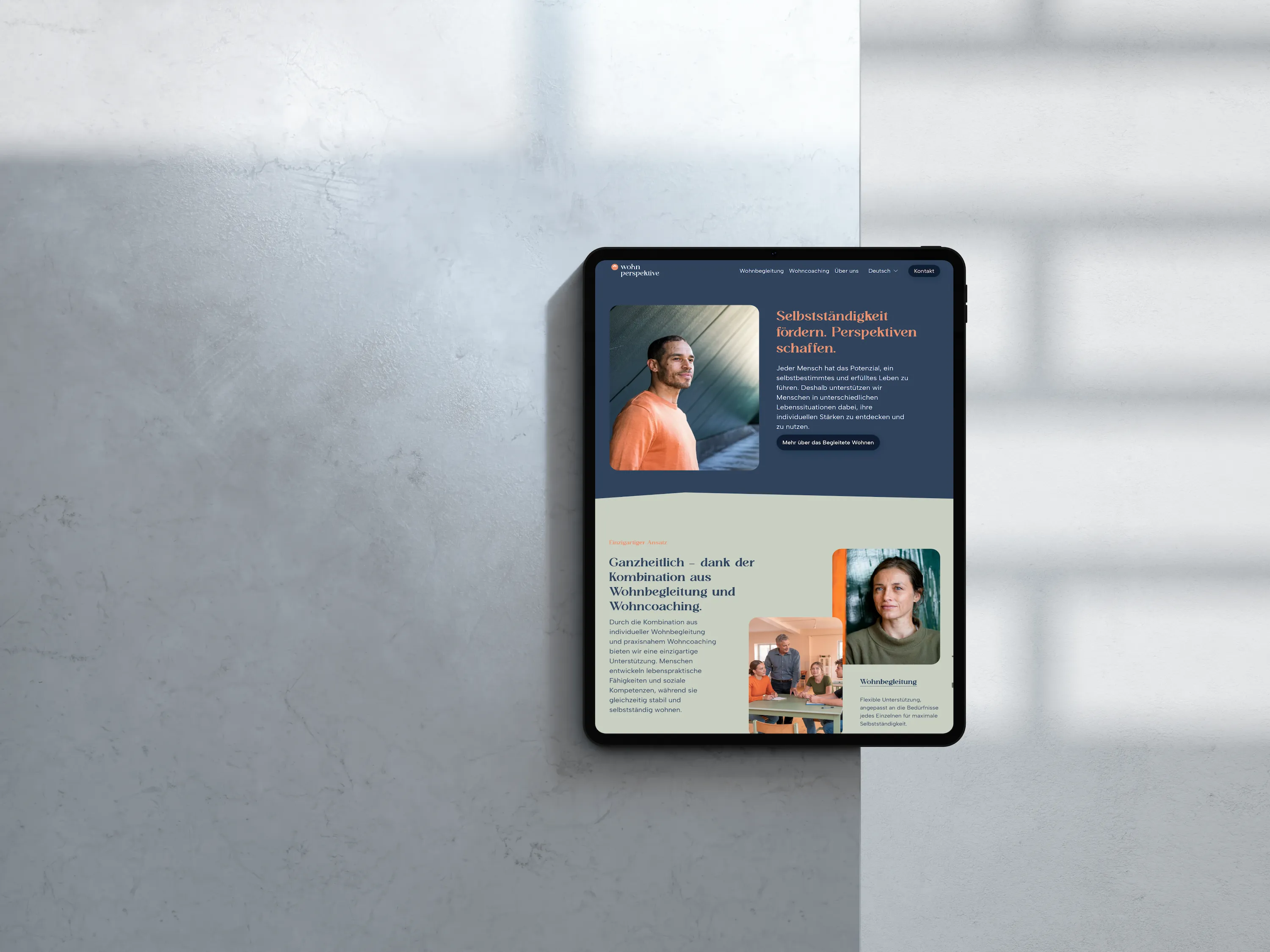
Social services need multilingual reach (DE/FR/IT, often EN, AR, TR). Noevu uses structured translation workflows (e.g. Squarespace Weglot, custom i18n), correct hreflang tags and culture-appropriate imagery per language. Live example: Wohnperspektive Bern.
What does a social enterprise website cost?
A multilingual social enterprise site starts at CHF 6,500 — including accessibility audit, brand work, 3 languages and donation integration if needed. Larger foundations land at CHF 12,000+. We check Swiss funding options (e.g. eGovernment Switzerland).
How do I handle sensitive enquiries and privacy?
Contact forms with sensitive data (care needs, addiction counselling) require: enforced TLS, no tracking, no cookie-banner pressure, hosting in CH/EU, logs deleted after 30 days. Optional anonymous counselling slots without email. FADP and FMH guidelines respected.
How do I integrate Twint donations on the website?
Twint integrates two ways: a Twint QR code in the donation form (desktop donors scan with their phone) and a Twint deeplink (mobile donors are sent straight into the Twint app). We combine that with credit card and SEPA direct debit in a single form. Providers like RaiseNow, Stripe and Datatrans handle the backend; we build the front end ZEWO-compliant and mobile-first.
What does ZEWO require to be visible on the website?
ZEWO requires public discoverability of: the current annual report (max. 18 months old), a financial statement with sources and uses of funds, governing body / board with names, impact communication and donation account details. We build these elements directly into the layout — as blocks, not as a PDF graveyard. The ZEWO seal links back to zewo.ch for verification.
How do we build anonymous counselling slots?
Pattern from SafeZone.ch: appointment booking without account and without email, only a self-chosen pseudonym. Optional: throwaway token instead of login, chat session deleted on browser close, no tracking pixels on the counselling URL. In the background runs a FADP-compliant booking backend (e.g. self-hosted Cal.com or Calendly under a FADP data-processing agreement). We connect it to internal counselling tools via encrypted webhooks.
How long does it take from briefing to launch?
Typical Swiss SME projects go live in 6-12 weeks. Workshop and concept (2-3 weeks), design prototyping (2-3 weeks), implementation and content (2-4 weeks), QA and launch (1-2 weeks). Larger projects with multilingual scope, shop or government integration need 3-6 months. You receive a binding roadmap with milestones before start.
Can I edit the website myself after launch?
Yes. By default Noevu ships a website you can maintain yourself — usually on Squarespace (drag-and-drop) or a Headless CMS with visual editor (Sanity Studio, Payload, Strapi). At launch you receive video training and a written guide. If you would rather not invest time, Noevu can maintain the site under a service plan.
What happens after go-live? Maintenance, hosting, support?
Noevu offers a service plan from CHF 90/month — includes hosting (Vercel + Cloudflare CDN), automatic backups, security updates, performance monitoring and 2 support hours monthly. Without a plan the site keeps running — you keep full access and can switch providers any time (no vendor lock-in).
Does Noevu translate the website into multiple languages?
Yes. Multilingual sites in DE/FR/IT/EN (also PT, ES, AR, TR on request) are part of the standard repertoire. We use structured translation workflows with correct hreflang tags, locale-specific imagery and clean SEO per language. Translations can be done by your team or by Noevu via professional translators.
Who owns the website, code and content?
You do. Fully. Noevu delivers code, design files and content for unrestricted reuse — no licensing model, no "platform lock-in". If you ever switch agencies, everything goes with you. Hosting, domain and CMS accounts are in your name. This promise is part of every quote.