What is the ChatGPT business profile?
It is your company's listing, which ChatGPT shows when you appear in an answer and someone clicks your name. It has nothing to do with the “ChatGPT Business” subscription. That is the paid plan for teams, and anyone who searches Google for the business profile often lands on its pages.
Picture it like this: a customer asks ChatGPT in the evening for a Swiss online shop for workwear. The answer names three companies, one of them yours. She clicks it and sees a profile with a description, logo and link to the website. Such a listing may already exist before you have heard of it, because ChatGPT also fills it with details from other sources. Claiming it gives you mainly one thing: the right to have a say.
The listing is managed in the Business Hub in ChatGPT's sidebar. After verification you can maintain your details there and add product feeds with prices and availability. OpenAI calls the whole thing an early step: it starts as a beta and is meant to expand to more markets and industries. It is not a small step all the same; according to OpenAI, 1.2 billion people use ChatGPT every week.
Does it work in Switzerland yet?
It is possible, but not yet confirmed. According to OpenAI, any eligible company can claim a listing if it is based where ChatGPT is available and the required verification is supported. Who is eligible depends on industry, location and OpenAI's checks. There is no country list, and at launch claiming is open first to companies with a website.
The clearest sign for companies outside the US comes from Italy. Flavio Copes had no listing yet, and on launch day the Business Hub offered to create one for him. First the Hub asked how the company serves its customers. On site and via an online shop were marked as available. The third option, service at the customer's location or remotely, said “Coming soon”. Copes noted that freelancers, agencies and consultants therefore have no choice yet. He picked the online shop. He did not complete the claim, and the Hub did not offer him a Business Agent or product feed: he could not use the agent, and the usual feed upload targets the US.
For local service providers this is the decisive point. If you visit customers or serve them remotely, such as a trades business, an agency or often a fiduciary firm, you belong to the category that was not yet open on launch day. According to its policy, OpenAI reserves the right to hold back entire categories. No field reports from Switzerland or the rest of the German-speaking region could be found up to 10 November.
For shops and restaurants, this applies for now only in the US: they can currently claim existing US listings only.
What does the profile bring – and what not?
Above all, control over your own details. After claiming and the ID check you can change website, description, category, logo, cover image and delivery and return policies. OpenAI reviews the changes before they appear. The blue check comes only with an approved ID check; claiming alone is not enough. Team members and an agency can be added, each person with their own ChatGPT account.
The profile does not guarantee more recommendations. OpenAI states it plainly: “Claiming does not guarantee higher placement or sales.” ChatGPT keeps comparing and recommending independently, advertising does not influence these answers, and a connected product feed does not guarantee a recommendation either. Business Agents, meaning AI assistants acting in the company's name, so far exist only for eligible online retailers and online service providers in the US.
With the profile you take on responsibility. Name, category, address or service area, opening hours, contact and offering must be correct. Invented reviews, unsubstantiated guarantees or concealed fees are prohibited. The details can be changed later, but the published profile itself cannot be withdrawn: according to the Help Center, support can neither delete nor hide it.
How do you claim your business in ChatGPT?
You sign in to ChatGPT, open the Business Hub in the sidebar, search for your company name and select the matching listing. Then you confirm your ChatGPT account and choose a verification method:
- Phone: a code by SMS or automated call.
- Company email: a code sent to the address linked to the company.
- Website domain: a TXT record that ChatGPT specifies and that has to go into your domain's DNS settings exactly as given. Anyone choosing this route needs someone who is allowed to change those settings. If someone else manages the domain, according to the Help Center that person has to set the record. It can take a while until the change takes effect, then “Verify domain” follows.
- Shopify: for merchants who connect their shop.
OpenAI reviews the claim and gets back by email. An ID check through the service Persona follows. Only once it is approved can you publish changes and see figures. An official ID, details of the company registration and proof that you may represent the company can be required. Name, address and any registration or tax number must match the official documents. OpenAI does not say how long this takes; the review time varies.
The first reports show how bumpy the start can be. The consultant Hans van Gent wrote on launch day: “I tried it for my own business on launch day and did not get through.” The phone verification failed, in his assessment because of overloaded servers. He recommended the domain route or a second attempt later. Barry Schwartz of Search Engine Roundtable took the domain route and ended up in “pending” status for the time being.
What do the figures in the Business Hub show?
After the claim and ID check you see, summarised over the last 28 days, how often ChatGPT cites your website and how often it is clicked. Individual conversations stay invisible. According to the Help Center, this includes:
- Online mentions: They count only when ChatGPT names your website as a source. The company name alone is not enough.
- Local mentions: They count when ChatGPT shows a result for your location.
- Website clicks: Clicks from ChatGPT to your website.
- Topics: recurring content of the answers in which you are mentioned or cited. They do not reveal individual questions.
Empty fields are not a bad sign at the start. Values appear only above a minimum number of conversations that OpenAI does not state, and according to the Help Center an empty value does not necessarily mean nobody asked about you. Barry Schwartz initially saw no data after claiming, while others in the same article already reported figures.
The figures in the Hub therefore start empty and count strictly. A measurement of your own alongside remains valuable for that reason. Every month we put ten typical customer questions to ChatGPT, Perplexity and Copilot and record who is named. Side by side, the two show whether anything actually moves after claiming.
ChatGPT profile, Google profile, website: what is each good for?
The two profiles are listings on other companies' platforms; the website is your own source and the one that, according to a Swiss study, AI answers draw on most. Whether a Google business profile is worthwhile for your company is covered in the article My Business on Google. The ChatGPT profile, by contrast, is in beta and not yet reliably accessible for Swiss companies.
| Own website | Google business profile | ChatGPT profile | |
|---|---|---|---|
| Platform belongs to | you | OpenAI | |
| Details maintained by | you | you | you; OpenAI reviews changes, adds from other sources |
| Figures on mentions in ChatGPT | no | no | yes, after ID check, last 28 days |
| Source in Swiss AI study | most cited (54–60%, Quaryan) | no data | no data yet |
| Guarantees a mention in ChatGPT | no | no | no |
As of 10 November 2026. Sources: OpenAI (announcement and Help Center), Quaryan analysis via Inside IT, October 2026.
Two Swiss studies show where AI assistants look things up today. An analysis by Quaryan, reported by Inside IT in October, found 41 percent of 276 companies in not a single AI answer. The most cited source was the company's own homepage (54 to 60 percent); local.ch appeared in 30 percent of answers. A second study by Propus Codestudio, picked up by Netzwoche, found 63 percent of 98 German-speaking Swiss SMEs in no answer.
This contains the perspective that easily gets lost in the excitement about the launch. A profile corrects what ChatGPT shows about you. Whether you are named at all is still decided on your website and in the directories. Visibility in AI answers therefore reaches further than the ChatGPT business profile. Clear information in the code, as structured data provides, helps with that. Whether an llms.txt is worthwhile in addition depends on your website.
What should Swiss SMEs do now?
What helps most now is a clear order: record what ChatGPT says about you today, check the Business Hub, and create a listing only once responsibility and documents are settled.
Hans van Gent recommends the first step in his launch-day report. After claiming, the details change, and what ChatGPT said about a company last week can no longer be reconstructed afterwards. A few typical customer questions, saved with date and answer, are enough as a baseline.
Then a look into the Business Hub shows whether your listing already exists or whether the option to create it appears. It is worth waiting with the creation itself until the points below are settled. A new profile goes online automatically once the ID check is approved, and it cannot be taken back afterwards. Van Gent also advises starting the ID check on the day of the claim, so the documents should be ready beforehand.
Five things can be settled today, most of them entirely without ChatGPT:
The fifth point also works while the profile remains out of reach. ChatGPT assembles its picture of your company partly from your website and directories.
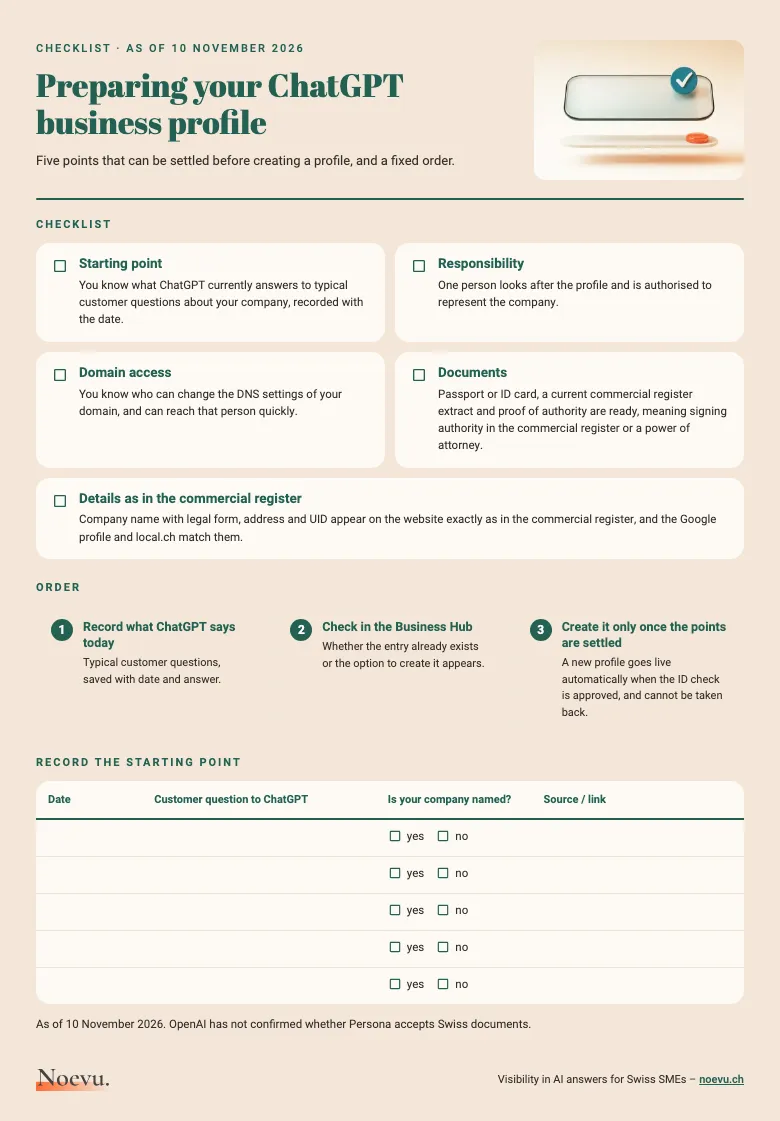
Checklist “Preparing your ChatGPT business profile”
The checklist for this article sums up the five points as a PDF to tick off.
Thank you. Your download will start shortly.
Anyone who records today what ChatGPT says about their company can later show whether the profile changed anything. Where your company stands today in ChatGPT, Perplexity and Copilot is something we are happy to look at with you. A short message is enough.

Not sure everything has been done right? Book a free, no-obligation online call and we'll take a professional look at your website.
Frequently Asked Questions
Do we need a ChatGPT Business subscription for this?
No. “ChatGPT Business” is the paid subscription for teams and something different from the business profile. According to OpenAI, claiming needs neither an ads account nor an Enterprise agreement; you sign in with a ChatGPT account.
Will the profile get us recommended more often?
Not automatically. According to OpenAI, claiming guarantees neither better placement nor more sales, and ChatGPT keeps recommending independently. Swiss studies show that AI answers mainly use your own website and directories such as local.ch as sources.
How long does the verification take?
OpenAI does not say; according to the Help Center, the review time varies. The launch-day reports give no duration either; after the domain check, Barry Schwartz stayed in “pending” status for the time being.
What if our company does not show up in the Business Hub?
According to the Help Center, companies running a legitimate online business may see the option to create the listing from scratch. Flavio Copes from Italy was offered this option on launch day. A profile created this way is published automatically once the ID check is approved.
What if someone else has claimed our profile?
Via “•••” and “Dispute ownership” the claim can be contested; this requires the ID check through Persona. It does not change visibility in ChatGPT. If a listing is locked, “Contact support” appears instead.