
Craft websites must show quality, build trust and bring enquiries. Real photos, clear services, local visibility. Noevu builds websites for floor layers, electricians, carpenters, painters and every Swiss trade business.
Websites for tradespeople that bring real enquiries
Professional web design for tradespeople & craft businesses
No projects published in this industry yet.
What a great tradesperson website delivers
Tradesperson websites fight a perception problem: the digital presence rarely reflects the craft quality. Stock photos, generic copy and template designs visually devalue the business — before a potential customer even calls.
Three levers reverse that: real photos of workshop, team and work (on-site photo shoot), clear service and project galleries with before/after comparisons, and local SEO with location-bound keywords ("floor layer Zurich", "electrician Aargau"). A Swiss tradesperson without a Google Business Profile loses enquiries daily.
Trade-by-trade structure instead of a catch-all "services" page
Electricians, carpenters and painters get searched differently depending on the job. "Emergency electrician Zurich", "custom furniture carpenter Aargau" or "facade renovation Bern" are three separate search worlds. A dedicated subpage per trade (parquet, vinyl, interior fit-out, kitchen building, interior painting, facade, plumbing emergency, heating retrofit) hits those long-tail queries directly. A single "services" page ranks for none of them.
EFZ, Suissetec, EIT.swiss — trust in three seconds
Swiss customers recognise the Eidgenössischer Fähigkeitsausweis (EFZ federal vocational diploma), a Suissetec membership or the EIT.swiss logo immediately. Those marks belong visibly in the header, footer and on every service page — not buried in the imprint. For plumbing, heating and electrical businesses, association logos measurably lift conversion.
Emergency button for plumbing, electrical and heating
Burst pipe, power outage, heating breakdown — these queries come in on mobile, evenings and weekends. An emergency button in the header (red, phone icon, click-to-call link) captures exactly that intent. If you are not visible there, you lose the job to the next competitor. Mandatory for any plumbing, electrical or heating business with 24/7 standby.
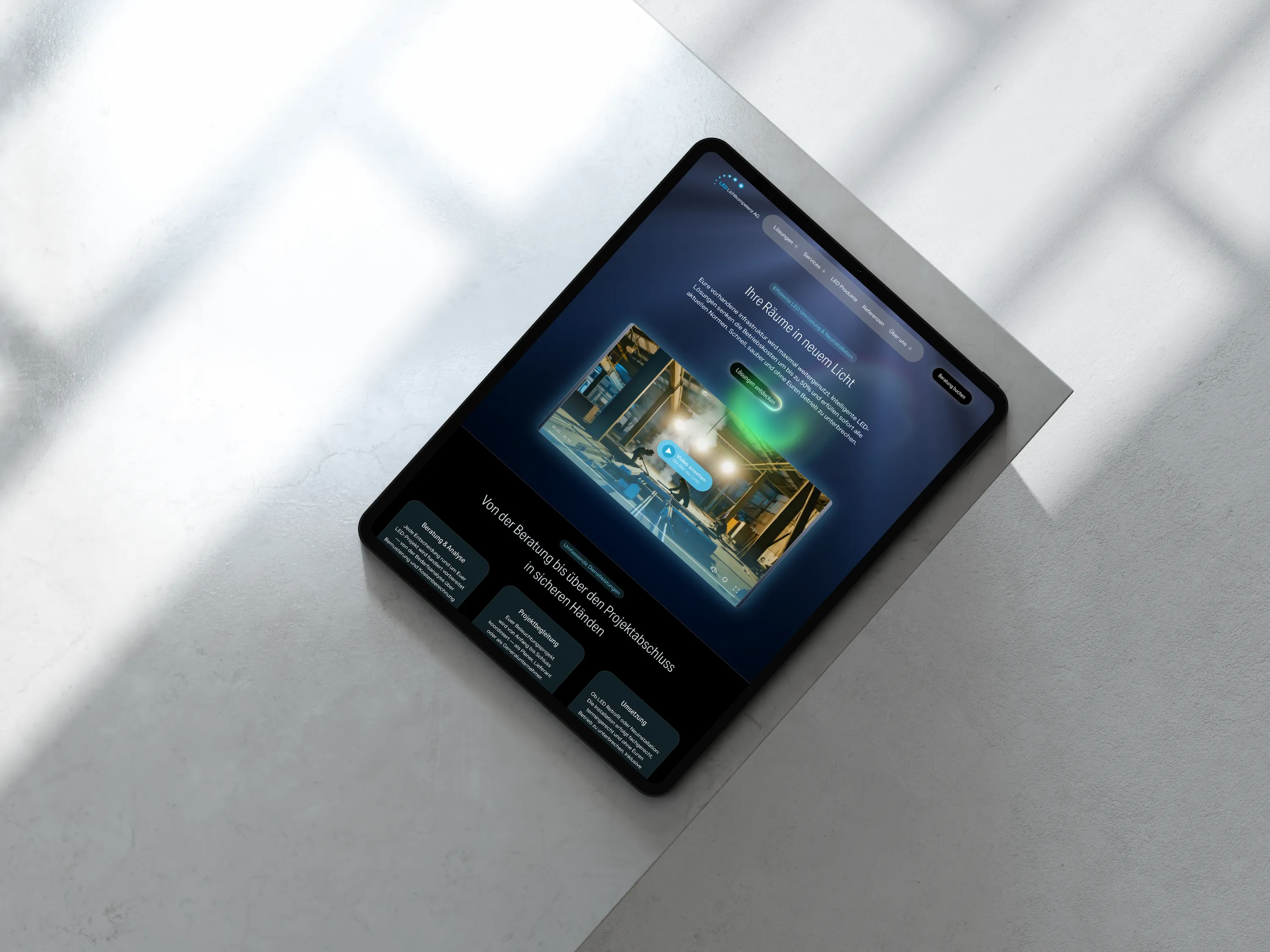
In practice: at LED Lichtkompetenz a professional web presence with photo shoot measurably improved enquiry quality — fewer discount hunters, more qualified leads.
8 levers for a conversion-strong tradesperson website
What Swiss tradespeople should get right on the website — from 20+ years of SME practice:
- On-site photo shoot instead of stock photos: Your real work, your real people. Beats any purchased imagery by a factor of 3. Investment pays back in enquiry quality.
- Before/after project gallery: Renovation, installation, refit — before/after photos are the strongest proof. Customers actively search for them.
- Dedicated pages per specialty: One page per trade (parquet, vinyl, carpet, renovation). Targets long-tail searches instead of a generic "services" catch-all.
- Active Google Business Profile maintenance: Upload photos, gather reviews (ask on-site via smartphone — higher conversion than email), post updates. 30% of organic traffic flows through here.
- Emergency button in the header (plumbing, electrical, heating): Red button, phone icon, instantly visible on mobile, click-to-call link. Captures acute searches ("emergency plumber Zurich"). Mandatory for any business with 24/7 standby.
- Show certification badges visibly (EFZ, Suissetec, EIT.swiss): Association and training logos belong in header, footer and on every service page — not buried in the imprint. Swiss customers recognise these marks instantly.
- Self-edit CMS: Squarespace or similar — upload new projects yourself, no agency appointment needed. Cuts follow-up costs and keeps the site alive.
- Own photo production bundle as differentiator: Professional shots of the business, team and finished projects as part of the website package — no stock photo compromise. Creates a visible gap to template-driven competitors.
What does a tradesperson website cost in Switzerland?
A professional craft website starts at CHF 4,500 — including on-site photo shoot, custom design, local SEO and self-edit CMS.
Typical project investments:
- Solo tradesperson / small business (5-8 pages): from CHF 4,500
- Established trade business (10-15 pages, team, project gallery): CHF 7,500–11,000
- Multiple specialties, quote form, service plan: from CHF 9,000
More in our tradesperson guide. Fixed price commitment before start.
Swiss craft market in numbers
Verified figures from associations, SME research and Swiss agency practice:
~90,000
- employees in the Swiss main construction industry (SBV)
~36%
- share of Swiss SMEs running their own website — the rest rely on Google Business Profile alone (CH agency consensus)
+35%
- more calls after weekly Google Business Profile upkeep — at roughly 10 minutes of effort per week (handwerker.ch)
78%
- of local mobile searches lead to a call or visit within 24 hours (Google / Ipsos)
46%
- of all Google searches have local intent — even higher for mobile emergency queries (Google)
Local + craft-specific visibility for Swiss businesses
One keyword world per trade cluster
Each craft has its own search world — a catch-all page hits none of them. Noevu structures craft websites per trade cluster with dedicated landing pages and matching long-tail keywords:
Electricians
"Emergency electrician", "new-build electrical installation", "SINA electrical inspection", "photovoltaic installation", "EV charging single-family home". EIT.swiss membership prominent.
Carpenters
"Furniture carpenter", "kitchen builder", "interior fit-out", "carpentry doors", "custom built-in wardrobe". Highlight EFZ Carpenter and master business status.
Painters
"Interior painting", "facade renovation", "wallpapering", "spray lacquering", "painter old-building renovation". Before/after galleries are especially strong here.
Plumbing
"Emergency plumber", "bathroom renovation", "burst pipe", "tap repair", "bathroom refurbishment". Emergency button mandatory. Suissetec and SVGW logos visible.
Heating
"Heating retrofit", "heat pump installation", "heating emergency repair", "pellet heating", "heating replacement". Dedicated page for funding programmes (cantonal + GEAK).
Gardeners
"Garden design", "garden maintenance", "hedge trimming", "garden paving", "irrigation system". Seasonal landing pages.
General contractors
"General contractor single-family home", "renovation refurbishment", "turnkey new build", "extension", "roof addition". Highlight SBV membership.
Floor layers
"Parquet laying", "vinyl laying", "laminate laying", "parquet renovation", "carpet laying". A dedicated page per flooring type.
Per region: dial in local visibility precisely
Swiss customers search locally — and Google serves local hits first. Location-bound keywords plus a Google Business Profile per branch decide who shows up in the top three:
Zurich + Limmattal: "electrician Zurich", "carpenter Limmattal", "floor layer Winterthur". Densest competition, highest volumes.
Aargau: "painter Aarau", "plumber Baden", "heating Brugg". Solid volume, less competition than Zurich.
Bern Mittelland: "carpenter Bern", "gardener Thun", "electrician Köniz". Conservative search behaviour, association logos very important.
Basel-Stadt / Basel-Landschaft: "general contractor Basel", "plumber Liestal", "electrician Riehen". Border proximity → German competition relevant.
Lake Geneva region: French dominant — website mandatory bilingual DE/FR or primarily FR with a DE variant.
Ticino: Italian dominant — own IT variant required.
Eastern Switzerland (St. Gallen, Thurgau, Appenzell): "carpenter St. Gallen", "painter Frauenfeld", "heating Wil". Medium volume, strong association culture.
Central Switzerland (Lucerne, Zug, Schwyz): "electrician Lucerne", "floor layer Zug", "general contractor Schwyz". High purchasing power, premium enquiries.
What a tradesperson website covers professionally + legally
Swiss Data Protection Act (revDSG) since September 2023
Contact forms, cookie banners and analytics on a craft website have to meet the revised Swiss Data Protection Act. Mandatory: privacy policy with a clear list of every data flow, cookie consent for non-essential trackers, right of access and erasure. Noevu ships a DSG-compliant base structure and documents every third-party service.
VAT obligation above CHF 100,000 turnover
Swiss trade businesses with more than CHF 100,000 annual turnover are VAT-liable. The VAT number (CHE-XXX.XXX.XXX) belongs in the imprint and on every quote. On the website state clearly whether prices include or exclude VAT — Swiss customers expect transparency.
Trade association membership (Suissetec, EIT.swiss, SVGW, SBV)
A membership in Suissetec (plumbing/heating/ventilation), EIT.swiss (electricians), SVGW (gas/water) or the Swiss Master Builders Association (SBV) belongs visibly on the website. Association logos are trust anchors — customers, insurers and partners recognise them immediately.
Federal Vocational Diploma (EFZ) and master diploma as trust markers
The EFZ is the Swiss standard qualification for trained tradespeople. On the "About" page name each team member with their training ("Markus Müller, EFZ Carpenter, 15 years of experience"). Highlight master diploma or federal diploma separately — these qualifications justify higher prices and filter discount enquiries.
Warranty terms and general conditions
Swiss construction work falls under SIA Norm 118 or the Code of Obligations (art. 367 ff. OR) depending on the contract. Warranty periods, defect notification duties and liability exclusions belong cleanly in the general terms — linked on the website and accepted during the quote process. Clear warranty communication ("2-year warranty on material and labour") reduces disputes and builds trust before the contract.
The most common mistakes on tradesperson websites
What Noevu has seen repeatedly across 20+ years of Swiss SME practice:
- Stock photos instead of real work: A generic image of a smiling tradesperson in a white helmet — customers spot it instantly and assume standard quality. Real photos of the business, team and finished projects lift the impression visibly.
- A single "services" page instead of a page per trade: A catch-all page ranks for no long-tail. Parquet, vinyl, interior fit-out, emergency — every trade deserves its own URL with its own keyword focus.
- No emergency button in the header: For plumbing, electrical and heating businesses this is a direct lost job: anyone with an acute problem clicks the first visible call button. Without one, you lose the job.
- Missing EFZ, Suissetec or EIT.swiss display: Certifications belong visibly — header, footer, service pages. Hidden in the imprint they have no effect. Swiss customers trust these marks.
- Only a profile on handwerker.ch or Houzy, no own domain: Platform profiles are one business card among thousands — no independent SEO value, no brand ownership. Combine your own website with platform profiles.
- No before/after galleries: Renovation, refurbishment and installation live off the visible difference. Before/after photos are the strongest conversion element on craft websites — and still routinely left out.
More reading on craft marketing


Book your free consultation:
Vielen Dank! Wir melden uns in Kürze.
Common questions about web design for tradespeople
What does a tradesperson website cost in Switzerland?
A professional craft website starts at CHF 4,500 — including on-site photo shoot, custom design, local SEO and self-edit CMS. More in our tradespeople guide.
What content does a craft website need?
Mandatory: clear service descriptions, project gallery (before/after), team presentation, real testimonials, prominent phone + contact form, service area. Stock photos are lethal — we produce real work and people during the photo shoot. Example: LED Lichtkompetenz.
How do I get found for "[trade] in [my city]"?
Local SEO decides: Google Business Profile with reviews + photos, location-bound keywords ("floor layer Zurich", "electrician Aargau"), structured data (LocalBusiness Schema), local backlinks (directories, association listings). Top-3 long-tail rankings within 3-6 months.
Can I maintain the website myself?
Yes. Noevu primarily uses Squarespace for trade businesses — you change text, images and projects yourself by drag-and-drop. Video walkthrough included at launch. If you prefer no time investment, Noevu maintains the site under a service plan from CHF 90/month.
Should I add an emergency call button to my website?
For plumbing, electrical and heating businesses with 24/7 standby: yes, clear recommendation. A red emergency button in the header (phone icon, instantly visible on mobile, click-to-call link) captures acute searches — burst pipes, power outages, heating breakdowns. Without it, you lose the job to the next competitor. For appointment-only businesses (carpenters, floor layers, gardeners) a clearly visible contact form plus phone number is enough.
Is a profile on handwerker.ch or Houzy enough instead of my own website?
Short-term first enquiries — yes. Long-term no. On handwerker.ch or Houzy you are one business card among thousands, with no SEO control, no own brand, no data ownership. Your own domain and website are yours and rank independently on Google. Combine both: own website as primary presence, platform profiles as additional sources. Without your own site every business stays platform-dependent — pricing, visibility and rules can change any time.
How do I show EFZ or master certificates on the website?
Certification badges (EFZ, master diploma, Suissetec, EIT.swiss, SVGW) belong visibly in the header or footer — not buried in the imprint. On the "About" page name each team member with their qualification (e.g. "Markus Müller, EFZ Electrician"). On service pages mention the relevant membership directly under the service ("Suissetec-certified plumbing business"). Swiss customers recognise these marks instantly — conversion rises measurably.
How long does it take from briefing to launch?
Typical Swiss SME projects go live in 6-12 weeks. Workshop and concept (2-3 weeks), design prototyping (2-3 weeks), implementation and content (2-4 weeks), QA and launch (1-2 weeks). Larger projects with multilingual scope, shop or government integration need 3-6 months. You receive a binding roadmap with milestones before start.
Can I edit the website myself after launch?
Yes. By default Noevu ships a website you can maintain yourself — usually on Squarespace (drag-and-drop) or a Headless CMS with visual editor (Sanity Studio, Payload, Strapi). At launch you receive video training and a written guide. If you would rather not invest time, Noevu can maintain the site under a service plan.
What happens after go-live? Maintenance, hosting, support?
Noevu offers a service plan from CHF 90/month — includes hosting (Vercel + Cloudflare CDN), automatic backups, security updates, performance monitoring and 2 support hours monthly. Without a plan the site keeps running — you keep full access and can switch providers any time (no vendor lock-in).
Does Noevu translate the website into multiple languages?
Yes. Multilingual sites in DE/FR/IT/EN (also PT, ES, AR, TR on request) are part of the standard repertoire. We use structured translation workflows with correct hreflang tags, locale-specific imagery and clean SEO per language. Translations can be done by your team or by Noevu via professional translators.
Who owns the website, code and content?
You do. Fully. Noevu delivers code, design files and content for unrestricted reuse — no licensing model, no "platform lock-in". If you ever switch agencies, everything goes with you. Hosting, domain and CMS accounts are in your name. This promise is part of every quote.