A career website helps decide who applies. Clear job listings, real faces from the team, an application that takes a few minutes. Noevu builds career sites, employer branding presences and alumni networks for companies, associations and institutions in Switzerland.

Websites for HR and employer branding that bring applications
Professional web design for HR teams & employer branding
No projects published in this industry yet.
What a good career site delivers
Applicants check out an employer before they get in touch. They read the career site, look for faces, workplaces and an answer to whether the job fits their day-to-day. A list of job titles does not give that answer.
Three levers change that: a concrete employer promise with statements HR can back up, real people from the team and a short application flow that works on a smartphone as well as on a laptop. The website then answers early what applicants would otherwise have to ask in the first interview.
Jobs as their own pages, not as PDFs
Each job gets its own address with title, location, working hours and tasks. The page carries structured data (JobPosting) that search engines can read, so the job can appear in Google job search. A PDF attachment stays hard to reach for search engines and on a smartphone.
Applying without registration
Name, contact, documents: the first step needs nothing more. An account before the application puts off people who were interested a moment ago. Where the data goes afterwards, into an applicant tracking system or by mail to HR, depends on your process.
An employer promise you can keep
Phrases such as "flat hierarchies" or "work-life balance" appear on almost every career site. Specifics come from everyday facts: working-time models, training, onboarding, locations. Only what applies in the organisation today goes on the page, because applicants later compare the promise with reality.
Alumni, members, early-career talent
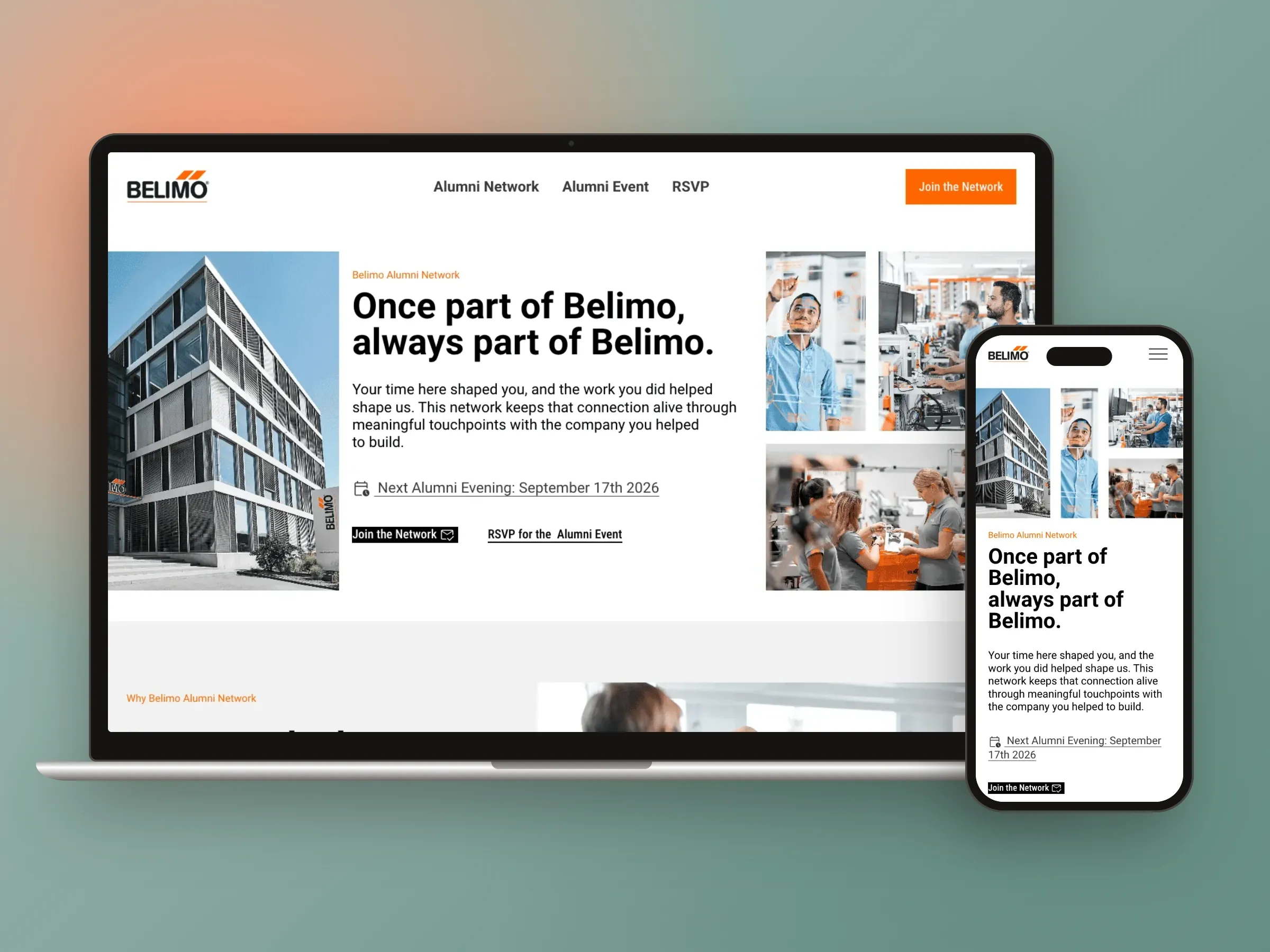
Associations and institutions often have a second audience next to applicants: former staff, members, career starters. An alumni area with newsletter, agenda and directory keeps the contact going beyond employment. Which functions belong to it is decided before the build.
Eight levers for a career site that brings applications
What HR teams in Switzerland should settle on the website before the first job goes live:
- A career page with the jobs at the centre: The job list sits right on the entry page, filterable by area, location and working hours. Anyone looking for a job should find it in a few clicks.
- Every job with structured data (JobPosting): Title, location, working hours, date and employer are machine-readable on the job page. Search engines can then show the job in job search.
- Application without registration: Name, contact, documents, send. Everything else is settled in conversation. The form works on every device, also on the go.
- Employer promise with evidence: Working-time models, training, onboarding: concrete facts instead of buzzwords. Only what HR can keep up in daily practice goes in.
- Team introductions with real faces: Photos and short portraits of employees, with role and tasks. An on-site photo shoot replaces stock images.
- An alumni area with newsletter and agenda: Former staff stay in touch, see events and new jobs. Which functions belong to it depends on the size and purpose of the network.
- Maintain jobs and team pages yourself: HR switches jobs on and off in the editing system, without developers and without waiting. Outdated jobs hurt the impression more than a short list.
- Privacy for applicant data from the start: Notice at the form, retention periods, handover to service providers: the routines are set before the first application arrives.
What does a career website cost in Switzerland?
Five things set the scope of a career website:
- Locations and languages: one presence or several language regions
- Job management: a self-maintained list or a connection to an applicant tracking system
- Application flow: a simple form or a multi-step flow with document upload
- Content: team introductions, employer promise, photo shoot
- Network: an alumni area with newsletter, agenda or a protected section
For every engagement we prepare a binding fixed-price quote: clear scope, no hidden costs. A starting price is given in the questions below.
Visible to applicants in every language region
One search world per audience
Applicants search in different ways, and each way needs its own page: a role with a place, the employer with the addition "careers" or "jobs", apprenticeships and internships, alumni offers. A single catch-all page hits none of these queries.
Role and place
Job pages carry role, location and working hours in title and description, for example "Construction project manager, Zurich, 80-100%". The structured data (JobPosting) confirms these details for search engines.
Employer search
Anyone searching your company name plus "careers" should land on your site and not on a job board. A clear address for the career page and its own description per job lay the groundwork.
Apprenticeships, internships, career start
Young people and their parents search differently from experienced professionals. A dedicated vocational training page with a contact person, the process and a look at everyday work meets that search directly.
Language regions
In Switzerland, people apply in several languages. A career website for German-speaking Switzerland, Romandy and Ticino needs jobs and notes in each language, with clean language links (hreflang). Multilingual scope is planned at the start so that maintenance does not triple later.
Locations
Several locations each get their own page with address, directions and contact person. The Google Business Profile of the location links to that page.
What a career website covers legally and organisationally
Revised Swiss Data Protection Act (revDSG) since September 2023
Applicant data is personal data. The revDSG requires a privacy policy with a clear list of data flows, understandable information at the point of collection and a rule for access and deletion. Noevu delivers the base structure and documents every third-party service. The legal review of the texts stays with your legal team or data protection adviser.
Retention and deletion periods
How long applications are kept is decided by HR before launch and written into the privacy policy. If a talent pool is to keep applications longer, the form collects separate consent for it. The editing system helps by making routines visible; the periods themselves are set by the employer.
Applicant tracking system and processing on behalf
If applications go to an external system, the provider acts as a service provider on your behalf. The privacy policy names it, and the hosting location belongs in the documentation. Noevu clarifies before the build where the data flows.
Cookies and analytics on the career site
For cookies and embedded services, Swiss law requires clear information and the option to refuse processing (Art. 45c Telecommunications Act, FMG). If the career site also addresses applicants from the EU, non-essential cookies need consent under the GDPR. The cookie banner and the documentation of third-party services are part of the basic setup of every career website.
The most common mistakes on career websites
What keeps turning up on career sites of companies, associations and institutions:
- Career page hidden in the footer: Anyone looking for a job cannot find the entry point. The career page belongs in the main navigation, with the job list as its first content.
- Registration before applying: An account asks for time and a password before there is any application at all. The first step needs only name, contact and documents.
- Job ads as PDF or image: Search engines read them poorly and they are tedious on a smartphone. A job belongs on the website as its own page with structured data.
- Employer promise made of buzzwords: "Exciting tasks" and "great team" appear on every career site. Concrete facts on working hours, training and onboarding set one employer apart from the next.
- Applications by mail without a privacy notice: Documents sit in the inbox without end and nobody has set retention periods. A form with a notice and a clear routine solves that.
- Jobs that only a developer can change: Outdated jobs stay up because maintenance means waiting. HR needs a way to switch jobs on and off on its own.
More reading on web design for HR




Book your free consultation:
Vielen Dank! Wir melden uns in Kürze.
Common questions about web design for HR
What does a career website cost in Switzerland?
A career website starts at around CHF 8,500. The price depends on scope, languages, connection to an applicant tracking system and a possible alumni area. Larger websites quickly reach CHF 12,000 to 20,000 or more. For operation, hosting and maintenance, plan on around CHF 125 to 500 per month. These are guide values. For every engagement we prepare a binding fixed-price quote.
What content does a career site need?
Four building blocks belong to it: a job list with filters, the employer promise with concrete facts, team introductions with photo and role, and a short application flow. Locations and a named HR contact with details come on top. Where it fits, apprenticeships, internships or an alumni area complete the presence.
How do our jobs appear in Google job search?
Each job needs its own page with structured data of the type JobPosting: title, description, location, date, working hours and employer. We build the data in so that the editing system generates it from the job page itself. Whether Google shows a job is Google's decision; the data creates the precondition.
How short should an application flow be?
Short enough to finish on a smartphone in a few minutes. The first step needs name, contact and documents, without an account. Additional details you collect in conversation. Every mandatory field should have a reason that HR can name.
How do we handle applicant data under the revDSG?
Applicant data is personal data, and the revised Swiss data protection act (revDSG) applies to it. We build in the base structure: privacy policy with all data flows, notice at the form, documentation of the service providers in use. Retention periods and the legal review you set together with your legal team or data protection adviser.
Can we connect an applicant tracking system?
Usually yes. Many systems offer an interface or an embeddable job list. We check at the start what your system provides and plan the website accordingly. The job pages keep their own address and their structured data.
Can we maintain jobs and team pages ourselves?
Yes. Switching jobs on and off, changing team portraits and adjusting texts is done by HR in the editing system, without developers. At launch you receive video training and a written guide. If you would rather not invest the time, Noevu takes over maintenance under a service plan.
How long does it take from briefing to launch?
Typical Swiss SME projects go live in 6-12 weeks. Workshop and concept (2-3 weeks), design prototyping (2-3 weeks), implementation and content (2-4 weeks), QA and launch (1-2 weeks). Larger projects with multilingual scope, shop or government integration need 3-6 months. You receive a binding roadmap with milestones before start.
Can I edit the website myself after launch?
Yes. By default Noevu ships a website you can maintain yourself — usually on Squarespace (drag-and-drop) or a Headless CMS with visual editor (Sanity Studio, Payload, Strapi). At launch you receive video training and a written guide. If you would rather not invest time, Noevu can maintain the site under a service plan.
What happens after go-live? Maintenance, hosting, support?
Noevu takes care of operation, hosting and maintenance for around CHF 125 to 500 per month, depending on scope. This covers hosting (Vercel + Cloudflare CDN), automatic backups, security updates, performance monitoring and support. These are guide values; the fixed-price quote sets the binding amount. Without this service the site keeps running — you keep full access and can switch providers any time (no vendor lock-in).
Does Noevu translate the website into multiple languages?
Yes. Multilingual sites in DE/FR/IT/EN (also PT, ES, AR, TR on request) are part of the standard repertoire. We use structured translation workflows with correct hreflang tags, locale-specific imagery and clean SEO per language. Translations can be done by your team or by Noevu via professional translators.
Who owns the website, code and content?
You do. Fully. Noevu delivers code, design files and content for unrestricted reuse — no licensing model, no "platform lock-in". If you ever switch agencies, everything goes with you. Hosting, domain and CMS accounts are in your name. This promise is part of every quote.