
Event sites thrive on traffic spikes, registrations and fast updates. Performance, booking flow and mobile-first decide attendance. Noevu builds sites for conferences, event agencies, security services and conference organisers in Switzerland.

Websites for events that handle peak load
Professional web design for events, conferences & security services
No projects published in this industry yet.
What a great event website delivers
The invisible conversion machine behind every event
Event sites are the invisible conversion machine behind every conference, festival and corporate event. They must structure the programme, reduce registration friction to zero, withstand peak load on sale-open and not break during live updates on event day. Three requirements are uncompromisable: performance (Astro/static + CDN — no WordPress slog), registration workflow (Stripe Checkout, ticketing embed or custom backend, with waitlists and multi-ticket logic) and bot protection (Cloudflare WAF against scalpers and spam registrations).
The Swiss ticketing market is a duopoly
Ticketcorner and Starticket together hold roughly 90–95 % market share in third-party ticket distribution in Switzerland. Alongside them sit around eleven other relevant platforms with web embed: Eventfrog (freemium, largest CH event calendar), Infomaniak (Swiss data sovereignty, API), Ticketino (#3, full API), Weezevent (complex events, cashless, access control), Ticketpark, Smeetz, Ticketcorner Light, monbillet.ch, Eventbrite, SeeTickets, Petzi. The right choice depends on reach, fee structure and brand control — we evaluate per event rather than preaching one platform up front.
Hybrid and livestream are the 2024+ standard
Since 2022 hybrid formats have been dominant: in-person plus simultaneous online attendance. That demands two parallel registration flows (onsite vs. online, often with different pricing), a clean streaming integration (Vimeo, YouTube Live, Restream or a dedicated provider) and a separate SUISA licence for the online part. On-demand recordings need an additional VOD licence. Sites that ignore this from day one get rebuilt six months later — we build it right once.
Security service providers: a website profile of their own
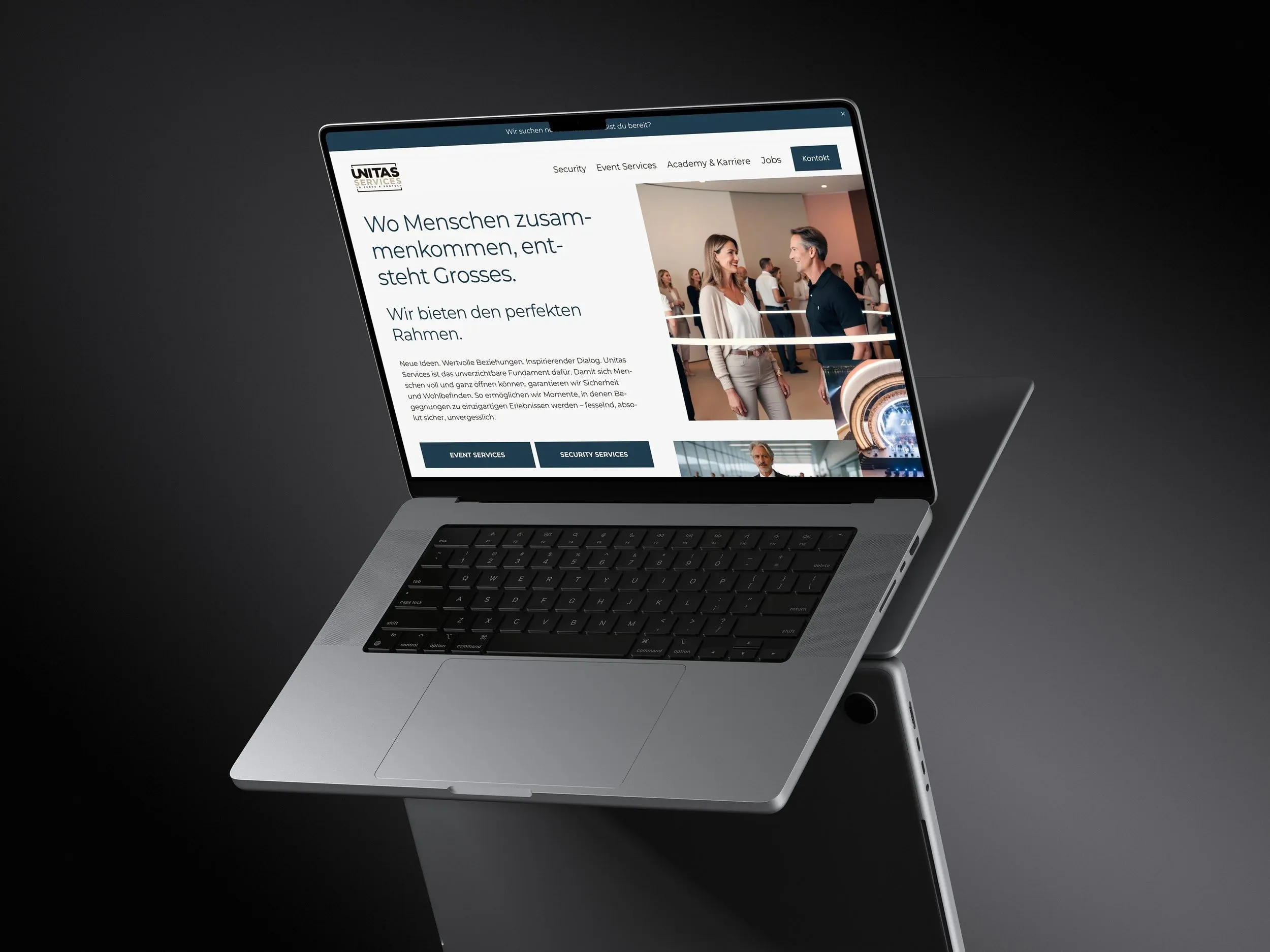
Event security firms are a different buyer persona than organisers: they do not sell tickets, they sell competence. Their website has to make their role in the cantonal Sicherheitskonzept tangible, list references visibly and structure deployment areas (crowd management, access control, executive protection, fire watch). The Swiss MICE market exceeded its 2019 pre-pandemic level again in H1 2024 — demand for professional event security follows. Portfolio reference: Unitas Services.
Recurring conferences need a multi-year setup
Annual conferences benefit from a multi-year architecture: old content is versioned (archives at /2024/, /2025/), new content rolls out efficiently — a full rebuild for CHF 14’000 every year is burning money. Event agencies with multiple parallel events need clean per-event separation but consistent brand presence and a shared CMS backend, so you’re not maintaining a separate site for every event.
Speaker and programme pages as an SEO lever
Most Swiss event sites are one-pagers with a non-indexable PDF programme. That throws away organic traffic. An HTML agenda with schema.org/Event markup plus individual speaker sub-pages ranks in Google for topical searches, generates rich snippets in the SERP, and pulls traffic months before the actual sale-open — table stakes for any conference that takes its speakers seriously.
8 levers for a high-performance event website
What event sites for conferences and agencies need to handle peak load:
- Static generation + CDN for peak load: Astro static + Cloudflare CDN withstands any sale-open. WordPress + standard hosting breaks at 1000+ concurrent visitors.
- Registration flow before programme detail: Sale-open day: prominent CTA, three fields, done. Programme details below the fold — conversion before information.
- Cloudflare WAF + Bot Management: Block scalpers and spam registrations without disturbing real visitors. Captcha only for suspicious requests.
- Multi-ticket logic with waitlists: Early bird, normal, late, multi-pass, students — clean logic saves support hours and avoids double-bookings.
- Live-update mode during event: Programme changes, room swaps, push notifications for registered attendees. Prepares the site for event day itself.
- Pick the ticketing platform via a decision matrix: Eventfrog for small events, Infomaniak or Ticketino for Swiss data sovereignty plus embed, Weezevent for large/complex events, Stripe Checkout for full brand control. We score reach, fees and brand control per event — no platform religion.
- Integrate hybrid + livestream cleanly: Two registration flows (onsite / online), streaming embed (Vimeo, YouTube Live, Restream), separate SUISA licence for the online part, optional VOD recording. Designed in from day one instead of retrofitted.
- Speaker pages + Event Schema for SEO: HTML agenda instead of PDF, individual speaker sub-pages, schema.org/Event markup for rich snippets in Google. Pulls organic traffic months before sale-open.
What does an event website cost in Switzerland?
An event site starts at CHF 5,500 — including programme management, sponsor area, registration flow and live updates during event phase.
Typical project investments:
- Single conference (10-15 pages, tickets, sponsors): from CHF 5,500
- Annual conference with multi-year setup: CHF 8,500–14,000
- Event agency with multiple parallel events: from CHF 15,000
Recurring conferences get a multi-year setup that versions content efficiently. Fixed price before start.
What the numbers tell us about event websites
Few reliable Swiss-specific figures, but clear global benchmarks for ticketing and bot traffic:
up to 96 %
- bot share of traffic at a major sale-open (~est) (DataDome)
16M
- malicious requests in a single ticketing attack over 6 days (DataDome)
exceeded 2019
- Swiss MICE market H1 2024 — pre-pandemic level surpassed (hotelinside.ch)
~ 11
- additional Swiss ticketing platforms with web embed besides Ticketcorner/Starticket (weezevent.com)
~ 90–95 %
- combined CH market share of Ticketcorner + Starticket in third-party distribution (~est) (Tagblatt)
Event websites by region and by format
Zurich — Hallenstadion, Kongresshaus, Letzigrund
Zurich is the largest Swiss MICE hub: Hallenstadion (~13,000 seats, concerts/sport), Kongresshaus (fully operational again from 2025 onwards), Letzigrund (open air and sport), Messe Zurich. Sites for events at these venues need multilingual setup (DE/EN, often FR), clean public-transport integration and high-load architecture for sale-opens. For security service providers in Zurich: reference pages on specific deployments at Hallenstadion or Letzigrund beat any generic service description.
Basel — Messe Basel, MCH Group
Basel is Switzerland’s number-one trade-fair venue: Messe Basel, with MCH Group as operator (Art Basel, the Baselworld successors, Swissbuilt, Holzmesse). Conference and trade-fair sites usually need B2B language versions (DE/EN/FR/IT), exhibitor registration forms, floor-plan integration and press area. The tri-national location calls for cross-border SEO and shipping logic.
Bern — BERNEXPO, capital-city conferences
Bern hosts BERNEXPO as its largest exhibition centre and, as federal capital, is strong on political and association conferences. Event sites here often have to handle accreditation workflows (press, delegates), security zones and elevated protocol requirements.
Lausanne — Beaulieu, Olympic capital
Lausanne, with Beaulieu (Comptoir Suisse legacy, now Comptoir Hospitalité Habitat), the IOC and several international sports federations, is the hub for Romandie and sports events. Sites are required in FR/EN, often DE/IT — with Olympic trust signals where appropriate.
Geneva — Palexpo, international diplomacy
With Palexpo (~140,000 m²) and the density of UN agencies and NGOs, Geneva is Switzerland’s home for international conferences and salons. Event sites here are multilingual (FR/EN, often AR, RU, ZH), require visa guidance, hotel partner lists and accreditation logic.
St. Gallen — Olma, business conferences
St. Gallen hosts the Olma as eastern Switzerland’s trade-fair venue and, through the St. Gallen Symposium and HSG-driven business conferences, shapes the country’s business-event scene. Programme pages with speaker bios, sponsor packages and multi-year archives are standard here.
Conference vs. festival vs. corporate event
Three formats, three website profiles: conference (B2B, programme pages, speaker bios, sponsor packages, accreditation, often multi-year), festival (B2C, line-up, locations/stages, festival-pass logic, high-load sale-open, bot protection critical), corporate event (often password-protected area, invited guests, RSVP instead of ticket purchase, high data protection bar). We build all three — but never from the same template.
What an event website carries legally + technically
Veranstaltungsbewilligung — cantonal, not national
Switzerland has no national event law — each canton and municipality regulates event permits and safety requirements independently. Rule of thumb: from ~300 attendees a permit is mandatory in most cantons, typically applied for months in advance. Your website should list the correct organiser, the permit authority and emergency contacts in the imprint — when conditions are breached, the organiser is liable, not the platform.
Sicherheitskonzept (security concept) requirements
A Sicherheitskonzept is recommended from ~200 attendees and formally required from ~1,000 in most cantons (threshold varies). The risk analysis is part of it. Relevant bodies: KKPKS (national coordination), VKF (fire safety), the cantonal police. For security service providers this means: your website has to articulate how your deployment covers the organiser’s Sicherheitskonzept obligation — a differentiation lever in B2B, not just a service description. The Swiss Professional Association for Security (BVS) is the relevant industry body.
SUISA, GEMA and music rights
Every public music performance — concerts, DJ sets, corporate parties, association events, background music — requires a SUISA licence. Livestreams need a separate licence (percentage of streaming revenue or minimum fee). On-demand storage costs a flat CHF 100 (concerts/DJ) or CHF 50 (other events). For German sub-bookings, GEMA applies in parallel. Your website should make SUISA compliance visible for hybrid/streaming events — a trust signal for sophisticated organisers.
revDSG for attendee data
The revised Swiss data protection law (revDSG, in force since 09/2023) requires a clear privacy notice, named controller, listing of all data flows (ticketing partner, email tool, analytics, stream provider) and a clean cookie/consent logic (Zaraz or equivalent). Conference attendee data is often sensitive (role, employer) — data processing agreements with every partner belong in the DSG folder.
BehiG — accessibility for public events
The Swiss Disability Discrimination Act (BehiG) requires reasonable accessibility per WCAG 2.1 AA for public websites — and websites for publicly accessible events count. Contrast, keyboard navigation, screen-reader-friendly ticketing embed, alt text. We build that in from day one rather than retrofitting later.
Common mistakes on event websites
Six patterns we keep seeing in audits — each one costs tickets and trust:
- WordPress as the sale-open platform: Standard WordPress hosting breaks at 1000+ concurrent visitors. At a major sale-open the site is down at second zero — the most expensive marketing moment of the year evaporates.
- Programme detail before the registration CTA: Hero shows speaker list and floor plan instead of the buy button. Conversion collapses because visitors have to scroll 800 pixels to purchase. Registration flow belongs above the fold, details below.
- No bot protection before sale-open: Scalper bots snap up every early-bird ticket in the first minute. Without Cloudflare WAF and Bot Management your real buyers get locked out — reputational damage on top of lost revenue.
- Static PDF programme without live updates: A room changes on event day, the programme sits as a PDF in the footer. Attendees rush to the wrong hall. An HTML programme with CMS edits and push logic costs once and saves chaos every time.
- Missing waitlist logic: Event sells out, the site only says "sold out". Every released ticket goes unused. A waitlist with automatic notification claws back double-digit percentages of revenue.
- No dedicated sponsor area: Sponsor logos sit in the footer with no story. You forfeit next year’s B2B sales — a dedicated sponsor page with tier packages, reach data and contact CTA is a conversion asset in its own right.
More reading on event marketing




Book your free consultation:
Vielen Dank! Wir melden uns in Kürze.
Common questions about event web design
How does an event site handle registration spikes?
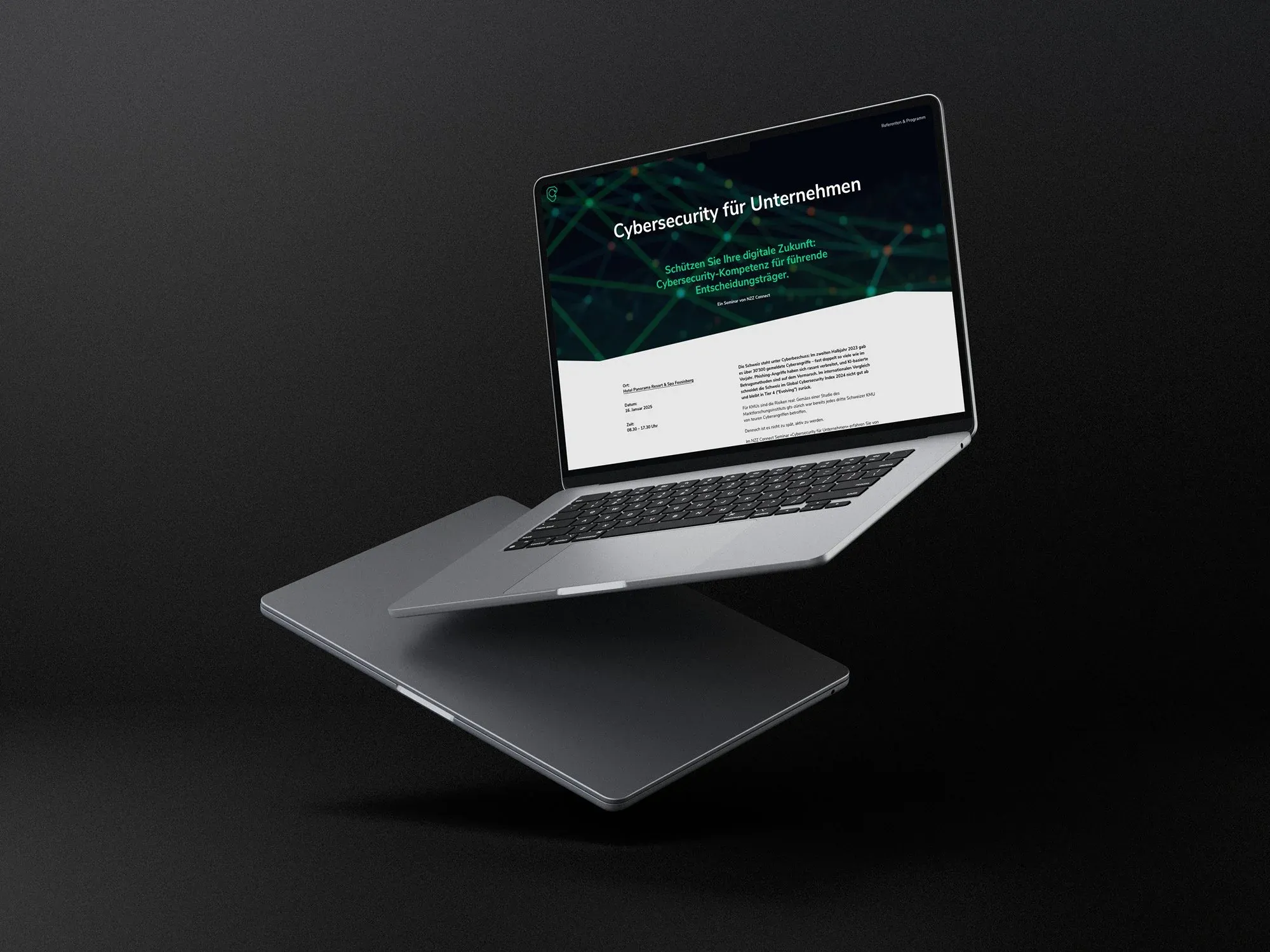
Peak load (e.g. ticket release) breaks standard hosting. We rely on Cloudflare CDN, static generation (Astro), decoupled registration endpoints (Stripe, Eventbrite) and queue systems under extreme load. Example: NZZ Connect — migrated from WordPress in 2 weeks to a high-load-ready stack.
How do I integrate ticketing and registration?
Three options: 1) external tool (Eventbrite, Tito, Doo) via embed — fastest path, 2) Stripe Checkout directly on site — full brand control, 3) custom solution — for complex tariffs. Noevu integrates all three by need, including waiting lists and multi-ticket logic.
What does a conference website cost in Switzerland?
An event site starts at CHF 5,500 — including programme management, sponsor area, registration flow and live updates during event phase. Recurring annual conferences get a multi-year setup that versions content efficiently. Fixed price before start.
How does the site handle DDoS and bot traffic?
Event sites are bot magnets (scalpers, spam registrations). Cloudflare WAF + Bot Management + rate-limiting block 99% of unwanted traffic without disturbing real visitors. For critical events also captcha challenge only for suspicious requests — see Unitas Services.
Ticketcorner, Eventbrite or our own Stripe Checkout — which fits our event?
Rule of thumb: Ticketcorner/Starticket for reach (90–95 % CH market share in third-party distribution; good for stadium events and festivals with walk-in buyers). Eventbrite for international visibility and fast setup, weaker on brand control. Your own Stripe Checkout for full brand control, data sovereignty and arbitrary tariff logic — ideal for conferences, B2B events and recurring programmes. We choose with you based on reach, fees and brand stance — never a platform across the board.
How does a hybrid event website with livestream work?
Two parallel registration flows (onsite vs. online, often with different pricing tiers), a password-protected stream area (Vimeo, YouTube Live or Restream embedded), a separate SUISA licence for the online part (percentage of online revenue or minimum fee), optional VOD storage of the recording (flat CHF 100 for concerts/DJ, CHF 50 for other events). We design this in from day one so you don’t rewrite half the stack after the first event.
Which schema.org markup do I need for a conference?
schema.org/Event as base markup for every event (date, location, price, tickets). For multi-day conferences EventSeries with nested Event nodes is correct, plus one Person object per speaker and one SubEvent per session. Hybrid events: eventAttendanceMode set to MixedEventAttendanceMode. Done right, this produces rich snippets in Google search results (date, location, book button) and pulls organic traffic long before sale-open.
How long does it take from briefing to launch?
Typical Swiss SME projects go live in 6-12 weeks. Workshop and concept (2-3 weeks), design prototyping (2-3 weeks), implementation and content (2-4 weeks), QA and launch (1-2 weeks). Larger projects with multilingual scope, shop or government integration need 3-6 months. You receive a binding roadmap with milestones before start.
Can I edit the website myself after launch?
Yes. By default Noevu ships a website you can maintain yourself — usually on Squarespace (drag-and-drop) or a Headless CMS with visual editor (Sanity Studio, Payload, Strapi). At launch you receive video training and a written guide. If you would rather not invest time, Noevu can maintain the site under a service plan.
What happens after go-live? Maintenance, hosting, support?
Noevu offers a service plan from CHF 90/month — includes hosting (Vercel + Cloudflare CDN), automatic backups, security updates, performance monitoring and 2 support hours monthly. Without a plan the site keeps running — you keep full access and can switch providers any time (no vendor lock-in).
Does Noevu translate the website into multiple languages?
Yes. Multilingual sites in DE/FR/IT/EN (also PT, ES, AR, TR on request) are part of the standard repertoire. We use structured translation workflows with correct hreflang tags, locale-specific imagery and clean SEO per language. Translations can be done by your team or by Noevu via professional translators.
Who owns the website, code and content?
You do. Fully. Noevu delivers code, design files and content for unrestricted reuse — no licensing model, no "platform lock-in". If you ever switch agencies, everything goes with you. Hosting, domain and CMS accounts are in your name. This promise is part of every quote.