Government sites must be accessible, multilingual and unbreakable. Citizens expect clarity, not bureaucracy. Noevu builds websites for compensation funds, municipalities, cantonal offices and public foundations with modern CMS and full eCH compliance.

Websites for government — WCAG and eCH compliant
Professional web design for government & public administration
 Project
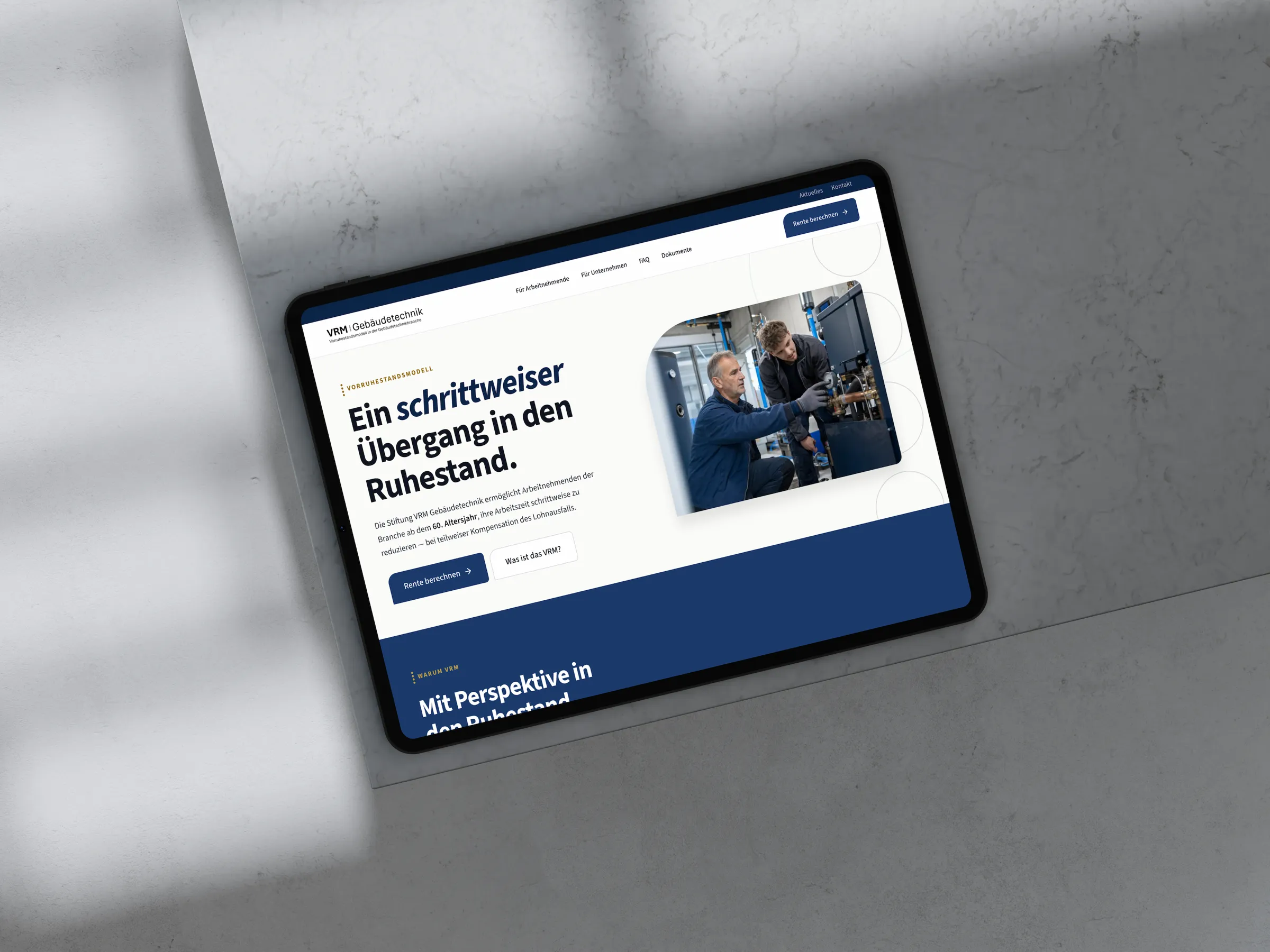
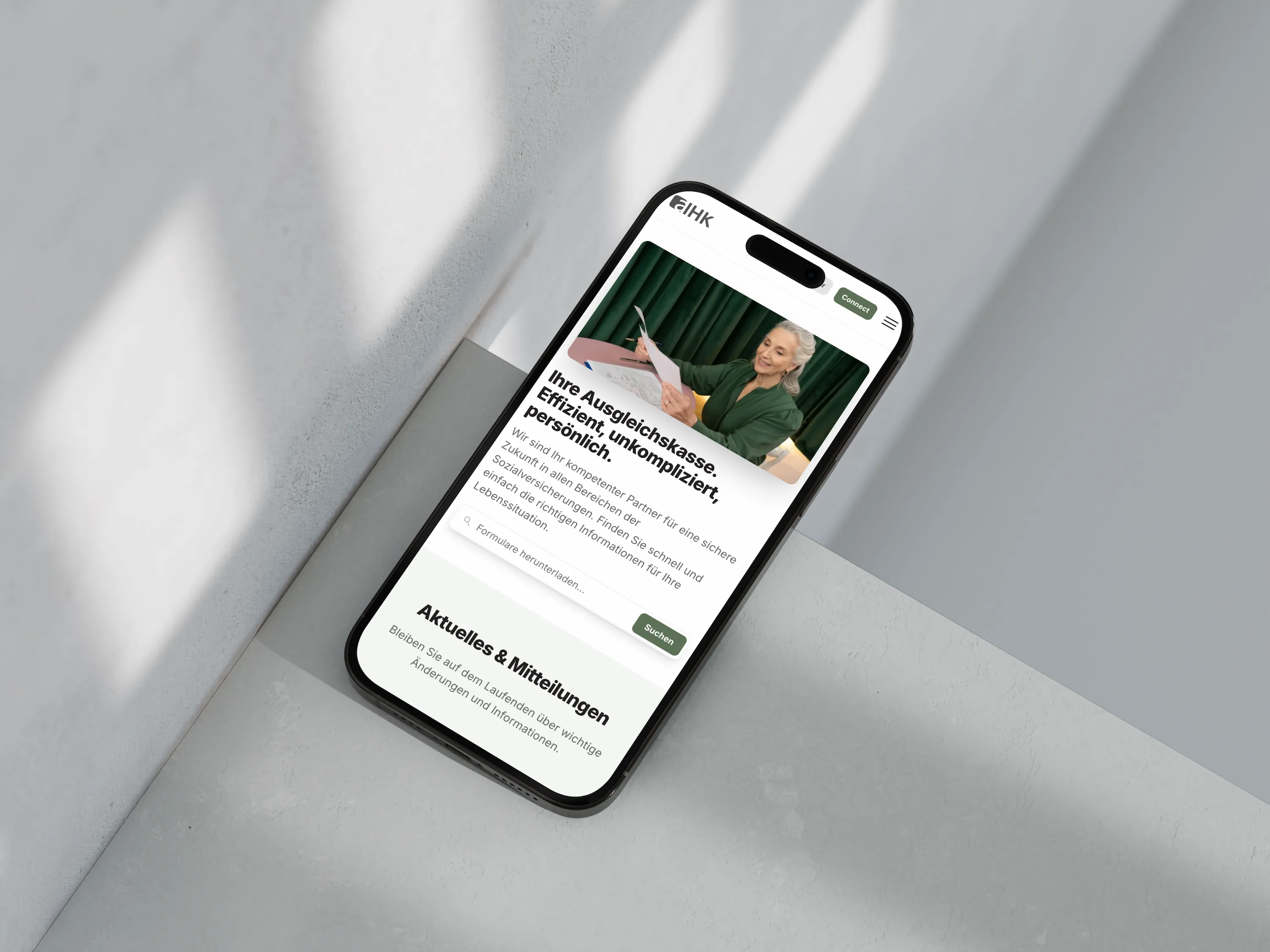
 Web design 9 min Website for a compensation office — an application form that saves the work The AIHK social insurance fund in Aarau wanted to replace its outdated Typo3 site. The result: a modern website whose content the AI took over entirely — instead of the handful of sample pages the editorial team would otherwise have to migrate themselves. Go-live in time for the opening of the new AIHK building.
 Project
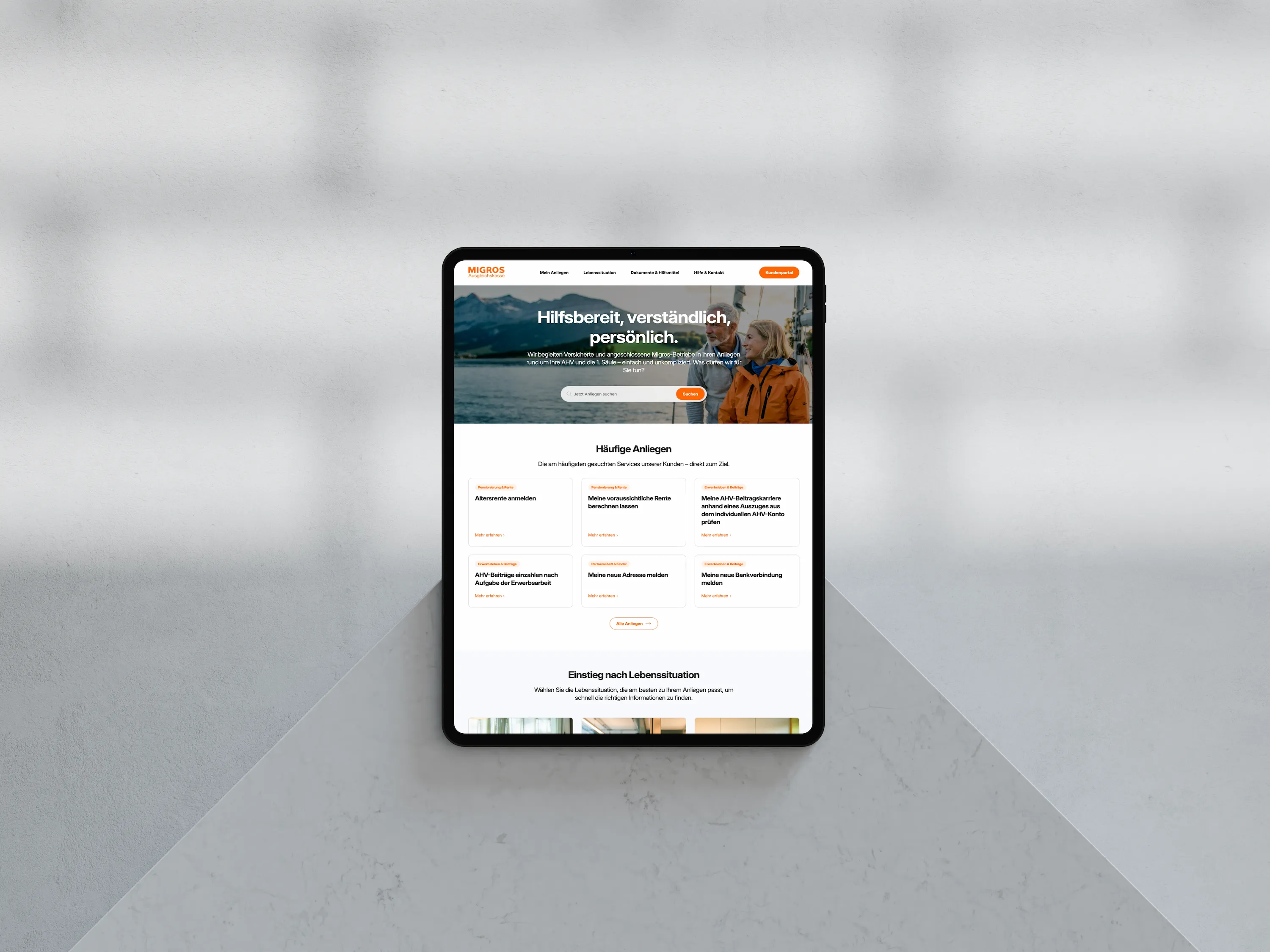
 Web design 6 min Relaunch for the Migros compensation office — plain language, no officialese Actually, AK Migros just wanted to visually refresh its old Typo3 site. The result is much more: probably the most beautiful compensation fund website in Switzerland, which also impresses with its radical user focus and maximum security.
No projects published in this industry yet.
What a great government website delivers
Government sites serve the entire population — from smartphone-savvy professionals to 80-year-old insured citizens without internet experience. The site must work for everyone, in every cantonal language, with absolutely reliable data protection.
Accessibility stopped being optional in June 2025
The revised Disability Discrimination Act (BehiG) made digital accessibility mandatory for every Swiss public body from June 2025 — federal, cantonal, communal, public-law entities. From January 1, 2027 the obligation extends to the private sector. Benchmark: eCH-0059 V3.0, the Swiss operationalization of WCAG 2.2 AA. A conformity statement in the footer is part of the obligation — not a bonus.
Reality check: 0 of 70 municipalities fully compliant
In October 2025, CORRECTIV.Schweiz together with the Stiftung Zugang für alle audited 70 Swiss municipality websites. The result: not a single site was fully accessible. 71 per cent (50 of 70) were rated not barrier-free, only 5 sites passed the screen-reader test, 36 lacked visible focus indicators for keyboard navigation. The pressure on Switzerland's 2,121 municipalities and roughly 72 compensation funds (26 cantonal plus around 46 association-AKs) is real and overdue.
Procurement: simap.ch and GemeindePortaleZH
Web projects above roughly CHF 230,000 must be tendered publicly via simap.ch under BÖB. Currently prominent: the GemeindePortaleZH project — a simap.ch tender for a shared CMS for Zurich municipalities, with 12+ committed municipalities and phase 2 starting August 2025. Noevu provides the complete tender documentation including specification, reference-project evidence and fixed-price model. In the Swiss government context, this is the rule, not the exception.
Where Liip and ti&m fit — and where they don't
Large players like Liip (Canton Basel-Stadt, opendata.swiss, City of Zurich) and ti&m (Federal Office of Civil Aviation, Canton Zurich Health, Federal Tax Administration) serve the cantonal and federal enterprise market with 150 to 200 staff and multi-year roadmaps. For a municipality of 4,000 inhabitants or an association compensation fund with 30 employees, that is over-engineered. The market lacks an agency that combines fixed price, a single accountable contact, 10-year maintainability and explicit BehiG/eCH/eIAM expertise — that is exactly the gap Noevu fills.
Three requirements are non-negotiable
Accessibility per WCAG 2.2 AA + eCH-0059 (mandatory), multilingual coverage (DE/FR/IT depending on canton, often EN), and modern digital application flows instead of PDF downloads. Pension, contribution or registration forms as guided multi-step forms save processing time significantly. Example: at the AIHK Aargau Compensation Fund TYPO3 was replaced with a modern Strapi 5 architecture, including AI-generated content and an accessible front-end.
8 levers for a modern government website
What public authorities should get right on the website:
- WCAG 2.2 AA + eCH-0059 by default: Accessibility is mandatory — not nice-to-have. Pre-launch audit, continuous testing, clear conformity declaration in the footer.
- Multilingual without third-party plugins: DE/FR/IT depending on canton, often EN. Structured translation workflow in the CMS, no external plugins for language switching.
- Guided multi-step forms instead of PDFs: Applications digitally fillable, saveable, submittable. Cuts bureaucracy time, reduces errors, improves citizen experience.
- ZAS/eIAM integration as a standard module: Secure citizen identification for sensitive applications. eIAM conformity is standard, ZAS connection for AHV/IV data is part of scope.
- Long-term maintainable CMS (Strapi/TYPO3): Granular roles, audit trail, versioning. Authorities need 10+ year maintainability — no plugin hell, no US SaaS dependencies.
- BehiG audit documented as a mandatory deliverable: Conformity statement in the footer, written accessibility audit, documented test tools (axe, WAVE, screen-reader pass). Documentation is part of delivery, not an extra.
- simap.ch tender support from day one: For projects above CHF 230,000 Noevu supports with full specification, reference evidence, eligibility and award criteria. Fixed-price model instead of T&M risk for the procuring body.
- Plan for Digital Switzerland (DVS): DVS strategy 2024–2027, One-Stop-Government, E-ID rollout, data reuse. A new website should enable the link to interagency services from day one, not block it.
What does a government website cost in Switzerland?
A compliant government site starts at CHF 12,000 — depending on multilingual scope, form flows and integrations (ZAS, eGov Switzerland, GEVER).
Typical project investments:
- Small municipality / authority office (10-20 pages, 2-3 languages): from CHF 12,000
- Mid-sized compensation fund / cantonal office (30-50 pages, application flows): CHF 25,000–45,000
- Large data portal with authority integration: from CHF 60,000
We deliver binding fixed prices before project start, including accessibility audit and conformity documentation.
Government web in numbers — the Swiss reality
What current statistics say about the Swiss government market:
2,121
- Municipalities in Switzerland (1.1.2025) — every one a potential client (BFS)
~72
- Compensation funds in total: 26 cantonal + ~46 association AKs (AHV-IV / BSV)
0 / 70
- Swiss municipality sites fully accessible (audit Oct 2025) (CORRECTIV.Schweiz)
71 %
- Municipality sites rated not barrier-free at all (CORRECTIV.Schweiz)
June 2025
- BehiG mandatory for public bodies — January 2027 for private sector (BehiG revision)
Authority types + language regions in Switzerland
German-speaking Switzerland (DE)
19 German-speaking cantons (Zurich, Bern, Lucerne, Aargau, St. Gallen, Thurgau, Schaffhausen, Schwyz, Zug, Obwalden, Nidwalden, Uri, Glarus, Appenzell AR, Appenzell IR, Solothurn, Basel-Stadt, Basel-Land, parts of Graubünden). Home to the majority of Switzerland's 2,121 municipalities. Currently active: the GemeindePortaleZH project for Zurich municipalities.
French-speaking Switzerland (FR)
Cantons Geneva, Vaud, Neuchâtel, Jura, Valais (partly bilingual), Fribourg (bilingual), Bern (bilingual). Websites mostly need FR/DE at minimum, often FR/DE/EN. CMS-native translation workflow is mandatory, not a plugin add-on.
Italian-speaking Switzerland (IT)
Canton Ticino and Italian-speaking Grisons valleys. Government sites mostly IT/DE/EN, with links to the cantonal administration in Bellinzona.
Authority type: municipality
2,121 political municipalities in Switzerland. Need ranges from the small mountain municipality (10–20 pages, 2 languages) to the city of 50,000 inhabitants (multilingual, online counter, GEVER connection). Fixed-price projects between CHF 12,000 and CHF 45,000 cover most cases.
Authority type: compensation fund (AHV/IV)
26 cantonal compensation funds + around 46 association compensation funds = roughly 72 in total. Specific requirements: ZAS connection for pension and contribution data, eIAM login for insured persons, multilingual application flows. Reference: AIHK Aargau.
Authority type: social services and insurances
Communal social services, regional social insurances, IV offices. High requirements for data protection (FADP), multilingual coverage and low-barrier application flows (including plain language).
Authority type: tax office and resident services
Communal and cantonal tax offices, resident services, civil registry offices. Growing demand for digital application forms instead of counter appointments.
Authority type: education and school boards
School boards, cantonal education departments, primary-school authorities. Parent portals, registrations, multilingual coverage (often 4+ languages in school context).
What a government site must deliver — legally + by standard
BehiG revision (June 2025 / January 2027)
The revised Disability Discrimination Act makes digital accessibility mandatory for every Swiss public body from June 2025 — federal, cantonal, communal, public-law entities. From 1 January 2027 the obligation extends to the private sector (banks, insurers, associations, larger companies). A transition period until 2030 applies for existing content; new content must be compliant immediately.
eCH-0059 V3.0 — Swiss accessibility standard
The Swiss operationalization of WCAG 2.2 AA. Four principles: perceivable, operable, understandable, robust. A conformity statement in the footer is part of the obligation — not a bonus. Benchmark for every audit.
eCH-0014 SAGA.ch V8.0
Standards and architectures for eGovernment applications — the technical reference architecture for Swiss e-government systems. Often mandatory in simap.ch tenders, recommended otherwise.
eCH-0090 and related eCH standards
Further eCH standards cover XML schemas, geodata services, authentication and inter-authority data exchange. Relevant for interface projects.
FADP (revised Federal Act on Data Protection)
The Swiss equivalent of GDPR. Mandatory: privacy notice, processing register, cookie consent, processor agreements with every service provider. For authorities, Swiss hosting is effectively the standard.
BÖB and simap.ch — public procurement
The federal law on public procurement requires web projects above roughly CHF 230,000 to be tendered publicly on simap.ch. Specification, eligibility and award criteria, reference projects, fixed price: Noevu provides the complete tender documentation.
Digital Administration Switzerland (DVS) — strategy 2024–2027
Joint strategy of federation, cantons and municipalities with six goals: One-Stop-Government, E-ID rollout, data reuse, cloud-enabled administration, networked systems, end-to-end digital services. Any government website built today should enable that linkage from day one.
Common mistakes on government websites
What goes wrong again and again at Swiss municipalities, compensation funds and cantonal offices:
- PDF forms instead of digital multi-step paths: PDFs force citizens to printer, pen and postal mail. A guided multi-step form saves significant case-handling time and reduces follow-up questions.
- US SaaS CMS for sensitive citizen data: Webflow, Wix, Squarespace and similar platforms operate under US data law — not FADP. For an authority, a no-go. Swiss hosting plus open-source CMS is mandatory.
- BehiG audit not documented: A website is not "accessible" just because it looks tidy. Without a written audit + conformity statement in the footer, the BehiG obligation is not met.
- No ZAS/eIAM connection for application flows: Pension or contribution certificates require secure citizen identification. Starting without eIAM means retrofitting the bridge later, at higher cost.
- Plugin hell instead of long-term architecture: WordPress with 40 plugins is a security risk after three years. Authorities need 10+ year maintainability — Strapi 5 or TYPO3 is the better call.
- Missing or patchy multilingual coverage DE/FR/IT: Cantonal bodies often need three to four languages. Translation workflow belongs in the CMS, not in a retrofitted plugin — otherwise languages drift apart over the years.
More reading on government web design



Book your free consultation:
Vielen Dank! Wir melden uns in Kürze.
Common questions about government web design
What compliance requirements must a government site meet?
Mandatory: WCAG 2.2 AA (accessibility), eCH-0059 (Swiss accessibility standard), FADP, BehiG, multilingual content (at least DE/FR/IT depending on canton), open data where possible. Noevu builds compliant sites by default and ships the accessibility audit with the launch. Example: AIHK Aargau Compensation Fund.
Which CMS fits a public authority?
Authorities need long-term maintainability, granular permissions and audit trail. Strapi 5 (Headless, Open Source) or TYPO3 (established, Swiss-strong) are top options. Noevu also migrates from legacy systems — see Migros Compensation Fund: TYPO3 → modern architecture.
How do I replace forms with digital workflows?
Application forms (pensions, certificates, registrations) as guided multi-step forms instead of PDFs: cuts processing time, reduces errors, improves citizen experience. Noevu integrates digital application paths including ZAS/eIAM connection, document-secure transmission and automatic confirmation.
What does a government website cost in Switzerland?
A compliant government site starts at CHF 12,000 — depending on multilingual scope, form paths and integrations (ZAS, eGov Switzerland, GEVER). More complex platforms with data portal and authority integration sit at CHF 30,000+. We deliver binding fixed prices before start.
What does the June 2025 BehiG revision mean for our municipality?
Since June 2025 digital accessibility is mandatory for every Swiss public body — regardless of municipality size. Benchmark: eCH-0059 V3.0 (= WCAG 2.2 AA). A transition period until 2030 applies for existing content; new content must be compliant immediately. A conformity statement in the footer is part of the obligation. Any relaunch starting now should make BehiG conformity a contractual deliverable — not an afterthought.
How does a simap.ch procurement work?
Web projects above roughly CHF 230,000 (BÖB threshold) must be tendered publicly via simap.ch. The flow: needs analysis → specification → publication on simap.ch → eligibility and award criteria → bid evaluation → award. Noevu delivers the complete tender documentation including reference-project evidence (e.g. AIHK Aargau), a fixed-price bid and evidence of compliance for every requested criterion. Currently prominent example: GemeindePortaleZH, a shared CMS for Zurich municipalities.
Why not Liip or ti&m?
Liip and ti&m are excellent — for federal, cantonal and City of Zurich scope. With 150–200 staff they serve the enterprise market with multi-year roadmaps and six-figure budgets. For a municipality of 4,000 inhabitants or an association compensation fund with 30 employees, that is over-engineered: too expensive, too process-heavy, no firm fixed price. Noevu fills the gap below: one accountable contact, fixed price before start, 10-year maintainability, explicit BehiG/eCH/eIAM expertise. If your project clearly sits in the federal or cantonal enterprise segment, we will gladly refer you.
How long does it take from briefing to launch?
Typical Swiss SME projects go live in 6-12 weeks. Workshop and concept (2-3 weeks), design prototyping (2-3 weeks), implementation and content (2-4 weeks), QA and launch (1-2 weeks). Larger projects with multilingual scope, shop or government integration need 3-6 months. You receive a binding roadmap with milestones before start.
Can I edit the website myself after launch?
Yes. By default Noevu ships a website you can maintain yourself — usually on Squarespace (drag-and-drop) or a Headless CMS with visual editor (Sanity Studio, Payload, Strapi). At launch you receive video training and a written guide. If you would rather not invest time, Noevu can maintain the site under a service plan.
What happens after go-live? Maintenance, hosting, support?
Noevu offers a service plan from CHF 90/month — includes hosting (Vercel + Cloudflare CDN), automatic backups, security updates, performance monitoring and 2 support hours monthly. Without a plan the site keeps running — you keep full access and can switch providers any time (no vendor lock-in).
Does Noevu translate the website into multiple languages?
Yes. Multilingual sites in DE/FR/IT/EN (also PT, ES, AR, TR on request) are part of the standard repertoire. We use structured translation workflows with correct hreflang tags, locale-specific imagery and clean SEO per language. Translations can be done by your team or by Noevu via professional translators.
Who owns the website, code and content?
You do. Fully. Noevu delivers code, design files and content for unrestricted reuse — no licensing model, no "platform lock-in". If you ever switch agencies, everything goes with you. Hosting, domain and CMS accounts are in your name. This promise is part of every quote.