
What Google Consent Mode v2 is
Google Consent Mode is neither a cookie banner nor a law. It is an interface. It passes your visitors' decision on to the Google tags, meaning Google Analytics 4 and Google Ads. The banner asks, Consent Mode forwards the answer, and the tags follow it.
Version two has widened the scope. Besides ad_storage and analytics_storage, ad_user_data and ad_personalization were added. They control whether Google may process and personalize user data for advertising.
Consent Mode v2 knows four consent signals: ad_storage (advertising cookies), analytics_storage (analytics cookies), ad_user_data (passing user data on to Google) and ad_personalization (personalized advertising, also called remarketing, meaning addressing former visitors again). Google doesn't ship a default value. You set it yourself, for EU visitors usually to “denied” until the decision is in.
What applies to Swiss SMEs
Swiss law relies on information and objection. Under Article 45c of the Telecommunications Act, you may process data on your visitors' devices. The condition is that you inform them of the purpose and point out the option to decline. The Federal Data Protection and Information Commissioner (FDPIC) confirms this in its fact sheet from March 2026. A prior, explicit consent is needed only in exceptions. It applies when the processing is unexpected, carries a high risk or involves particularly sensitive data.
It looks different for visitors from the EU. European law requires consent there before non-essential cookies are set. If you deliberately address customers in the EU, you come into contact with it. On top of that comes Google's own policy. It applies to the European Economic Area (EEA: the EU plus Iceland, Liechtenstein and Norway), to the United Kingdom and, since 31 July 2024, also to Switzerland. If you use advertising tags such as Google Ads, you must obtain consent from these visitors. It applies to cookies where the law requires it, and to personalized advertising such as remarketing.
Google requires the verified consent signal only for the EEA. It applies as soon as you measure visitors with Google tags or use audiences and personalized advertising. For Swiss and British traffic, Google's own help says it does not expect such a signal. That is the status as of October 2026, and Google can change it. Check the policy before every new campaign.
| Swiss audience only | EU audience as well | |
|---|---|---|
| Swiss law | Information and opt-out are usually enough | Still applies, with EU law on top |
| Google's rule | Consent for advertising cookies and remarketing, no verified signal expected | Verified consent signal required, via Consent Mode or the industry standard TCF |
| Consent Mode v2 | Not enforced, sensible with a banner | The usual way to deliver the signal |
The table shows the core: Google's signal requirement depends on the audience, not on the company's seat. A Swiss SME with EU customers falls under it, a purely local business usually doesn't.
Consent Mode v2 is often sold to Swiss SMEs as a legal obligation. It is not. Google requires the verified signal for visitors from the EEA, as soon as you measure or advertise to them with Google tags. For a purely Swiss audience, two things apply: Swiss law requires information and a way to decline, and Google's policy requires consent for advertising cookies and remarketing. In borderline cases, a data protection professional clarifies the details.
Basic or Advanced – the actual decision
Consent Mode comes in two implementation types. The difference determines how much measurement remains after a decline and how data-sparing the solution is. It is not a formality, but a trade-off between privacy and measurement depth.
| Basic Consent Mode | Advanced Consent Mode | |
|---|---|---|
| Google tags before the decision | Don't load | Load immediately, with your default value |
| On a decline | No data goes to Google | Cookieless pings go to Google, meaning short signals without a cookie |
| Modeling | Google Ads: only a general model. Analytics: no behavioral modeling | Google Ads: model for your account. Analytics: behavioral modeling once enough data is there |
| Data minimization | Higher | Trade-off: cookieless pings leave the website |
| Best for | Little EU budget, focus on privacy | Relevant EU budget and enough visitors for modeling |
Modeling means that Google estimates the missing figures from the behavior of visitors who gave consent. For Google Analytics 4 there is a hurdle. Google requires at least 1,000 events per day from visitors who decline, over at least seven days. In addition, at least 1,000 visitors per day with consent on seven of the last 28 days. That presupposes several thousand visitors a month, and even then modeling is not guaranteed. A website with around 850 visitors in 30 days, like noevu.ch, doesn't reach the threshold.
For Google Analytics 4, Advanced therefore closes measurement gaps only with enough traffic. Basic holds back as much as possible and loses the data of visitors without consent in return. The right choice follows your visitor numbers and your EU advertising budget, not the standard tutorial.
The privacy trade-off in Advanced mode
Advanced Consent Mode sounds tempting: more data, fewer measurement gaps. The price is in the fine print. Even those who decline trigger cookieless pings, which Google uses for modeling. You should know that and name it in your privacy policy before you activate Advanced.

Don't activate Advanced as a reflex just because a tutorial recommends it. First check whether your website reaches the thresholds for modeling and whether enough advertising budget flows into the EU. With small numbers, Basic is the more data-sparing choice. Advanced pays off when measurement gaps distort real decisions and the EU budget is relevant.
What you actually need
A clean implementation needs four building blocks, whether you choose Basic or Advanced. If one is missing, the banner appears to work, but the signals may reach Google wrongly or not at all.
The building blocks of a clean implementation
Google does not require advertisers to use a CMP from its partner program. The certification obligation applies to operators of websites that serve Google ads.
If you use no Google tags at all
Consent Mode is a Google interface. If you use neither Google Analytics nor Google Ads, you have nothing to pass on and don't need it. Cookieless analytics such as Rybbit work without Consent Mode. Which providers exist is shown in the article below.
The price lies elsewhere. Without Google tags there are no remarketing lists and no measurement for Google campaigns. If you don't run campaigns, you lose hardly anything. If you do, you still need Google tags and therefore Consent Mode.
Cookieless also doesn't mean rule-free. Rybbit advertises “no cookies, no banner”. On noevu.ch, it stores a random identifier in the browser's local storage (Local Storage). The FDPIC explicitly names this storage as a similar technology. Whether such measurement can do without consent for EU visitors has not been conclusively settled. Your privacy policy therefore names every tool with its purpose and provider.
How Noevu handles consent and measurement on noevu.ch
Two measurement systems run in parallel on noevu.ch. Cloudflare Zaraz, a tag manager, manages Google Analytics 4 centrally, as well as the consent banner. Visitors from the EU see the banner and decide there about analytics and advertising. Alongside it, Rybbit measures on its own server in Switzerland, without a banner and without cookies.
Both systems receive the same events, such as a booked appointment. The comparison shows roughly how many visitors are missing in Google Analytics, partly because of the banner for EU visitors. Read the gap as an order of magnitude, because the two systems count differently.
For client projects, an inventory comes first: Which services load, and which route fits them? Then follow the connection of Consent Mode v2 and a test of whether, before the decision, only what the chosen mode allows flows. The banner itself is explained in the guide to cookie banners for Swiss shops. If you want to tackle measurement and website together, you'll find the framework under website optimization.
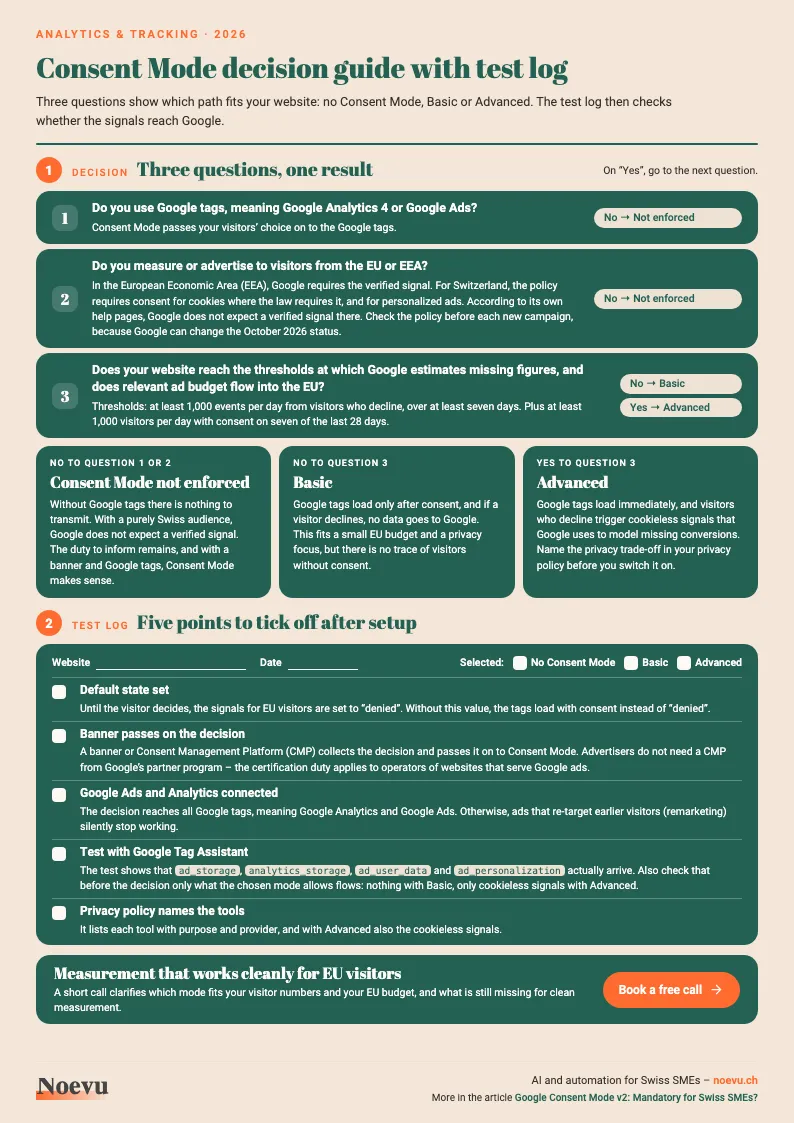
Consent Mode decision guide with test log
The decision guide as a PDF: three questions lead to “Consent Mode not enforced”, “Basic” or “Advanced”. Plus the test log you use to tick off whether the four signals arrive at Google.
Thank you. Your download will start shortly.
Common mistakes in implementation
The same mistakes repeat in implementation. They cost measurement data or trust, and usually show only once the numbers are already missing.
Five mistakes that cost measurement or trust
- The banner blocks tags but doesn't pass on Consent Mode signals: Google sees no consent, and measurement for EU visitors drops out
- The default value is missing: without it, the tags load with consent instead of “denied” and switch off the privacy protection for EU visitors
- Only Analytics is connected, Google Ads is not, and remarketing drops out unnoticed
- You activate Advanced without checking the privacy trade-off and without reaching the thresholds for modeling
- Nobody tests the signals after setup, and the error only shows once conversions are missing
Conclusion
Google Consent Mode v2 is rarely what vendors promise. It is not a Swiss legal provision, but Google's condition for working measurement and advertising with visitors from the EEA. If you address only a Swiss audience, you have more room than many vendors claim. If you advertise to or measure EEA visitors, you can hardly avoid it.
Three decisions count: Do you need Google tags at all, does Basic or Advanced fit your visitor numbers, and does your banner solution pass on the signals cleanly? Everything needs testing, otherwise the checkmark becomes an alibi. The legal situation in borderline cases is for a data protection professional to clarify; the technology can be built cleanly regardless.

A short conversation clarifies which mode fits your visitor numbers and your EU budget, and what is still missing for clean measurement.
Frequently Asked Questions
What is Google Consent Mode v2, explained simply?
Consent Mode is an interface between your cookie banner and the Google tags on your website. It passes your visitors' decision on to Google Analytics 4 and Google Ads. Version two adds two new signals to the existing ones, ad_user_data and ad_personalization. They control whether Google may process and personalize user data for advertising. So Consent Mode is neither a banner nor a law, but the connection between the two.
How do I set up Google Consent Mode v2?
In four steps: First, you choose a banner or CMP that supports Consent Mode. Second, you set the default value to “denied”. Third, you connect the decision to all Google tags, meaning Analytics and Ads. Fourth, you use the Google Tag Assistant to test whether the four signals arrive. Whether Basic or Advanced fits depends on your visitor numbers and your EU budget. What the banner itself should look like is shown in the guide to cookie banners.
Is Consent Mode v2 a legal requirement in Switzerland?
No, not under Swiss law. For most cookies it requires information and a way to decline (Article 45c of the Telecommunications Act, fact sheet of the FDPIC from March 2026), but no Consent Mode interface. The obligation comes from Google's policy: for visitors from the EEA, the decision must reach Google, via Consent Mode or the industry standard TCF. For Swiss and British traffic, Google's own help says it requires consent for advertising cookies and remarketing, but does not expect a verified signal. In borderline cases, a data protection professional clarifies the details.
What is the difference between Basic and Advanced Consent Mode?
With Basic Consent Mode, the Google tags only load once a visitor has decided in the banner. If someone declines, nothing happens: no tags, no data. With Advanced, the tags load immediately and, on a decline, send cookieless pings, meaning short signals without a cookie. Google uses them to model missing conversions. Google Analytics 4 needs Advanced and enough traffic for behavioral modeling. Advanced therefore delivers more measurement data, but also passes something on to Google even when a visitor declines. Basic avoids that privacy trade-off.
Which Consent Management Platform (CMP) do I need?
One that collects the decision, stores it and passes it on to all four signals. Google does not require advertisers to use a CMP from its partner program. The obligation to use a certified CMP applies to operators of websites that serve Google ads. More important than the name is a clean connection: the signals must be set before the first Google tag. A CMP that looks good but doesn't pass on the signals doesn't serve its purpose.
What happens without Consent Mode v2 in Google Ads?
For visitors from the EEA, Google then lacks verifiable consent. That can lead to data loss, and remarketing and personalized advertising can no longer be used for them. If Google reviews an account and finds no consents, it may suspend audience features and conversion measurement. For a Swiss SME that deliberately targets customers in Germany or Austria, this means considerably less data for the campaign.
Does Consent Mode improve my data quality in Google Analytics 4?
Indirectly, but only in Advanced mode and only with enough traffic. Google Analytics 4 estimates missing visits from the cookieless pings. The requirements are at least 1,000 events per day from declining visitors and 1,000 visitors per day with consent, each over several days. This closes measurement gaps when many visitors decline, but it is not guaranteed. With Basic, the gap stays open. A website with a few hundred visitors a month doesn't reach the thresholds, so Advanced brings no measurable gain.
Do I need Consent Mode if I use Rybbit or another cookieless tool?
No. Consent Mode only affects Google tags. If you use neither Google Analytics nor Google Ads, there is nothing to pass on. The duty to inform remains: your privacy policy names the tool with its purpose and provider. Rybbit advertises “no cookies, no banner”. Whether cookieless measurement can do without consent for EU visitors has not been conclusively settled.
Sources
- Help with the EU User Consent PolicyGoogle
- Set up Consent ModeGoogle
- About Consent ModeGoogle
- Requirements for behavioral modeling for Consent ModeGoogle
- Consent Mode updates for traffic in the EEAGoogle
- Troubleshoot issues with the EU User Consent Policy consent auditGoogle
- Telecommunications Act (FMG), Art. 45cFedlex
- Cookies fact sheet, March 2026FDPIC
- Google Consent Mode in Cloudflare ZarazCloudflare
- Rybbit: cookieless web analyticsRybbit