


When a Google Analytics alternative pays off in Switzerland
Google Analytics is not prohibited in Switzerland. Using it comes with several obligations, and those obligations determine the effort.
The revised Federal Act on Data Protection, revDSG (revised FADP), has applied since 1 September 2023. Your privacy policy must state at least who processes the data, for what purpose and who receives it. If the data goes abroad, the country and the safeguards are part of it (Art. 19 revDSG). For Google Analytics, that means naming Google and the USA.
Since 15 September 2024, the Swiss-US Data Privacy Framework has applied to the USA. The Federal Council rates data protection as adequate at US organizations that have certified under it. By its own account, Google relies on this framework in certain cases.
For cookies and similar technologies, Art. 45c of the Telecommunications Act (FMG) requires two things. Visitors learn that you process their data and why, and they can decline the processing. That is an opt-out. The Federal Data Protection and Information Commissioner (EDÖB) confirms this in its fact sheet of 31 March 2026.
The EDÖB guide of 6 October 2025 sets a limit. If tracking leads to high-risk profiling, you need explicit consent in advance. That can include advertising tracking across several websites.
People in the EU change the picture. If your offering is also aimed at them, the GDPR and ePrivacy rules usually require consent before Google Analytics runs. The guide to the Shopify cookie banner under revDSG and GDPR explains how to solve both in one dialog.
Google Analytics remains usable in Switzerland. The effort lies in the consent dialog for EU visitors, in the privacy policy and in ongoing maintenance. Cookieless measurement can spare you the dialog if no other service needs it.
What cookieless analytics measures – and what it doesn't
Cookieless analytics sets no cookies. From the IP address, a browser identifier and a salt that changes daily – a random extra value – it computes a hash. That is a calculated code that recognizes the visit for one day. Plausible and Fathom describe the method this way. Without the daily change, the identifier stays valid for longer. Some tools also store a random identifier in Local Storage. That, too, counts as access to the device.
A limit follows: someone who visits you on Monday and on Wednesday counts as two visitors. Plausible states itself that it does not recognize the same visitor across several days and devices.
What you see
- Pageviews and most popular pages
- Where visitors come from: search engine, link or direct visit
- Country, device type and browser
- Events such as a submitted form, an appointment or a click on the phone number
What you don't see
- Returning visitors across several days
- A visitor's path across several devices
- Age, gender and interests of individual visitors
- Google Ads audiences built from your visitors
For a website that is meant to bring in inquiries, what you see is usually enough. What counts are sources, most popular pages and the number of inquiries.
A dialog changes the figures too. Visitors who decline are missing from Google Analytics. In Consent Mode, Google can estimate the gap, but only with an advanced setup and enough data volume. A comparison with a cookieless measurement running in parallel shows roughly how large the gap is for you.
For visitors from the EU, cookieless does not automatically mean free of consent. According to the European Data Protection Board (EDPB), the ePrivacy rules can also apply to scripts and to tracking through the IP address alone. That does not yet decide whether consent is needed.
The French supervisory authority CNIL exempts pure audience measurement from consent under strict conditions. Several conditions apply, for example anonymous statistics only, no cross-site identifiers and no reuse of the data by the provider. If your offering is aimed at customers in the EU, check this beforehand.
Five Google Analytics alternatives compared
All five measure without cookies or can be set up to do so. The differences lie in how you run them, in the license and in the price. The visitor identifier differs as well. Plausible and Fathom change the salt daily, Simple Analytics stores no IP address. With Rybbit and Matomo it depends on the settings. The information comes from the providers' own pages, as of 5 October 2026.
| Hosting | Cookies | Source code | Entry price per month | |
|---|---|---|---|---|
| Plausible | Cloud (EU) or self-hosted | None | Open (AGPL) | USD 9 (10,000) |
| Fathom | Cloud service | None | Closed | USD 15 (100,000) |
| Matomo | Frankfurt or self-hosted | Default: yes | Open (GPL) | About EUR 22 (50,000) |
| Simple Analytics | Cloud (Netherlands) | None | Closed | USD 20 (100,000) |
| Rybbit | Cloud (EU) or self-hosted | None; Local Storage | Open (AGPL) | USD 13 (100,000) |
Prices per month according to the providers' pricing pages, as of 5 October 2026. In brackets: included pageviews, for Matomo hits. Rybbit with annual billing, Matomo Cloud excluding VAT, self-hosted Matomo without a license fee. Fathom: only the earlier version, Fathom Lite, is open source. Hosting details come from the vendors.
Plausible and Fathom are the simplest starting points: one script, few figures, hardly any settings. Matomo works with cookies by default. In cookieless mode it loses accuracy for returning visitors and for assigning conversions to the original source. In return, it ships with a mode for the French CNIL exemption.
Rybbit has existed since January 2025 and keeps developing (version 2.9, September 2026). Like Plausible, you can host it yourself. Check the settings for the salt. With Rybbit you switch on the daily change yourself, with Plausible it is the default.
If you only need visitor numbers, Cloudflare Web Analytics offers a free, cookieless option. Raw data is kept there for seven days, after that only in aggregated form.
How Noevu measures: Google Analytics and Rybbit side by side
Two measurement systems run in parallel on noevu.ch. Google Analytics runs through Cloudflare Zaraz, a manager for scripts. EU visitors see a consent dialog for it. Rybbit runs without a dialog, sets no cookies and stores a random identifier in Local Storage. Whether that stays free of consent for EU visitors has not been conclusively settled. Rybbit runs on Noevu's own server at Infomaniak in Switzerland.
Both systems receive the same events: chat opened, appointment booked, click on phone or email. That makes the figures directly comparable. The privacy policy names both systems with purpose and provider.
The parallel setup has a purpose. The comparison shows roughly how many visitors are missing in Google Analytics, partly because of the dialog for EU visitors. Read the gap as an order of magnitude, because the two systems count visitors differently. Running it yourself also costs maintenance: updates and backups are your responsibility.

Let both systems run in parallel for at least two months before you switch off Google Analytics. Only then do you know the gap between the two series of figures and can place old reports correctly.
How the switch works in five steps
Switching takes five steps, and the longest of them is waiting.
Set your goals
Which three to five figures do you really need? Usually it is the number of inquiries and where they come from.
Write down your events
Every action that counts as a success is an event in the new tool: form, appointment, click on phone or email, download.
Install the tool
First add the new tool to your privacy policy. Then the script goes on all pages, most simply through the tag manager (the script manager) or directly in the page header. After that, check that visits and events arrive.
Measure in parallel
Google Analytics keeps running for at least two full months, so that fluctuations within a month show up in both series of figures. You compare the two series week by week.
Switch off the old tool
Export the important reports from Google Analytics, then switch it off and remove it from your privacy policy.
The dialog only goes away if no other service needs it. Advertising pixels such as the Meta pixel usually need consent. For embedded videos, maps and chat widgets, check each service individually before you remove the dialog.
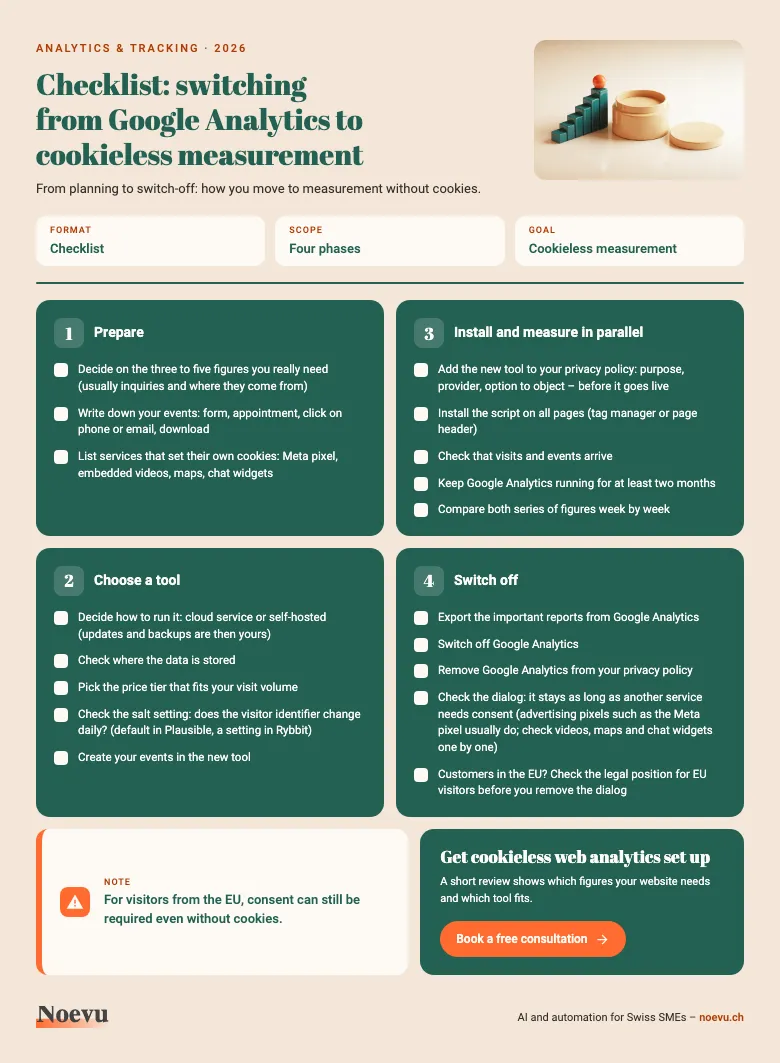
Checklist: switching from Google Analytics to cookieless measurement
The checklist guides you through the switch in four phases, from preparation to switching off. It includes two months of parallel measurement and the update of your privacy policy.
Thank you. Your download starts shortly.
When Google Analytics remains the right choice
An alternative does not suit every website. Google Analytics remains sensible if you run Google Ads and feed conversions back into the campaigns. The same applies if you want to build audiences from your visitors. In that case the connection to Google's advertising tools outweighs the effort of the dialog.
If you mainly want to know where inquiries come from, Plausible, Fathom, Simple Analytics and Rybbit work well for you. With Matomo it depends on the mode: with cookies, the original source is retained across several visits, without cookies it is not. A conversation is the fastest way to settle which measurement suits your website. Noevu reviews your website, services and goals and sets up the right measurement. That happens as part of website optimization or as part of search engine optimization.

A short review shows which figures your website needs and which tool fits. It includes a parallel run in which you read old and new figures side by side.
Frequently Asked Questions
Is Google Analytics allowed in Switzerland?
Yes, it is not prohibited. You name it in your privacy policy, inform visitors about the processing and let them decline. If your offering is aimed at people in the EU, you usually need consent. If the tracking leads to high-risk profiling, for example through cross-site advertising profiles, the Federal Data Protection and Information Commissioner (EDÖB) requires explicit consent.
Does cookieless web analytics need a cookie banner?
For visitors from Switzerland, Art. 45c of the Telecommunications Act (FMG) requires a notice with an option to object. The EDÖB guide does not generally prescribe a consent banner. The notice must be recognizable on the first visit, though, and objecting must work in a few clicks. For visitors from the EU, it depends on the country and on the tool's settings. The dialog also stays as soon as another service on the page needs consent.
Which Google Analytics alternative suits an SME?
That depends mainly on how you want to run it. If you don't want to operate anything yourself, choose a cloud version such as Plausible, Fathom or Simple Analytics. If you want to keep the data with a Swiss host, run Plausible, Matomo or Rybbit yourself. All five tools show sources, most popular pages and events.
What does a Google Analytics alternative cost?
Cloud plans start at USD 9 per month (Plausible, 10,000 pageviews) and rise with visitor volume. If you run the tool yourself, you pay no license fee, but you pay for the server and maintenance.
Is the old data lost when I switch?
The new tool starts at zero, old data does not carry over. Export the most important reports from Google Analytics before you switch it off. Let both systems run in parallel for two months, then read old and new figures side by side.
Can you measure inquiries without Google Analytics?
Yes, through events. Plausible, Fathom, Matomo, Simple Analytics and Rybbit count actions such as a submitted form or a click on the phone number. On noevu.ch, chat, appointment booking and contact clicks report the same events to Google Analytics and to Rybbit.
Sources
- Telecommunications Act (FMG), Art. 45cFedlex
- Data Protection Act (DSG), Art. 19 and 16Fedlex
- Cookies fact sheet, 31 March 2026EDÖB
- Guide to data processing using cookies and similar technologies, v. 1.1EDÖB
- Swiss-US Data Privacy FrameworkEDÖB
- Google Ads Data TransfersGoogle
- Consent Mode and behavioral modeling in Google AnalyticsGoogle
- Requirements for behavioral modeling in Consent ModeGoogle
- Guidelines 2/2023 on Art. 5(3) of the ePrivacy DirectiveEuropean Data Protection Board
- Consent exemption for audience measurementCNIL
- Data PolicyPlausible
- How Fathom counts visitorsFathom
- What Simple Analytics collectsSimple Analytics
- Matomo pricing and hostingMatomo
- Plausible pricingPlausible
- Fathom pricingFathom
- Simple Analytics pricingSimple Analytics
- Cloudflare Web Analytics: frequently asked questionsCloudflare
- Rybbit pricingRybbit
- Rybbit source code and licenseGitHub