


What «my business on Google» means — explained briefly
A Google Business Profile is the free listing that makes your business visible in Google Search and Google Maps. Until 2022, the service was called Google My Business, and many SMEs still know it under that name or simply as «my business on Google». Functionally, little has changed. It is the central place where you store your address, opening hours, phone number, photos, services, and reviews in a structured way for Google.
In practice, the profile is more than a digital business card. Anyone searching in Switzerland for «lawyer Zurich», «hairdresser Bern», or «web agency Olten» sees a map with three listings at the top — the so-called Local Pack. For many SMEs, this position is more visible than rank one of the classic search results. A business not shown there hardly exists for local searchers.
Important to understand: the profile does not replace a website. It complements it. Google uses the data in the profile to build trust and answer local search queries. Detailed information, branding, and the path to an inquiry still need to live on your own website.
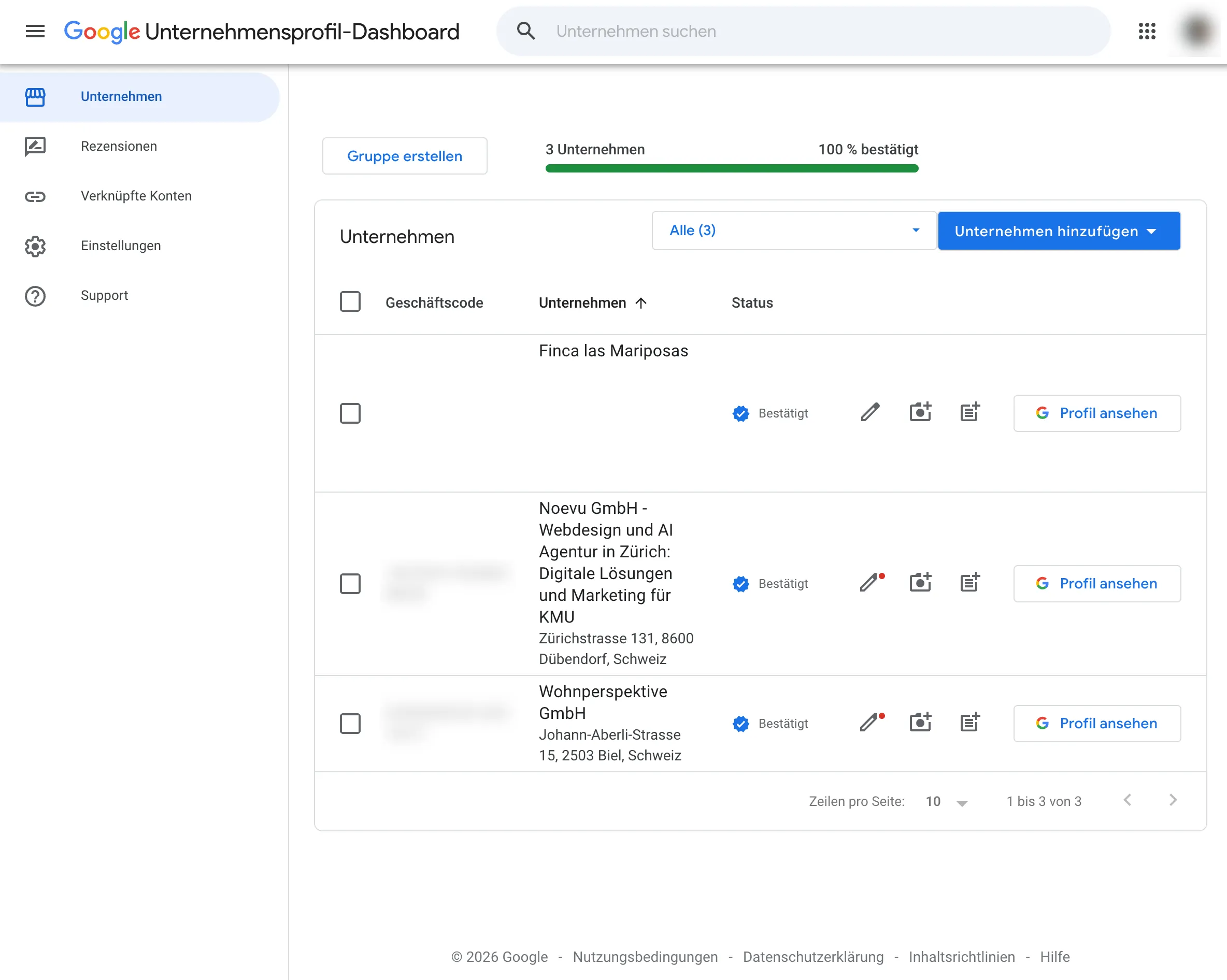
In consulting calls with Swiss SMEs, a pattern often emerges: the profile has existed for years, but nobody maintains it. Opening hours are wrong, the main image is pixelated, the latest reviews are older than two years. That is exactly where most SMEs find the biggest, fastest improvement potential.
When is the effort worth it for your SME?
A Google Business Profile is worth it whenever a relevant share of your customers searches for you locally — through a city name, a canton, or a neighborhood. Companies working across regions or purely online benefit less. Companies serving customers who decide within ten to thirty kilometers often receive more inquiries through a maintained profile than through their own website alone.
From work with Swiss SMEs, four typical situations stand out where the profile pays off immediately:
When a profile makes sense
If at least one of these points applies, the profile is not an option but a requirement. Skipping this lever means leaving inquiries on the table regularly — without noticing, because most searchers do not click further when the Local Pack shows no matching listing.
When is the profile the wrong priority?
Just as important is the counter-question. Not every Swiss SME benefits from a Google Business Profile. Companies without local context or without capacity for maintenance should invest the effort elsewhere — for example in a better service page, focused content, or a well-conceived landing page.
Typical situations where a profile distracts more than it helps:
When the profile is not the priority
- You sell B2B software or digital products without local relevance — searchers evaluate you through reviews, demos, and content, not through Maps
- You run a pure online shop without showroom, pickup warehouse, or physical point of contact
- Your customers are distributed across Germany or Europe — local ranking signals help little there
- Nobody on the team has capacity to respond to reviews and keep data current — an abandoned profile harms more than no profile at all
The most common mistake is setting up the profile once and then forgetting about it. Outdated opening hours on a holiday, an old phone number, or a wrongly placed map pin cause more frustration than no listing at all. If maintenance cannot be handled internally, it is better to skip the profile — or to buy maintenance deliberately.
What should be clarified before creation
Before you set up a profile, a short, honest check pays off. It avoids the most common mistakes that are hard to fix later. The checklist below is based on recurring consulting cases with Swiss SMEs:
Checklist before creation
Create the profile and verify it
Creation itself is done in fifteen minutes: sign in at business.google.com, search for your own business, claim or create new, enter base data. The real hurdle is verification — Google wants to make sure you are actually allowed to control what appears about your company.
Three verification paths are relevant in Switzerland. Which one is offered is decided by Google case by case — not by you.
Postcard verification
- Google sends a code by post to the stored address
- Postal delivery time in Switzerland typically seven to fourteen days
- Best choice for businesses with a clear location and a mailbox at the entrance
Video verification
- An unedited video shows the location, team, and an official document
- Activation usually within 24 hours
- The new 2026 standard — recommended for service providers without a storefront
Phone or email verification
- Google offers these methods only for certain industries and locations
- Fastest variant when available — code in a few minutes
- Not selectable on demand, suggested automatically or not at all
Stumbling block on the address: a pure service provider working from home without receiving customers there should use the «service area» function. The address stays private, the catchment area is still represented correctly. Listing a private address publicly without declaring it as a business location risks conflicts with Google's policies — and occasionally leads to suspended profiles.
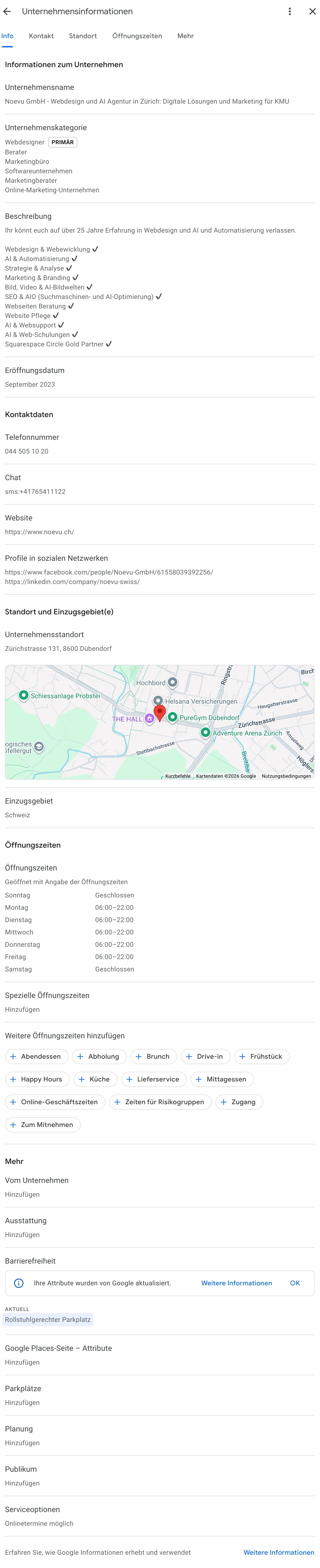
What a complete profile actually needs
Google rewards complete profiles measurably. According to Google's own data, businesses with fully filled profiles receive about seventy percent more visits than incomplete ones. «Complete» here does not mean «all fields filled for the sake of filling» — it means Google can pull an answer from your profile for every meaningful search query.
The most important elements in order of impact:
Order by impact
- Main category — decides which searches you qualify for at all
- NAP — name, address, phone number in identical spelling as on the website and local.ch
- Opening hours including holidays and cantonal specifics
- Description with clear positioning — no marketing phrases, but concrete services and target audience
- Photos: current, sharp shots of location, team, and work — never stock images
- Services and products with short descriptions — even when nobody «reads» them, they feed the AI summary
- Posts: short updates on news, offers, events — frequency matters more than length

Most of the time in practice flows into maintenance, not optimization. A business that sets up cleanly once and then manages one photo, one post, and three responded reviews per month beats a competitor who optimizes heavily once and then stops. Consistency is the underestimated lever — and the only one that signals to Google long-term that your business is active.
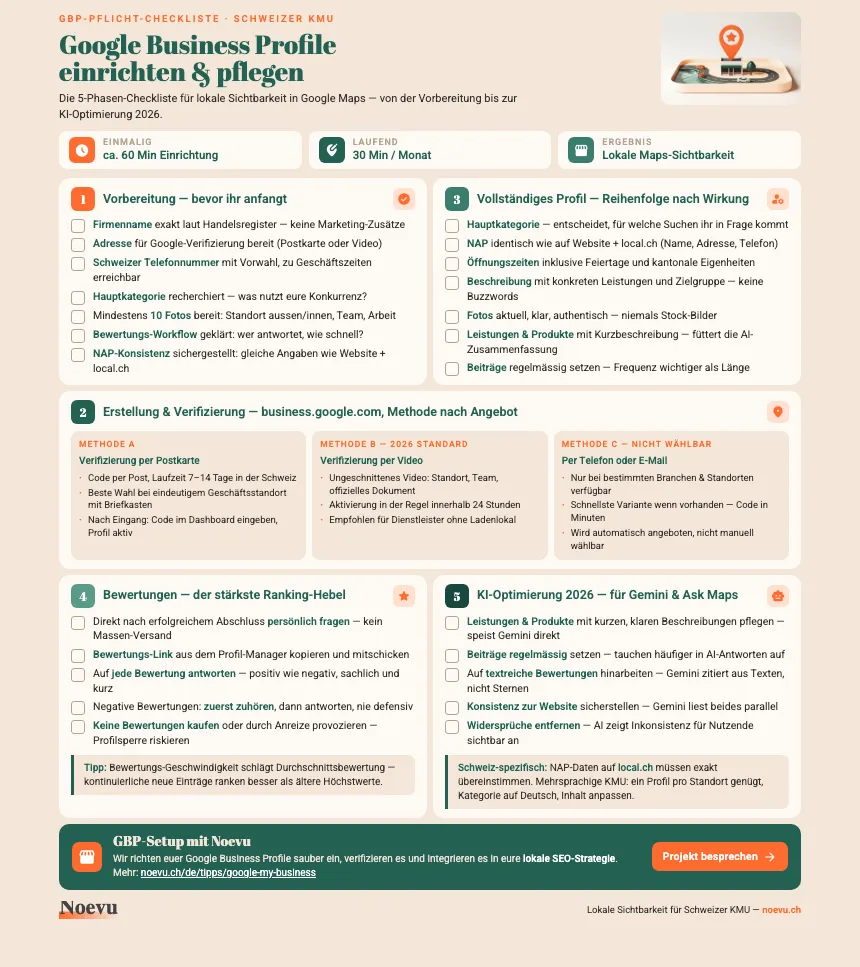
GBP Mandatory Checklist for Swiss SMEs
The 5-phase checklist as a printable A4 PDF — from preparation through verification and profile setup to AI optimisation for Gemini 2026. Set it up once, spend 30 minutes a month maintaining it.
Thank you. Your download will start shortly.
Reviews: the underestimated ranking lever
Reviews are the single strongest ranking factor in the Local Pack in 2026. The point many SMEs underestimate: the star count does not decide — the review velocity does. A business with fresh, continuously arriving reviews beats one with a higher average rating but older entries. Google reads activity as a sign of life.
The most effective levers for a healthy review situation:
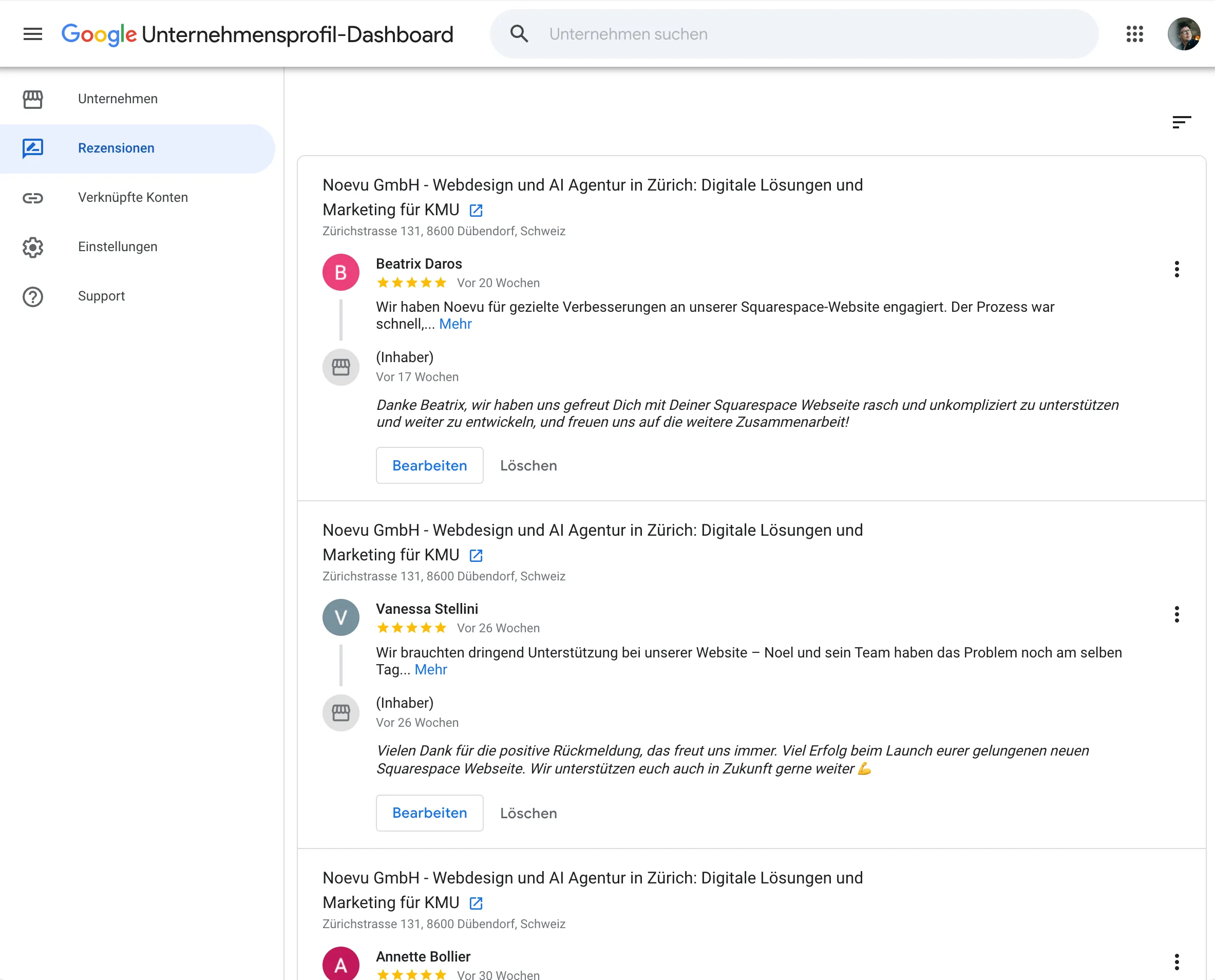
Build reviews cleanly
Thinking long-term means building a small, calm workflow: a weekly look at new reviews, a standardized but personal response, regular active requests to satisfied customers. This saves stress and delivers a profile that ranks more reliably every month.
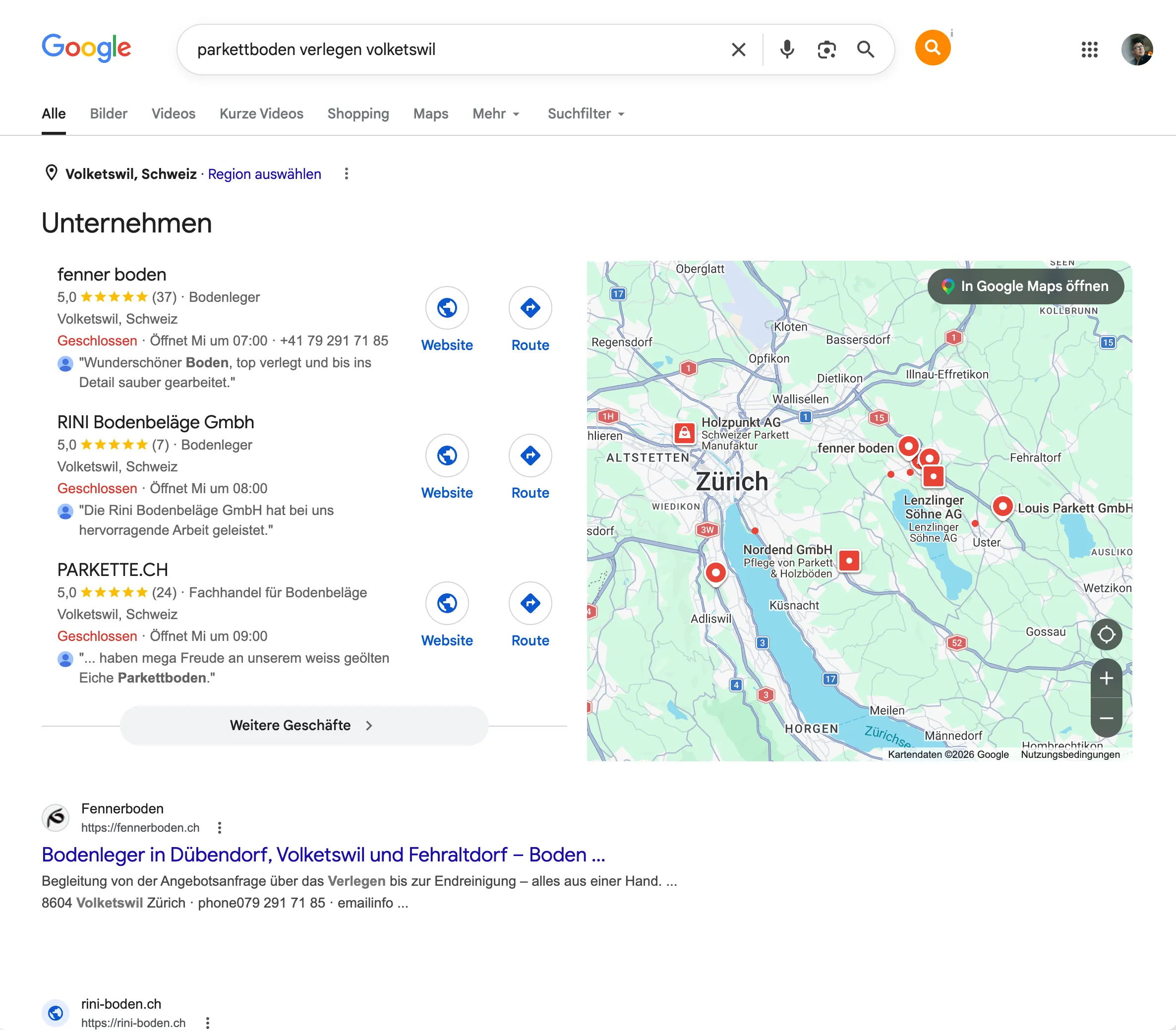
Our project with the Zurich flooring contractor fenner boden shows what this looks like in practice — a new website plus consistent profile maintenance now puts the business reliably into the local three-pack for searches like «parquet installation volketswil», with consistently five stars and fresh reviews.
How Gemini and Ask Maps shifted the game in 2026
Google rebuilt its local search fundamentally in 2026. Instead of a pure list with reviews and data, Gemini now generates an AI summary directly within the profile: What stands out about this business? Which topics appear repeatedly in the reviews? How likely is it that today's opening hours are correct? This summary often appears more visibly than the reviews themselves.
In parallel, «Ask Maps» is gradually replacing the classic Q&A section. Instead of answering preset questions, users can ask the profile questions directly — Gemini pulls answers from reviews, posts, profile data, and the linked website. For your profile, this means: anything not stored in a structured way does not appear in the AI answers.
Concretely, this changes profile maintenance:
What changes in 2026
- Services and products with short, clear descriptions — that feeds Gemini
- Set posts regularly — they appear more often in AI answers than static profile fields
- Reviews with concrete content are more valuable than star ratings without text — Gemini quotes from texts
- Consistency with your own website becomes more important — Gemini reads both in parallel
- Outdated or contradictory details become visible to users, because AI points out inconsistency
Gemini summaries are not editable at the moment. Anyone unhappy with the picture Google draws of their business has to work on the sources — reviews, posts, and profile fields. That is exactly what makes consistent maintenance more important than one-off optimization.
Swiss specifics: local.ch, multilingualism, data protection
Three points often missing from German or American guides but concretely important for Swiss SMEs. Skipping them means optimizing past the actual market.
local.ch: The Swiss business directory is read by Google as an additional source for address and contact data. The NAP data there must match the Google Business Profile exactly — same spelling, same format, same phone number. Maintaining both platforms cleanly builds measurable trust with Google.
Multilingualism: Companies serving customers across multiple language regions have two options. Either one profile per location with local language (for branches in Lausanne, Lugano, Zurich) — or one shared profile with description in the main language and multilingual posts. Both paths work, both require consistency. What does not work: a German-only profile for a Romandy-focused market.
Data protection and FADP: Review workflows with automated emails need clean consent since the revised Swiss Data Protection Act. A request for a review should happen within existing communication, not as a cold mail. For website optimization, that means less automation and more occasion-based personal requests.
Squarespace, WordPress & Co — where the profile gets linked
The platform behind your website changes little about profile maintenance — but the linking between site and profile decides whether Google can merge both sources cleanly. Three places where internal linking is consistently missing at Swiss SMEs:
- Squarespace: Under Settings → Marketing → Google Search Console and Business Information, enter your GBP address and phone with NAP consistency, then verify the domain. Every key page — Contact, About, Services — should carry a visible link to your Google profile as a reviews bridge. If you work with a Squarespace agency, set it up cleanly once and it keeps paying off.
- WordPress: Plugins such as Yoast Local SEO or Rank Math Local handle the schema markup (LocalBusiness, Organization). That complements — but does not replace — work in the profile manager.
- Custom builds (Astro, Next, etc.): Add Schema.org LocalBusiness JSON-LD in the footer template, keep NAP data as a single constant, and pull reviews via the official Places API where it adds value.
In all three cases: link to the profile with concrete anchor text («View our reviews», not «click here») and emit a single source-code entry per page — Google does not count repeated links to the same profile as reinforcement; it reads them as spam signals.
In closing
Google Business Profile is not a bonus for locally positioned Swiss SMEs but a requirement — and for purely cross-regional or digital businesses it is often the wrong priority. The honest upfront question «Do our customers search for us locally?» decides whether the effort pays off.
Anyone deciding for the profile gains most through consistency: set up cleanly once, then maintain reliably. Build reviews actively, set posts regularly, keep NAP data consistent — across your website, local.ch, and the profile. In 2026, Gemini and Ask Maps amplify this effect: whatever is stored in a structured way gets quoted in AI answers. Whatever is missing is also missing from perception.
If after reading you are unsure whether your profile reflects the current state, that is not a disadvantage — it is the right moment for a calm free website assessment. Without sales pressure, with a clear position.

Noevu helps you assess whether a Google Business Profile is worth the effort for your situation — and what really matters in maintenance.
Frequently Asked Questions
What does a Google Business Profile cost?
The profile itself is free. Google provides the entire infrastructure at no cost — from creation through verification to ongoing maintenance. Costs only appear when you buy external help: for setup, regular maintenance, post creation, or photo production. A sensible initial setup with clean categorization, NAP consistency, and a first set of photos typically costs CHF 500 to 1,500 at an agency. Ongoing maintenance takes a few hours per month once a workflow is in place.
How long does verification take in Switzerland?
Postcard verification in Switzerland typically takes seven to fourteen days. The exact time depends on the location and current postal delivery times. Since 2026, Google offers video verification broadly: a short, unedited video showing the business location and an official identity document. On success, the profile is active within 24 hours. For service providers without a publicly accessible storefront, video verification is often the only practical option. Postcard delivery to a private address is frequently rejected by Google.
Do I need to maintain the profile alongside local.ch?
Yes — both listings matter in Switzerland and must carry identical NAP data (name, address, phone number). Google uses consistency across directories as a trust signal. local.ch is the most-used Swiss business directory and is frequently pulled in by Google as an additional source. Maintaining different address formats, phone numbers, or opening hours on the two platforms confuses Google and wastes ranking potential. The extra effort for local.ch is minimal, the benefit for local visibility is concrete.
What do you do when competitors place negative reviews?
First: stay calm and do not respond emotionally. Second: check whether the review actually violates Google's policies — for example because it describes no real customer contact, is insulting, or seems clearly fake. In these cases, the review can be reported through the profile manager. Third: in any case, respond factually and briefly. A professional, calm response often carries more weight with future readers than the disappearance of the review itself. Important: reviews are not a repair tool — the best protection is a continuous flow of real, positive reviews.
Do I need a separate profile for each branch?
Yes, every physical location with its own opening hours and team needs its own profile. Google handles this through location groups, organized centrally in the profile manager. For SMEs with two to five branches, manual maintenance is sufficient. From around ten locations, bulk management starts to pay off. Important: every branch needs its own locally verified phone number and address. Otherwise the listing looks generic and loses local ranking signals.