

What structured data is — and why Google reads it
Your website says “Monday to Friday, 8 am to 5 pm”. A person understands that immediately. A search engine initially sees only characters and has to guess whether these are opening hours, a delivery window or a course timetable. Structured data takes the guesswork away.
Technically, structured data sits in the HTML source code of your page, usually as a short block invisible to visitors. It describes the content using a fixed vocabulary called Schema.org. Google, Microsoft, Yahoo and Yandex founded it so that all major search engines understand the same terms. Organization then stands for a company, openingHours for opening hours, offers for an offer with a price.
As the format, Google recommends JSON-LD, because it is the easiest to add and maintain. The block sits apart from the visible text, usually in the head of the page. That makes it robust when you rewrite copy, but also easy to forget when facts change.
Structured data is information about a page that machines read unambiguously: who, what, where, when and at what price. The vocabulary is called Schema.org, the recommended format JSON-LD. In everyday use, the two together are often called schema markup.
What schema markup does — and what it doesn’t
First the limit, because many false promises hinge on it. Structured data does not push a page up. Google’s own rules show this: whoever violates the guidelines loses the enhanced display in search results. The position in search is unaffected. And even correct markup does not guarantee any special display. Anyone who promises you first place through schema markup is promising too much.
More prominent search results. With markup, a page becomes eligible for so-called rich results, meaning enhanced search results. These include price and stock status for products, or the company logo next to the listing. Such results stand out. Google cites case studies from large brands comparing pages with and without rich results. Rotten Tomatoes measured a 25 per cent higher click-through rate on pages with structured data. At Nestlé, pages with rich results had an 82 per cent higher click-through rate.
Unambiguity. Several companies often share a name, and Google has to decide which one is meant. According to Google, Organization markup on the homepage helps distinguish your own company from others. It also helps determine which logo appears in search results and in the Knowledge Panel, the info box next to the results. With the sameAs property, you link the website to LinkedIn and industry directories. Scattered entries thus become one recognisable company.
Google has dropped several displays. From 2023, Google showed FAQ accordions only for government and health websites, and since 7 May 2026 it shows them for no one. How-to displays disappeared entirely in 2023. Review stars that a business marks up about itself on its own website are not shown by Google for Organization and LocalBusiness markup. Google highlights events only in certain countries: Germany is one of them, Switzerland currently is not. Anyone planning markup just for their own review stars is counting on a surface that does not exist for businesses.
The benefit has therefore shifted. Special displays are becoming rarer, while the unambiguity of your company data counts all the more.
Which Schema.org types matter for SMEs
Schema.org now comprises more than 800 types, from dentist to brewery. An SME needs a handful of them, and the order matters more than the number. First, the markup describes who you are. Then comes what is on the individual pages.
| Used for | Effect in Google | Where to use | |
|---|---|---|---|
| Organization, LocalBusiness | Name, logo, address, phone, opening hours, profiles | Logo, Knowledge Panel, clear attribution | Homepage |
| BreadcrumbList | Position of the page in the navigation | Page path in search results (desktop) | All subpages |
| Article, BlogPosting | Title, author, date, image | Author and freshness readable for Google | Blog, articles, news |
| Product with Offer | Price, currency, availability | Price and stock status in search results | Shop, product pages |
| Event | Date, venue, tickets | Event search, currently not in Switzerland | Courses, events, guided tours |
| FAQPage | Questions and answers | Barely shown for SMEs since 2023, not at all since May 2026 | Only where real FAQs are visible |
As of September 2026, based on the Google Search Central documentation.
The Organization markup of noevu.ch, abridged here, shows how little it takes.
<script type="application/ld+json">
{
  "@context": "https://schema.org",
  "@type": "Organization",
  "name": "Noevu",
  "legalName": "Noevu GmbH",
  "url": "https://noevu.ch",
  "logo": "https://noevu.ch/assets/images/noevu-logo.svg",
  "telephone": "+41 44 505 10 20",
  "address": {
    "@type": "PostalAddress",
    "streetAddress": "Zürichstrasse 131",
    "postalCode": "8600",
    "addressLocality": "Dübendorf",
    "addressCountry": "CH"
  },
  "sameAs": ["https://www.linkedin.com/company/noevu-swiss/"]
}
</script>
There is nothing spectacular about it. What matters is that every detail matches your legal notice, Google Business Profile and industry directories. If the phone number differs between two places, the machine has two truths and has to pick one. If you list opening hours, use the subtype LocalBusiness instead of Organization, for example for a practice or a restaurant.
Structured data and AI answers: what the evidence shows
AI Overviews in Google Search and AI assistants answer questions directly, often without a click to any website. Whoever does not appear there is hardly seen anymore. That is why SEO providers like to sell schema markup as the ticket into these answers. The evidence is thinner than the promise sounds.
In its guide to AI features, Google writes that they require neither special files nor special Schema.org markup. The same fundamentals apply as for regular search. One of them concerns structured data directly: it must match the visible text of the page. Microsoft sounds somewhat different. A Bing product lead said at an industry conference in 2025 that schema markup helps the language models behind Bing understand content.
So structured data does not force any AI system to mention you. But it gives machines unambiguous facts instead of text they have to interpret. If you want to appear in AI answers with correct opening hours, prices and locations, you need unambiguous facts, in the text as well as in the markup. And they must read the same on the website as in profiles and directories. How to measure and deliberately improve this is shown on the page on AI visibility for Swiss SMEs.
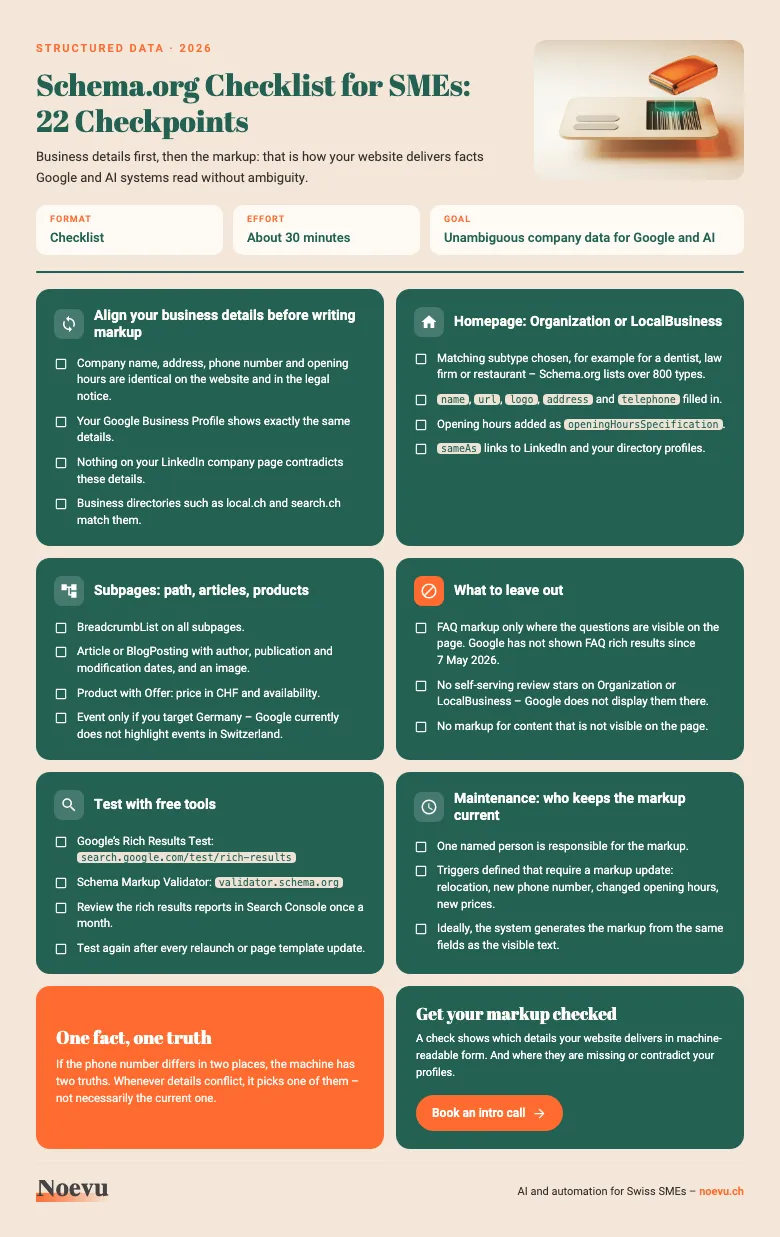
Schema.org checklist for SMEs
The checklist takes you through 22 points, from core company data to maintaining the markup. In about 30 minutes, you will see whether Google and AI systems read your company data unambiguously.
Thank you. Your download will start shortly.
Testing structured data: three free checks
You can check whether your website delivers structured data, and whether it is technically valid, without a developer. Three free tools are enough.
All three check whether the markup is valid. Whether the information is correct only shows in a manual comparison.

Open your homepage in the Schema Markup Validator with your Google Business Profile next to it. Compare name, address, phone number and opening hours field by field. For every discrepancy, the machine picks one of the two — not necessarily the current one.
Who maintains the markup: website builder, manual work or data model
Adding structured data is rarely the problem. It gets difficult a year later, when prices, opening hours or contact people change. Whether the markup is still correct then depends on where it comes from.
From the website builder. Squarespace, Wix and common SEO plugins for WordPress generate basic types automatically, for example for businesses, blog posts and products. For many small websites, that is enough. Limits appear with types the system does not know — more on this in the article on Squarespace SEO.
By hand. With code injection, you can add any Schema.org type. The catch shows at the next copy update, because hardly anyone thinks of the invisible block then. If the phone number changes only in the visible text, the markup contradicts the page. Google, however, requires markup to reflect the visible content and can penalise misleading markup with a manual action.
From the data model. Here the system generates markup and visible text from the same fields. Website builders do this for their basic types too. A custom-built website can do it for every type you need. Whoever then changes the opening hours in the content management system changes both at once. On noevu.ch this also applies to this article: title, date, author, FAQ and sources are stored once in the system. The website outputs them twice, readable for you and machine-readable for search engines.
For an SME, this means in concrete terms: equip the homepage with Organization markup, align your core data everywhere, then add markup page by page. If you are rebuilding your website anyway, plan the markup into the data model from the start. Then it stays correct even when nobody thinks about it anymore.

A check shows which information your website delivers in machine-readable form. And where it is missing or contradicts your profiles.
Frequently Asked Questions
Is structured data a ranking factor?
No. Markup does not push a page up. Even when Google takes manual action over misleading markup, it only withdraws the rich results; the page keeps its position in search. The benefit lies in more prominent listings and unambiguous company data. Google cites Nestlé, for example, with an 82 per cent higher click-through rate for pages with rich results.
What is the difference between Schema.org, JSON-LD and structured data?
“Structured data” is the umbrella term for machine-readable information about a page. Schema.org is the vocabulary, the list of terms such as Organization or Event. JSON-LD is the format in which these terms appear in the source code. Google recommends JSON-LD because it is the easiest to add and maintain.
Is FAQ markup still worth it in 2026?
Not for Google Search. From 2023, Google showed FAQ rich results only for government and health websites, and since 7 May 2026 for no one. The markup does no harm as long as the questions are visible on the page, and other systems can still read it. Today, though, we would rather put the budget for new FAQ markup into organisation and product data.
Does my website builder add structured data automatically?
Usually in part. Squarespace, Wix and WordPress with common SEO plugins generate basic types such as business, blog posts and products. The Rich Results Test shows in a few seconds which of these Google uses for enhanced search results; the Schema Markup Validator checks the rest. You can add missing types via code injection, but then you maintain them by hand.
Does structured data get you into AI answers?
There is no guarantee. Google does not require any special markup for its AI features. Existing markup must, however, match the visible text. A Bing product lead said at an industry conference in 2025 that schema markup helps the language models behind Bing understand content. Structured data delivers unambiguous facts instead of text a machine has to interpret.
How long until Google picks up new markup?
Google reads the markup as soon as it crawls the page again. Depending on the website, that takes days to a few weeks. In Search Console you can request a recrawl for individual pages. Whether rich results appear afterwards is up to Google.
Sources
- Introduction to structured data markup in Google SearchGoogle Search Central
- General structured data guidelinesGoogle Search Central
- Organization structured dataGoogle Search Central
- Review snippets: rules for self-serving reviewsGoogle Search Central
- Event structured data: availability by regionGoogle Search Central
- Changes to HowTo and FAQ rich results (August 2023)Google Search Central
- Search updates: FAQ rich result removed (2026)Google Search Central
- AI features and your websiteGoogle Search Central
- Schema.org: vocabulary overviewSchema.org
- Bing: schema markup helps Copilot’s language modelsSearch Engine Roundtable