

What holistic content really means
Holistic content covers a topic completely — instead of writing a separate, detached article for every keyword. At its centre sits a thorough pillar page on the main topic. Around it lie several cluster articles that answer individual sub-questions. All are linked to each other and point back to the pillar page.
The goal is topic authority. Search engines and AI answer engines recognise that a website commands a topic in depth — rather than merely grazing a keyword. For an SME that is good news: the largest website does not win, but the one with the clearest topic coverage in a niche.
Holistic content: a topic approach that combines a pillar page on the main topic with several linked cluster articles on sub-questions. The result is topic authority instead of keyword piecemeal — visible to classic search and AI answer engines at once.
Why single keywords are no longer enough in 2026
For years the rule ran: one keyword, one article. This logic produces piecemeal. Many pages fight individually for a term, none builds a topic. Search engines judge differently today — they measure how comprehensively a website treats a topic, not how often a word appears.
A second shift comes on top. A growing share of searches ends without a click on an external website — the answer appears directly in the featured snippet or in an AI overview. Anyone who wants to stay visible there needs content that is clearly structured and easy to cite. An isolated keyword article rarely delivers that.
Holistic content solves both problems with the same structure. Once your company positioning is sharpened, choosing the topic gets easier: you know which topic you want to stand for — and build authority exactly there.
Pillar and cluster: the architecture of topic authority
The structure is simple and robust. A pillar page carries the main topic, several cluster articles deepen the sub-questions. Internal linking holds both together — it is not decoration, but the signal that makes authority visible in the first place.
The pillar page
- Covers the main topic comprehensively — the overview everything points to
- Answers the big question, not a single detail
- Links to every cluster article and is linked from each
- Stays current long-term — it is the foundation, not a daily post
The cluster articles
- Each answers one concrete sub-question in depth
- Target specific search and question phrasings
- Point back to the pillar page and to each other
- Four to six per cluster suffice for a start
An example from practice: this article is itself a cluster article. It belongs to the marketing and branding topic field and points to related pieces like the right AI prompts for content marketing. It is exactly this web of connected pieces that builds the authority a single page never reaches.
AEO: visible in the AI answer engines
Classic search engine optimisation (SEO) and answer engine optimisation (AEO) often feel like two separate building sites. They are not. The same holistic content serves both — it only has to be clearly structured and precisely worded. The comparison below shows where the differences lie and where the cluster structure strengthens both sides at once.
| Classic search (SEO) | AI answer engines (AEO) | |
|---|---|---|
| How people search | Short keywords in the search bar | Whole questions to ChatGPT, Perplexity, or Google AI Overviews |
| What wins | The page with recognisable authority on the topic | The source with clear, citable answers |
| Role of the clusters | Internal linking strengthens the pillar page in ranking | Coherent topic coverage makes the brand citable |
| What no longer suffices | An isolated article per keyword | Isolated texts without topic connection |
The practical consequence is convenient: you do not build twice. A cleanly structured topic cluster ranks in classic search and is simultaneously picked up by AI systems as an answer basis. One approach, two visibilities.
The real-world test: our own website
The most honest way to test an approach is on yourself. That is exactly what we did with noevu.ch — openly and with real numbers.
Phase one was a relaunch with sporadic, opportunistic SEO. An article now and then, when time allowed, without a common thread. Phase two was a second relaunch, this time with an automated AI content pipeline, an SEO strategy, and a content plan built on topic clusters. This article is itself part of it.
The figures come from Google Analytics 4 and show the organic sessions — visits from unpaid search, the «Organic Search» channel group exactly as in the Analytics dashboard. In the first half of 2025, organic reach stood at around 30 sessions per month. After the first relaunch in summer 2025 it rose to around 80. In the first half of 2026 — with the AI content pipeline and systematic topic clusters — it is over 200 per month. Across the eighteen months, organic reach has thus grown roughly sevenfold; individual peak months like June 2026 with 471 sessions run higher still.
This is not a controlled experiment, and we do not sell it as one. Relaunch and systematic cluster content are the plausible driver, not a proven cause. What is clear is the timing: since we switched from opportunistic to systematic, organic reach grows month after month.
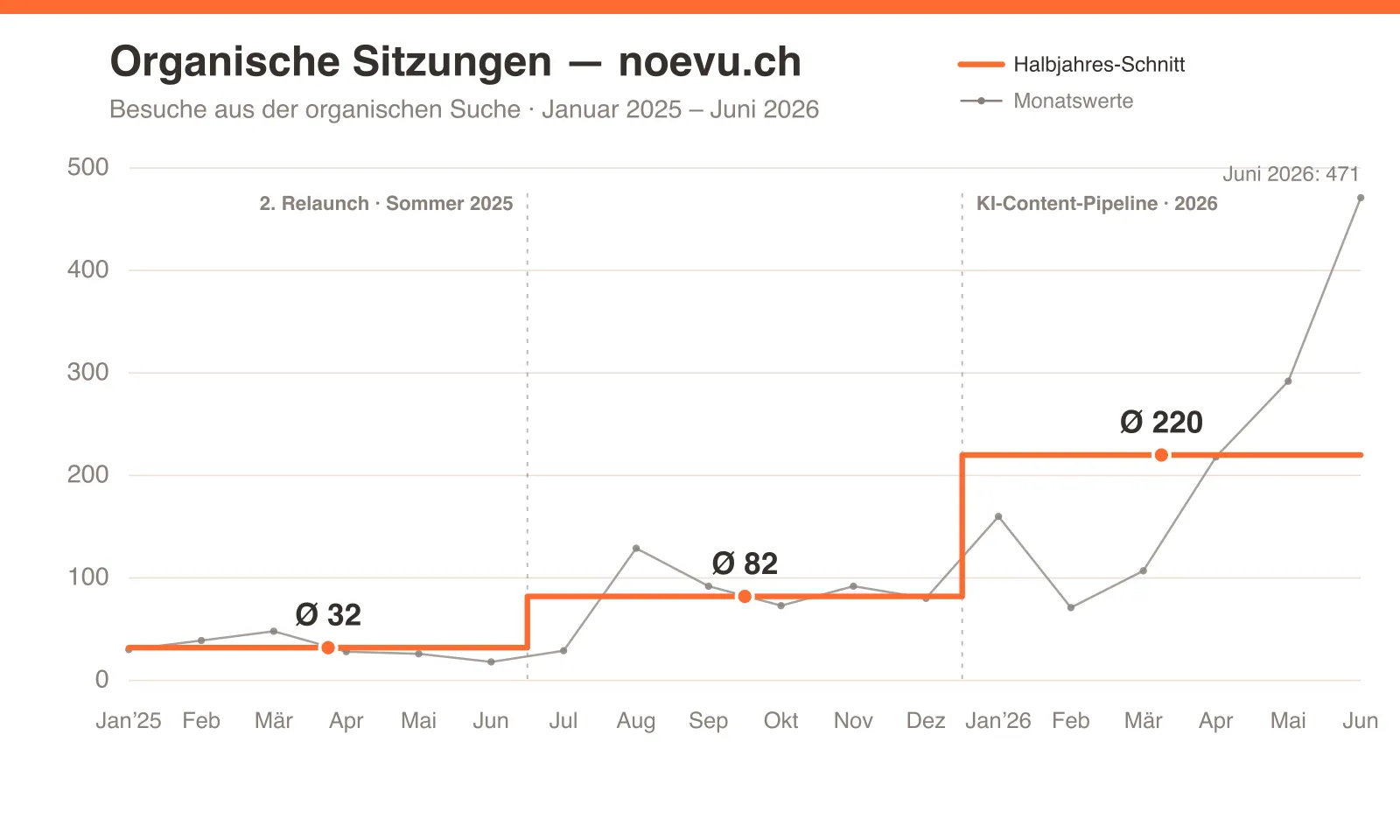
We deliberately show the organic sessions from GA4 — the «Organic Search» channel group, meaning visits from unpaid search, exactly as in the Analytics dashboard. Reach is only the first stage: it says nothing about enquiries, closings, or rankings — and for those we deliberately name no figures here that we cannot cleanly back up.
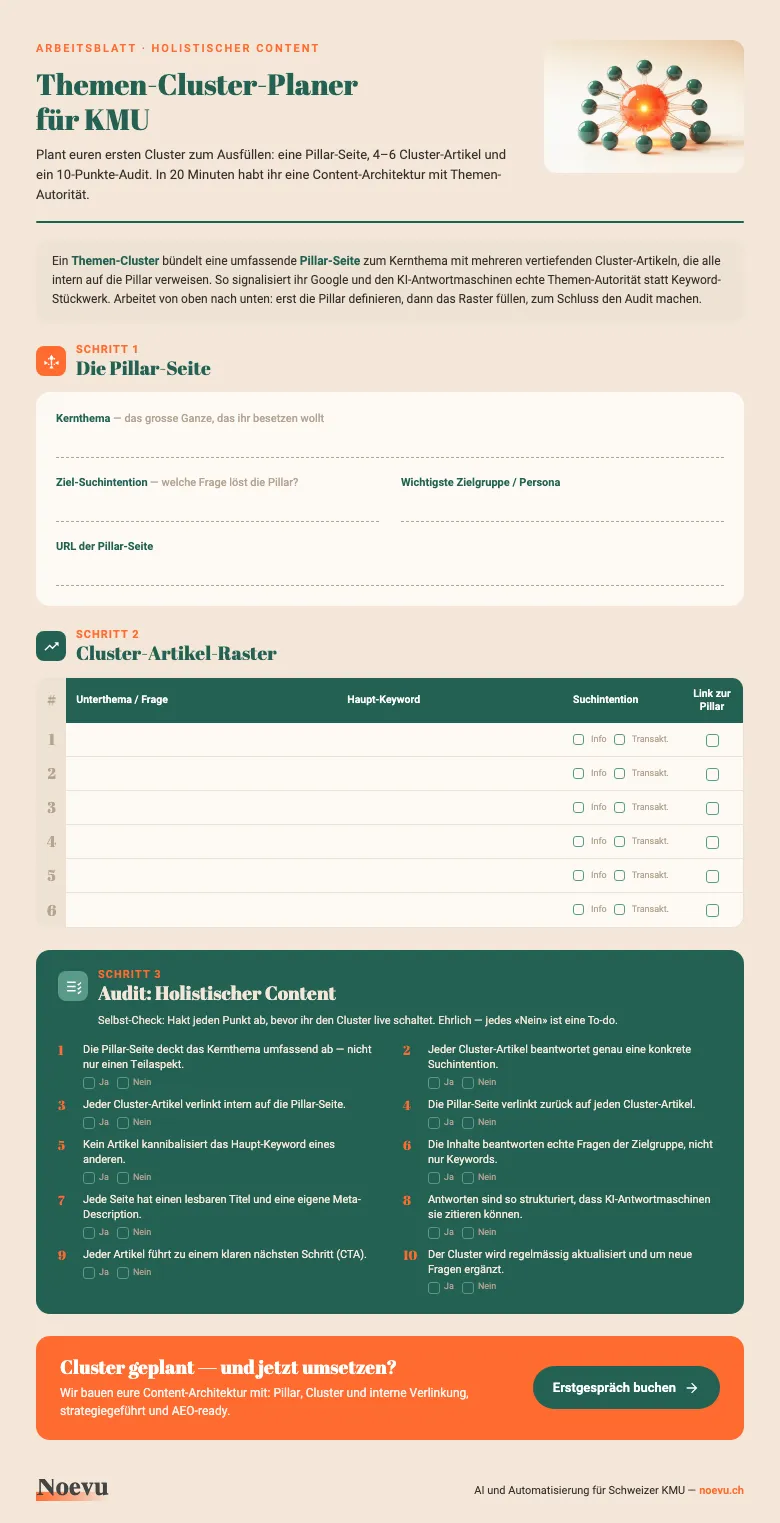
Topic cluster planner for SMEs
An A4 worksheet to fill in: define the pillar page, plan 4–6 cluster articles in the grid, and check them against the 10-point «Holistic content» audit before you go live.
Thank you. The download starts shortly.
How many clusters an SME really needs
The most common misconception runs: more topics, more visibility. The opposite holds. For most Swiss SMEs, two to four topic clusters suffice — covered completely rather than ten half-finished. Depth beats breadth, especially in a niche.
An advisory-heavy niche provider rarely needs more than three strong clusters to become visible in its field. More important than the number is the order: make one cluster viable first, then the next. Half a cluster brings less than none, because authority only emerges with complete coverage.

Start with the topic where customers most often ask you the same questions. For one week, note down every recurring question from sales conversations and emails. That list is your first cluster — the pillar page answers the big topic, each question becomes a cluster article. You invent nothing; you write down what you already explain every day.
How you start with holistic content
The entry is manageable and breaks into three stages. None of them needs a large team — it needs subject expertise and a clear plan.
1. Choose the topic
- A core topic with genuine expertise and genuine demand
- Close to your most important advisory service
- Reconciled with the sharpened positioning
- Output: the topic of your first cluster
2. Build the pillar
- A comprehensive overview page on the main topic
- Structure first, then text — the outline carries everything
- Clear, citable statements for SEO and AEO
- Output: the anchor page of the cluster
3. Fill the cluster
- Four to six articles on the individual sub-questions
- AI pipeline for research and first draft, human for the final edit
- Internal linking back to the pillar page
- Output: a viable topic cluster
Common mistakes — and how you avoid them
Holistic content rarely fails on the idea, often on the execution. Three patterns regularly cost time and impact — all of them are avoidable.
First: touching on many topics at once, covering none completely — that never builds authority. Second: publishing AI first drafts unchecked. Without an expert final edit, the substance that Google and AI systems reward is missing. Third: forgetting the internal linking. Without it the articles stay separate parts, not a cluster — and the authority never becomes visible.
How Noevu approaches holistic content
At Noevu the approach sits between two services: UX & Content Strategy plans the topic clusters, AI and Automation builds the pipeline behind them. We choose the core topic with you, design the pillar structure, and derive the cluster articles from the questions of your buyer personas.
The AI content pipeline speeds up research, outline, and first draft — the same pipeline this article came from. The final editorial check stays with a person who has subject expertise, because that is exactly what secures the substance SEO and AEO reward. What AI can speed up, it speeds up; what needs judgement stays with the human.
In first conversations the topic is usually called «more visibility» or «finally getting found». Behind it almost always sits a topic question: what should the website actually stand for? Once that question is answered, the first cluster becomes surprisingly concrete — and the rest is discipline, not magic.
Conclusion
Holistic content is the calmer but more effective choice over keyword piecemeal. It builds topic authority instead of isolated pages — and makes an SME website doubly visible in 2026: in classic search and in the AI answer engines, with a single approach.
You can see it on our own website. Since we switched from opportunistic to systematic, organic reach grew from around 30 to over 200 organic sessions per month on the half-year average — a plausible driver, not a guaranteed recipe. Anyone who wants to start small takes one topic, notes the most common customer questions, and builds the first cluster from them. The rest follows. Topical authority now pays twice: on Google and on visibility in ChatGPT and Perplexity.

Noevu picks the right core topic with you, builds the pillar page and the cluster articles, and sets up the AI content pipeline for your team.
Frequently Asked Questions
What is holistic content?
Holistic content is an approach that covers a topic completely — instead of separate articles for separate keywords. At its centre sits a thorough pillar page on the main topic, surrounded by several cluster articles on sub-questions, all linked to each other. This is how topic authority emerges: search engines and AI answer engines recognise that a website commands a topic in depth, rather than merely grazing a keyword. For an SME that means concretely: fewer, but connected pieces instead of many isolated texts.
What is the difference from classic keyword SEO?
Classic keyword SEO optimises one article for one search term each — often with no connection between them. The result is piecemeal: many pages fighting individually for a term, without any topic authority emerging. Holistic content turns the logic around. First the topic is thought through as a whole, then broken down into pillar and cluster. Keywords stay important, but they subordinate themselves to the topic. The advantage: strong topic coverage also ranks for hundreds of related queries — including ones nobody explicitly planned for.
What does AEO — answer engine optimisation — mean?
AEO stands for Answer Engine Optimization. It means visibility in AI answers: ChatGPT, Perplexity, Google AI Overviews, and similar systems answer questions directly instead of just showing links. To do so, they draw on sources that cover a topic clearly and coherently. That is exactly what holistic content delivers. Structure a topic cleanly into pillar and cluster, and you become easier for these systems to cite. AEO and SEO are therefore not opposites — the same structured content serves both.
How many content clusters does an SME need?
For most Swiss SMEs, two to four topic clusters suffice — not twenty. What counts is depth over breadth: one topic that hits your core service, covered completely, works stronger than ten half topics. We recommend starting with a single cluster around your most important advisory topic: one pillar page plus four to six cluster articles. Only once that cluster holds does the next one follow. An advisory-heavy niche provider rarely needs more than three strong clusters to become visible in its niche.
How does an SME start with holistic content?
The entry is manageable. First you choose a core topic where you hold genuine expertise and that your customers actually search for. Then the pillar page takes shape as a comprehensive overview, followed by the cluster articles on the individual sub-questions. For this we build an AI-supported content pipeline that speeds up research, structure, and first drafts — the final editorial check by a person with subject expertise stays mandatory. A sharpened positioning helps enormously, because it sets which topic you want to stand for in the first place.