
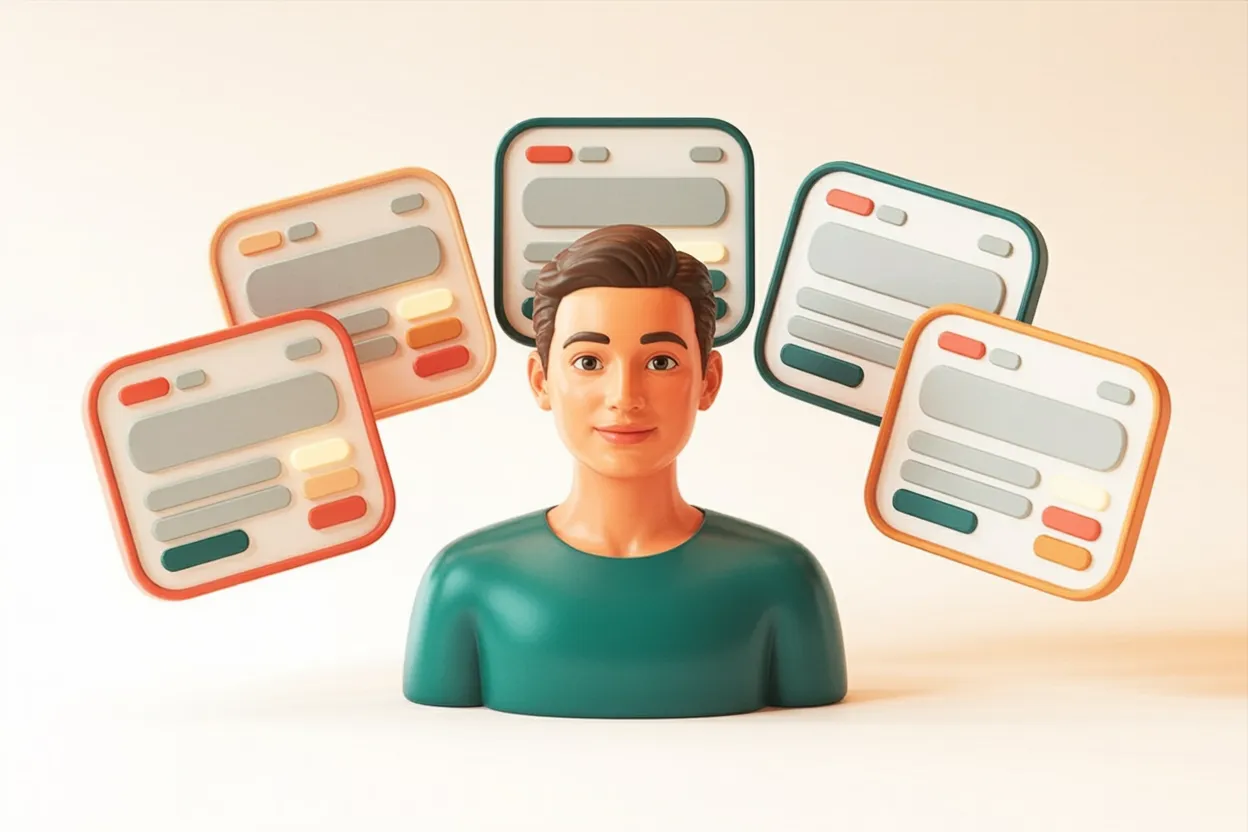
What user-centered design really means
User-centered design does not start with the company logo. It starts with one question: what do the people who land here need?
Most websites grow from the inside out. A company mirrors its own structure, so its departments, products and history. For the owners this makes sense, because they think about their business in exactly that way.
Users think differently. They arrive with a task or a problem and look for the fastest solution. When the website does not match that expectation, they leave without ever enquiring.
User-centered design reverses the viewpoint. Instead of mirroring the company, it aligns the website with the tasks of its users. The result is pages visitors understand, and pages that therefore produce more enquiries.
The UX workshop: reveal blind spots, harvest quick wins
A good project often starts with a UX workshop. Together with you, we analyse what your users truly need. This structured conversation gives a clear picture of where the website does its job and where it does not.
Two kinds of insight prove especially valuable. Blind spots are things nobody on the team saw, because you know your own site too well. Quick wins are high-impact improvements you can ship with little effort.
User needs
Blind spots
Quick wins
Match with your business

User needs and business goals rarely conflict. They simply both need a seat at the table. In the workshop we match the findings against your requirements. That builds a website that convinces users and still fits your company.
Customer journey: pain points become solutions
A customer journey usually follows the workshop. It traces the path a user takes from the first search to the final enquiry. At each step we ask one thing: where does it stall, and why?
Those stalling points are the pain points, the friction that slows visitors down or drives them away. Every pain point we identify gets a possible solution. Then we weigh together with you which solution comes first.
| Pain point | Possible solution | |
|---|---|---|
| Unclear entry | Visitors do not know where to start | A clear homepage with one next step |
| Too many options | The menu overwhelms and stalls the choice | Reduced navigation with a clear priority |
| Missing trust | An anonymous page without references or proof | References and faces where people decide |
| Awkward contact | The form asks for too much at once | A short form with few required fields |
Example pain points from typical SME projects. Your real ones come from the customer journey. As of July 2026.
Know your users well and you find these points faster. A clearly defined audience is the foundation of every good customer journey. So it pays to start by defining Buyer Personas first.
First the base version — then targeted optimisation
Not every optimisation needs to be finished at launch. Often we build a solid base version first, one that goes live and delivers real data. Those numbers beat any guess made in advance.
On that foundation we see how visitors actually use the site. Only then comes the second step: targeted improvements where they measurably work. We develop them together with you, rather than investing blind.
The wish for the perfect website often delays the launch. Plan for months and solve every detail up front, and you lose time while learning nothing. A good base version that is live beats any perfect draft in a drawer.
UX and conversion: the same foundation
Every pain point you remove lowers the friction on the path to an enquiry. Less friction means more visitors take the final step. This is exactly where user-centered design and conversion meet.
The link is direct: the better the user experience, the higher the conversion rate. A website that understands users never has to persuade anyone. It simply removes the hurdles that would otherwise cost enquiries.
Want to go deeper? You will find the details in our guide to conversion optimization for SMEs. User-centered design supplies the foundation. Conversion is then usually the outcome, not the goal.
Three signs a website misses its users
Some signals show early that a website misses its users. You do not need to be an expert, because three patterns stand out in everyday use.
High bounce rate on key pages
Unclear path to contact
Many visitors, few enquiries
Recognise yourself in one of these points? A closer look pays off. Usually a few clearly fixable causes sit behind them, and a UX workshop exposes them one by one. That is how you put user-centered design on your website to work.
Conclusion: user-centered is not a buzzword
User-centered design is not a label for gloss. It is a stance. A website works when it works for people, not just for the org chart. That is what separates a pretty page from one that brings enquiries.
The path is clear: understand users, fix pain points, improve in steps. You do not need a big budget, only the right order. Know your users' needs and you build websites that work.
The easiest way in is a conversation about your specific situation. A free UX consultation shows where your website misses its users. After that, you know which steps bring the most. The execution then sits with improving the website systematically.
Plenty of visitors, but too few enquiries? A short conversation shows where your website misses its users and where the biggest levers sit.
Frequently Asked Questions
What is user-centered design?
User-centered design aligns a website with the needs of its users. Instead of mirroring the company structure, it starts with the tasks visitors arrive with. The result is pages people understand, and pages that produce more enquiries. It treats the user's goal as the starting point, not an afterthought.
How does user-centered design differ from good design?
Good design often means aesthetics: colours, typography and a tidy layout. User-centered design asks about the task first and the look second. A page can look beautiful and still miss its users completely. Only alignment with real needs turns attractive design into design that works.
What happens in a UX workshop?
In a UX workshop we analyse your users' needs together with you. We surface blind spots, the hurdles your team no longer notices. At the same time we find quick wins you can ship with little effort. You leave with a clear list, matched against your business requirements.
How are UX and conversion connected?
Strong conversion usually follows strong user experience. When visitors understand quickly, build trust and reach out without hurdles, enquiries rise almost on their own. Every pain point you remove lowers the friction on the path to an enquiry. User-centered design is the foundation of reliable conversion.
Does an SME need user-centered design?
User-centered design pays off for an SME precisely because every budget counts. A few targeted improvements win more enquiries without buying extra traffic. You do not need a large investment, only the right order of steps. Even a single UX workshop often surfaces the most important insights.