What Bexio AI solves in everyday SME work
A common discovery in everyday SME work: Bexio does not offer an integrated batch receipt download, and Kontera's automatic receipt pull is only available on more expensive subscriptions. Instead of accepting higher costs or manual workarounds, the question becomes: can artificial intelligence help here?
The answer is yes — and this solution was built entirely with AI tools. Not a single line of code was written manually. Even this blog article was written with AI assistance.
Small tools, big impact
Small tools often have a big impact. Two Python scripts solve a typical SME problem:
Tool 1: Automatic receipt downloader
Fetches all documents from Bexio via API — no more manual clicking. An existing open source application with Microsoft technology was converted into a platform-independent script using AI in seconds, then improved.
Tool 2: Intelligent document analyzer
An AI model reads invoices and receipts, recognises the date, supplier and type, and names the files automatically in a meaningful way. The first version used Google Gemini, the current version on GitHub works with Claude.
The result:
Instead of Scan_2023_X.pdf, files are named 2023-10-12 - Swisscom - Invoice - Internet.pdf.
What areas of application are there for AI in an SME?
This example shows what artificial intelligence can do for Swiss SMEs today — no grand transformation required:
Document management
Receipts are sorted and named automatically, invoice contents and types are recognised, and everything is prepared for archiving.
Process automation
APIs connect without in-depth programming knowledge, so data is prepared automatically and files are organised and managed intelligently.
Development aid
Code is created even without technical expertise, problems are solved through AI-powered analysis, and prototypes come together fast.
Why this is relevant for Swiss SMEs
Many SMEs shy away from AI solutions because they seem too complex or too expensive. This example shows the opposite:
- Easy to implement: With the right tools, specific problems can be solved without in-depth technical knowledge.
- Cost-efficient: A script of your own can save you an extra subscription. It takes access to an AI model and some time for setup and upkeep.
- Practical: It's not about groundbreaking innovations, but about small improvements that make everyday work easier.
The AI tool stack for SMEs
The solution was built with a combination of AI assistants:
- Google AI Studio, Windsurf, Visual Studio Code with Gemini Extension and Cursor for script creation
- Dia Browser for the blog post
- Ideogram for the blog image
- Gemini CLI for analyzing the files and images
For Swiss SMEs, these tools are accessible and affordable today.

Run a home-built script on a copy of your receipts first, never directly on the archive. Check the new file names by hand, because the AI occasionally misreads a date or a supplier. Treat the access key for the Bexio API like a password: it never belongs in code you share or publish.
From problem to solution in five steps
If you are faced with a challenge as an SME, it can usually be solved with AI in five steps.
Identify problem
Where does the team lose time in everyday work? Which tasks are repetitive and error-prone?
Check AI options
Can AI help here? Are there already solutions or APIs that can be used?
Select tools
Which AI assistants fit the problem? Which ones are affordable and accessible?
Develop a solution
Create prototypes with AI help - even without in-depth programming knowledge.
Test and optimize
Adapt and improve the solution in everyday life until it works reliably.
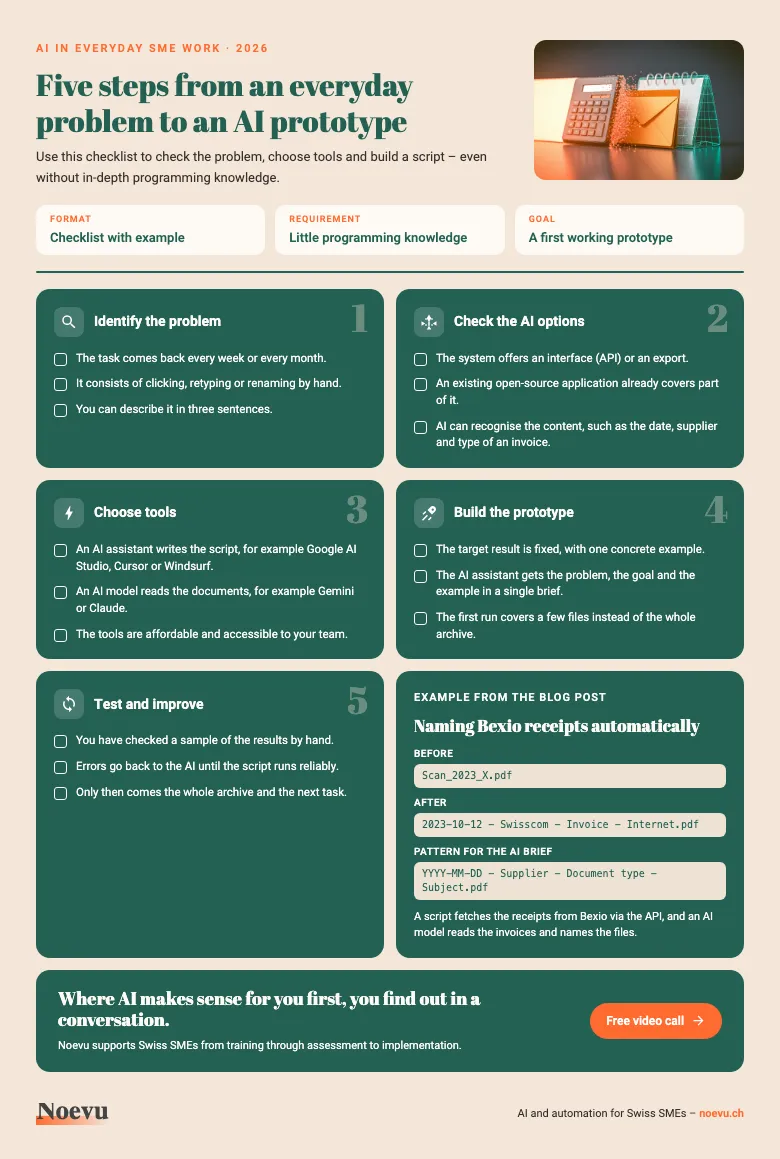
Checklist: Five steps from an everyday problem to an AI prototype
The checklist leads in five steps with three checks each from a recurring office problem to a tested script. Take the naming pattern from the Bexio example straight into your AI brief.
Thank you. Your download will start shortly.
Experience it yourself
The full project is available at github.com/Noevu/bexio-tools.
To try it out you need Python 3, a terminal, a personal Bexio access key and access to Claude Code (subscription or API key).
Download the tools, try them out, and see firsthand how useful artificial intelligence can be in your SME. Where it brings the most in your own company is what you find out with an AI strategy for SMEs.

Potential for AI in your company but no clear starting point? Noevu supports Swiss SMEs in unlocking the full value of AI — from training to potential analysis.
Frequently Asked Questions
What does AI bring beyond email?
AI connects your knowledge, automates routine work and makes processes measurably faster. Typical gains are fewer media breaks, consistent quality and shorter lead times. Offer drafts come from templates and price data, support answers point to your guidelines and meetings are minuted automatically. That lets you work with more focus and deliver more reliably.
How does an SME get started with AI in a meaningful way?
Start with a small, clear use case, such as drafting offers or a support FAQ, and set the goal, data source and success criteria (time saved, error rate). Within two to four weeks a first working version emerges, which a pilot team tests and improves in short cycles. Clear ground rules and early visible wins matter, so the team goes along with it.
How much does AI implementation cost and is it worth it?
Costs depend on scope and integration, so it pays to start small and measure the ROI against the process. Typical levers are measurably less time on routine tasks, less rework and faster response times. Calculate openly with saved hours times hourly rate, plus quality and revenue effects, and you will quickly see whether scaling up is worth it.
What data does AI need?
Use the content you already have, such as offers, emails, guidelines, product information and project documents. Organise it so it is easy to reach, set versions and clarify access rights. It does not have to be perfect, as long as the most important sources are structured and up to date. Short FAQs help as well, so the system gives priority to clear answers.
How does an SME integrate AI into the existing system?
Start without risk with side workflows such as documents or email drafts, then connect your tools through interfaces: CRM/ERP, document storage, tickets and calendar. Clear guardrails such as templates, approvals and logs give you security. Switch things on in stages: first a pilot, then the team, finally the whole area. That keeps control with you, and the effect grows step by step.
How do SMEs involve employees in the topic of AI?
Show the concrete benefit in everyday work, not the technology, and train briefly and practically with examples, templates and clear owners. A pilot team collects feedback and improves the processes, and visibly recognised successes bring the others along. What stays important: AI supports, the decisions stay with you.
What are the risks of AI?
The risks are manageable, for example wrong answers (hallucinations), data leakage or provider dependency. Verified sources, approval processes, access controls, traceable logs and hosting in Switzerland or the EU help against them. Define off-limits data, monitor usage and regularly weigh benefit against risk, and AI stays a tool instead of a risk.