

HubSpot integration: what HubSpot is — and what the competition often lacks
HubSpot is a platform that brings CRM, marketing automation, sales pipelines and customer service into one system. The Free Plan covers contact management, deals, simple email campaigns and forms without licence costs. You only pay when more complex workflows, reporting or AI features come into play.
The decisive advantage over leaner alternatives like Pipedrive or Bexio CRM is the depth of contact data. HubSpot can manage multiple email addresses per contact — the record survives employer changes, new mail domains or rebrandings. Anyone who maintains long-term B2B relationships knows the value of that detail.
HubSpot was founded in 2006 as a marketing tool and only later evolved into a full CRM. That heritage still shows: marketing features feel deliberate, sales features pragmatic, service features increasingly mature.
When HubSpot makes sense for Swiss SMEs
HubSpot unfolds its value where marketing, sales and service really have to work together — and where contact data becomes more valuable over time than the CRM itself. It's not about feature collecting, but a sober assessment of your own maturity level.
Typical situations in which HubSpot works well for SMEs:
- Marketing and sales work the same lead pool and need a shared view
- Newsletters, landing pages and forms should be maintained centrally
- Contacts survive job changes — multiple email addresses per record
- Pipeline reporting matters because sales is scaling
- AI support for service and content workflows is desired
At Noevu we use HubSpot to mirror contacts into Bexio automatically and to track email opens and conversations. The strength lies not in any single feature, but in keeping every touchpoint with a contact visible in one place.
When HubSpot is the wrong choice
Not every SME benefits from HubSpot. The platform rewards structured work and punishes half-hearted upkeep. Underestimate that and you pay for features no one uses — and block yourself when it's time to switch.
HubSpot is often the wrong choice when:
- Sales runs entirely through personal referrals — then a simple tool like Bexio CRM or even a shared spreadsheet is enough
- Accounting and contact base are tightly coupled — Bexio CRM makes more sense
- The team is fewer than five people and marketing is not its own discipline
- Sensitive data must absolutely stay in Switzerland
- Nobody is willing to treat data hygiene as an ongoing process
HubSpot is often rolled out because the Free Plan sounds attractive — and a year later you have 200 unstructured contacts, three half-finished workflows and a forecast nobody trusts. The Free Plan is good, but it does not replace a CRM strategy. Clarify who owns data maintenance before you set up.
Free, Starter, Professional: what the plans really cost
HubSpot communicates its prices remarkably transparently. The devil still lives in the detail: onboarding fees, Marketing Contacts, extra seats and hub combinations often push the real cost to double the list price. The numbers below reflect the situation in May 2026 and are based on the list-price page plus mandatory accompanying costs.
| Free | Starter | Professional | |
|---|---|---|---|
| Price per month | CHF 0 | from CHF 13/seat | from CHF 700 |
| Onboarding | none | optional | mandatory from USD 3,000 |
| Marketing automation | – | simple workflows | full |
| Lead scoring | – | – | |
| Custom reports | limited | limited | full |
| Breeze AI Agents | Limited | Limited | full |
| Suitable for | SMEs up to 20 employees | sales teams 5–15 | marketing + sales 15+ |
Prices as of May 2026, list prices without add-ons. HubSpot bills in USD, Swiss companies pay conversion costs and VAT on top.
The decisive threshold sits between Starter and Professional. Anyone who needs lead scoring, marketing automation and custom reporting cannot avoid Professional — and therefore mandatory onboarding, which depending on the provider costs between USD 3,000 and USD 15,000. That is the real investment decision, not the monthly list price.
Breeze: what the HubSpot AI agents really do in 2026
Breeze is HubSpot's AI layer — and since 2026 no longer just for marketing, but a standalone product. Three components are worth a closer look: Breeze Agents as specialised AI co-workers, Breeze Assistant as in-app helper and Breeze Studio as a tool for custom agents.
The most important agents and what they actually deliver today:
- Customer Agent — answers support requests autonomously, with around 65 percent resolution rate per HubSpot
- Content Agent — generates landing pages, blog drafts and case studies based on CRM data
- Prospecting Agent — qualifies leads and suggests outreach recommendations
- Knowledge Agent — searches the internal knowledge base and returns answers with source attribution
- Breeze Studio — configure custom agents without writing code
Since April 2026, Customer and Prospecting Agent run on a pay-per-result model: USD 0.50 per autonomously resolved conversation, USD 1 per recommended lead. The model is honest — customers only pay for measurable outcomes. In practice, Breeze works well for standardised tasks. Once requests become nuanced or brand voice matters, human polish remains mandatory.
The most important HubSpot integrations for Swiss SMEs
The biggest leverage is not in HubSpot itself but in how it talks to the rest of the tooling. A native Bexio integration does not exist — Swiss SMEs need intermediaries like Zapier, Make or self-hosted n8n to set up data flow cleanly.
Integrations with the highest impact
- Bexio — sync contacts automatically, deal stage → invoice
- Google Workspace — mail, calendar and Drive directly in CRM context
- Microsoft 365 — Outlook mail tracking and Teams notifications
- Slack — escalations from pipeline events into the team channel
- Cal.com or Calendly — bookings create contacts automatically
- WordPress or Astro — forms and tracking pixels without plugin sprawl

Start with a single integration — Bexio or Google Workspace — and automate exactly one process. Once that runs, the next one is up. Anyone setting up ten integrations at once builds ten failure sources that no one maintains.
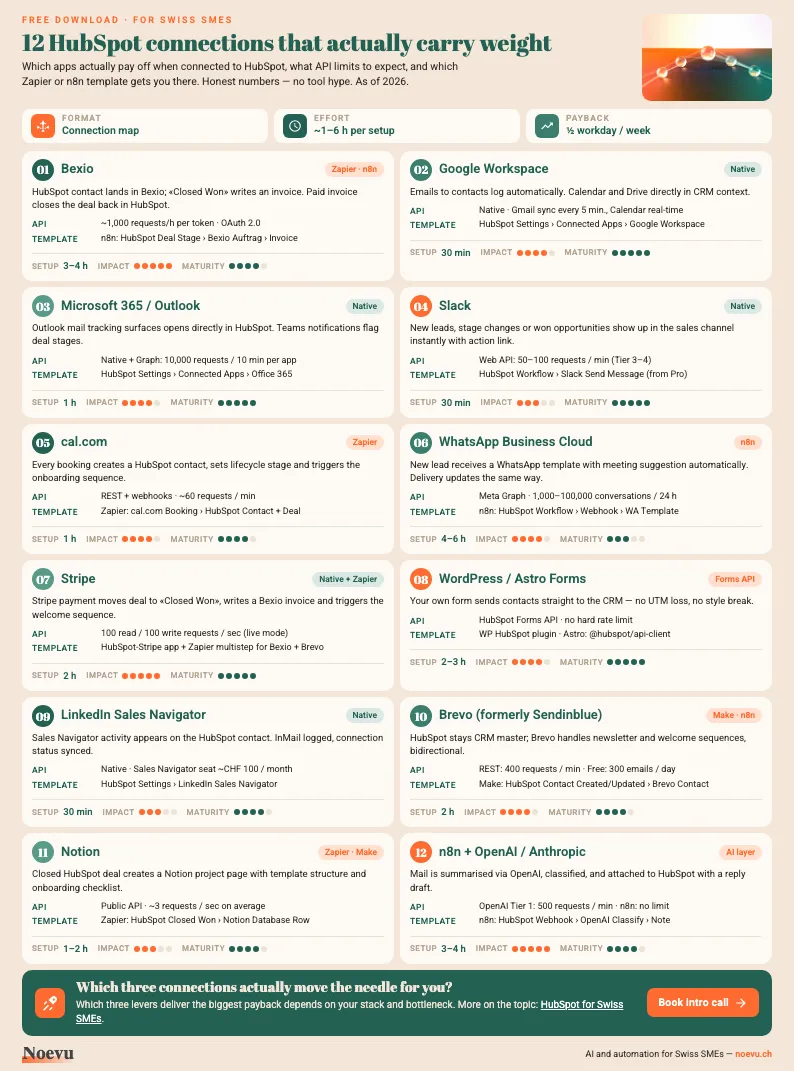
Which twelve integrations are worth the effort for Swiss SMEs in detail, which API limits apply and which Zapier or n8n templates are ready, is compiled in a compact checklist that is in preparation — more on that below.
What HubSpot changes for user experience and conversions
HubSpot affects not only the back office but also what visitors experience on your website. Forms, pop-ups, live chat and tracking pixels are three clicks away — and that is exactly where the risk begins. Use the tool uncritically and you build websites that feel like sales funnels and dilute the brand.
Three design decisions deserve special attention. First: HubSpot forms ship with their own CSS that often clashes with the design system. Clean integration requires either a custom form layout via the HubSpot API or consistent styling overrides — part of an honest AI automation for SMEs that does not stop at the design layer. Second: tracking pixels and cookie banners must be aligned, otherwise data collection collides with the consent model. Third: AI chat widgets often look generic — they need adjustment to the brand voice, otherwise they sound like any other bot.
Conversion-relevant is not the quantity of HubSpot features on a page, but their restraint. A single, context-sensitive form beats four pop-ups any day. More on that in the article on landing pages that really convert.
HubSpot and SEO — what really matters
HubSpot ships its own SEO tools — keyword suggestions, on-page recommendations, internal link structure analyses. For many SMEs these features are a good entry point but do not replace serious SEO work. Anyone betting on the HubSpot CMS lives with a technical handbrake: Core Web Vitals are solid but not outstanding, and the editor rarely allows the depth needed for AI search visibility.
Three points are decisive from an SEO perspective. HubSpot blog URLs can be structured but not freely — anyone running an Astro or headless website gains significantly more leeway. Schema.org markup for FAQ, HowTo and Article is partly generated automatically by HubSpot, but not granular enough for AI citations. And JavaScript-heavy blocks often cannot be switched off, which extends render time unnecessarily.
For most SMEs the honest recommendation is: HubSpot for CRM and marketing automation, but website and blog on an SEO-optimised platform like Astro or a headless CMS. That keeps the brand fast, indexable and AI-visible — without giving up the CRM strengths.
Connected AI: will HubSpot soon be obsolete?
The question sounds provocative but deserves to be taken seriously in 2026. With Connected AI — ChatGPT, Claude and Gemini accessing Bexio, Google Workspace, your own knowledge base and Slack directly via Model Context Protocol — the question shifts. It is no longer “which CRM” but “which data base and which interface”.
HubSpot remains strong for structured contact management and marketing workflows. But the daily work flow increasingly moves into the AI front end: research a lead, draft a mail, suggest a meeting, save a note — all in the chat interface that taps into the CRM. Anyone investing today should see HubSpot as a robust data base, not as the primary surface.
For our own processes we are increasingly building custom tools — for example the noevu-crm for offers — and dock HubSpot in as a data base. The argument for a custom system is not “better” but “a precise fit for our process, without seat inflation”.
Which CRM strategy fits your SME
The CRM choice is rarely a tool decision. It is a question of maturity: how structured is sales today? How many people maintain data? Which systems need to be connected? How important will AI integration become over the next 24 months?
For most Swiss SMEs the three sensible paths look like this:
- Path 1 — Bexio CRM for pure accounting proximity, up to ~500 contacts, no marketing automation
- Path 2 — HubSpot Free or Starter for light marketing–sales coupling with a clear owner structure
- Path 3 — Custom system with HubSpot as data base and AI front end for proprietary workflows
Anyone seriously considering Path 3 should understand in parallel how Bexio connects with AI tools — the article on Bexio tools with AI for Swiss SMEs shows the concrete workflows. Anyone still early in the decision finds the broader context in the overview of AI tools for Swiss SMEs.
Lead magnet: 12 HubSpot integrations for Swiss SMEs
Anyone who wants to use the HubSpot integration lever concretely needs a curated list of connections that actually work in Swiss SMEs — not the full Zapier directory with 6,000 apps. The compact A4 template “12 HubSpot connections for Swiss SMEs” puts it all on one page.
12 HubSpot connections for Swiss SMEs
An A4 template covering the twelve most impactful connections — Bexio, Google Workspace, Microsoft 365, Slack, cal.com, WhatsApp, Stripe and more. Per connection: API limits, ready Zapier or n8n template, setup effort and an honest impact rating.
Thank you. Your download will start shortly.
Conclusion
HubSpot remains one of the strongest CRM systems for Swiss SMEs in 2026 — robust, well documented, with a mature AI layer. The strength lies not in any single feature, but in the depth of contact data and the coupling of marketing, sales and service. The Free Plan lasts a long time, the jump to Professional is the real investment decision.
At the same time, Connected AI shifts the question. Anyone investing in HubSpot today should think of it as a data base, not as the final solution. The next CRM generation runs in the AI interface — HubSpot behind it, well maintained and cleanly connected.

Whether HubSpot, Bexio CRM or a tailored setup fits your company is best clarified in a short conversation — without sales pressure.
Frequently Asked Questions
What does HubSpot really cost for a Swiss SME?
The Free Plan is free and covers a lot of SMEs for a long time. Starter begins at around CHF 13 per month and seat. Professional starts around CHF 700 per month — plus mandatory onboarding from USD 3,000. Enterprise sits at USD 3,600 per month and up. The real investment is not the plan itself, but onboarding, seats and add-ons like Marketing Contacts or Custom Reports.
Is the HubSpot Free Plan enough?
For many Swiss SMEs with fewer than 20 employees: yes. Free covers contact management, deal pipelines, email sending, simple forms and meeting bookings. As soon as marketing automation, lead scoring or custom reporting are needed, the road leads to Professional. Until then, there is no reason to pay.
How does HubSpot connect with Bexio?
The most robust route runs through Zapier or Make: new HubSpot contacts are created in Bexio automatically, deal-stage changes trigger invoices. For more complex integrations, n8n on Swiss hosting is worth the effort — see n8n in practice. A native HubSpot–Bexio integration does not exist.
Is HubSpot revDSG- and nFADP-compliant?
In principle yes, but with caveats. HubSpot is primarily US-cloud-based. EU data residency requires the matching add-on, which is not included in every plan. The data processing agreement must be requested actively. Anyone handling sensitive data should clarify the configuration with a privacy professional before going live.
What do Breeze AI Agents actually deliver?
According to HubSpot, the Customer Agent autonomously resolves an average of 65 percent of support conversations. The Content Agent generates landing pages and blog drafts based on CRM data. In practice this works well for standardised tasks — nuanced requests still need human polish. Since April 2026, Customer and Prospecting Agent run on a pay-per-result model.
Should we switch to Pipedrive or Bexio CRM instead?
Pipedrive is leaner and cheaper, suited to pure sales teams. Bexio CRM makes sense when accounting and CRM are tightly coupled and the contact count stays manageable. HubSpot pays off when marketing, sales and service should run in one system and the contact base becomes more valuable over time than the CRM itself.