In finance the best-looking presence loses to the one that can prove itself. Whoever is trusted with money has to show where the data sits, who gets verified and what happens in the bad case. That is what these platforms are built for.

Websites for financial services that prove trust
Regulated web design for asset management, fiduciaries & crypto mandates
No projects published in this industry yet.
What makes a dependable finance website
Finance websites rarely fail on design. They fail because the questions a client asks before signing are not answered on the page: who owns my assets if something goes wrong? Where are my ID documents stored? Who sees my numbers? What exactly does this cost, and on what basis?
Three traits separate the dependable from the pretty: ownership and custody are named explicitly rather than paraphrased, fees are shown in full — including the ones that go to third parties — and identity verification is part of the presence, not an appendix after sign-up.
Which pages a finance presence needs
The minimum: home with the model in three sentences, services or investment model with the allocation disclosed, security covering custody, data location and encryption, process from inquiry to access, legal documents with version stamps, and contact with direct booking. Everything else follows from the business model.
Client portal: the point where the status calls stop
Once mandates run, the same question keeps coming: "How are we doing?" A portal answers it without a call — holdings, performance, capital flow and monthly statements that are frozen once instead of recalculated on every visit. Access to custody data stays read-only: the platform displays, it does not trade.
AML onboarding
Verification is not a formality at the end, it is the condition for everything else. The clean order is application, review, access — no half-registered state in between. That constraint makes the presence stronger: stating openly that nobody gets in unchecked also says something about your diligence.
Keeping data in Switzerland
ID documents, source-of-funds evidence and bank details are highly sensitive. For many mandates a Swiss server location is not marketing but a condition — backups included. Anyone serious about it also checks whose jurisdiction reaches the provider.
7 levers for a finance presence that wins mandates
What makes the difference on sites for asset managers, fiduciaries and crypto mandates:
- Settle ownership in one sentence: Who owns the assets, where they sit, who has access. One sentence, high up, no hedging. It is the first question any serious prospect has — and the most avoided on finance sites.
- Disclose fees in full, including third-party ones: Your own share, exchange fees, network costs: all on one page. Showing only your margin looks dishonest at the first statement.
- Show verification as part of the promise: AML identity checks belong visibly in the process, not in a footnote. They cost sign-ups and win mandates.
- Name risk in the client's language: Loss potential, volatility, lock-up periods — plainly, where they apply. A risk page nobody reads meets the duty, not the purpose.
- Portal instead of status calls: A client area with value, allocation and monthly statement cuts inquiries and makes operations scale without extra headcount.
- Legal documents with versions and consent records: Which version was accepted when has to be traceable. A PDF without a version stamp is worthless in a dispute.
- Booking instead of a contact form: In finance the mandate starts in conversation. A directly bookable slot shortens the path there to one click.
What does a finance website cost in Switzerland?
A marketing presence for asset management or fiduciary services starts at CHF 5,500 — including concept workshop, custom design, legal pages, SEO foundation and CMS training.
Typical ranges:
- Presence without a client area (6–10 pages, legal texts, booking): from CHF 5,500
- Presence with an AML onboarding route: from CHF 11,000
- Platform with client portal, custody connection and reports: from CHF 16,000
Third-party running costs — verification service, Swiss hosting, custody connection — run directly through your accounts, not through a markup. Binding fixed price before the project starts.
Swiss financial centre — regional focus
Zurich
Private banks, independent asset management, insurers. The densest competition in the country, German first, English for international mandates. Differentiation comes from specialisation, not breadth.
Zug
Holdings, crypto and blockchain firms, international structures. English is not a secondary language here, it is the first. Questions about custody and supervision arrive early and in detail.
Geneva and Lausanne
Private banking, commodity trading, international organisations. French and English are mandatory. Expect restrained imagery and a presence that shows discretion through omission rather than claiming it.
Basel and Bern
Fiduciary services, pensions, pension funds, federal-adjacent structures. German first, French for cross-regional mandates. Traceable processes and document management weigh more than visual effects.
Lugano
Cross-border wealth business, Italian-speaking clientele. Italian first, German and English alongside. Clarity on tax and reporting topics is a selection criterion.
Thun, Lucerne and the regions
Smaller asset managers and fiduciary offices with personal clientele. Local ties carry weight here — but only together with a presence that feels institutional when money is the subject.
What a Swiss finance presence has to cover
Anti-Money Laundering Act (AMLA)
Financial intermediaries must identify every contracting party and establish the beneficial owner before a business relationship starts. For the website that means: the path to access runs through a review — and you may show that openly.
Supervision and self-regulation
Depending on the activity, either FINMA authorisation or membership of a self-regulatory organisation such as VQF comes first. Whatever applies belongs on the page, precisely. A vague hint of supervision is worse than a clear description of the actual status.
No investment advice without the matching licence
Where mandates are executed only and no individual recommendations are given, the site has to say so explicitly. Otherwise it creates an expectation with no legal cover. Likewise: no return guarantees, no capital-preservation promises.
Data protection under the revised FADP
ID copies, source-of-funds evidence and bank details are highly sensitive. Encrypted storage, documented retention periods, access and deletion processes belong in the privacy statement — and in the technology behind it, not only in the text.
Server location and foreign jurisdiction
A Swiss data centre is not enough if the provider is subject to a foreign access regime. Anyone promising Swiss data residency checks the operator, the group structure and the backup targets — otherwise the promise is just a dot on a map.
Common mistakes on finance websites
Recurring patterns from reviews of Swiss finance sites:
- Claiming trust instead of proving it: "Secure", "reputable", "discreet" — worthless as adjectives. It becomes provable through custody, server location, verification procedure and open fees.
- Showing fees only partly: Your own share is there, exchange and network costs are not. The first statement corrects that — at the cost of trust.
- Offering an instant account without verification: A sign-up button leading straight into a client area contradicts the verification duty. Order: application, review, access.
- Risk notice as a footnote: The notice belongs where the expectation forms — next to the return figure, not in grey at the bottom of the page.
- Legal documents without version stamps: Terms, mandate contract and risk disclosure without a version number cannot later be matched to a consent.
- Portal figures without a caveat: Values from a custody connection are snapshots. Without an "indicative" marker they create a commitment nobody can honour.
More reading on platforms and trust




Book your free consultation:
Vielen Dank! Wir melden uns in Kürze.
Common questions about web design for financial services
What belongs on an asset manager's website?
The model in three sentences, the allocation disclosed, a dedicated page on custody and data location, the process from inquiry to access, the legal documents with version stamps and direct booking. Six building blocks; everything beyond that follows the business model.
Is a client portal necessary — or is a presence enough?
While mandates can be counted on one hand, a presence is enough. Once "how are we doing?" arrives regularly, every answer costs unbilled time. A portal with value, allocation and monthly statement replaces those calls.
How does AML identity verification work online?
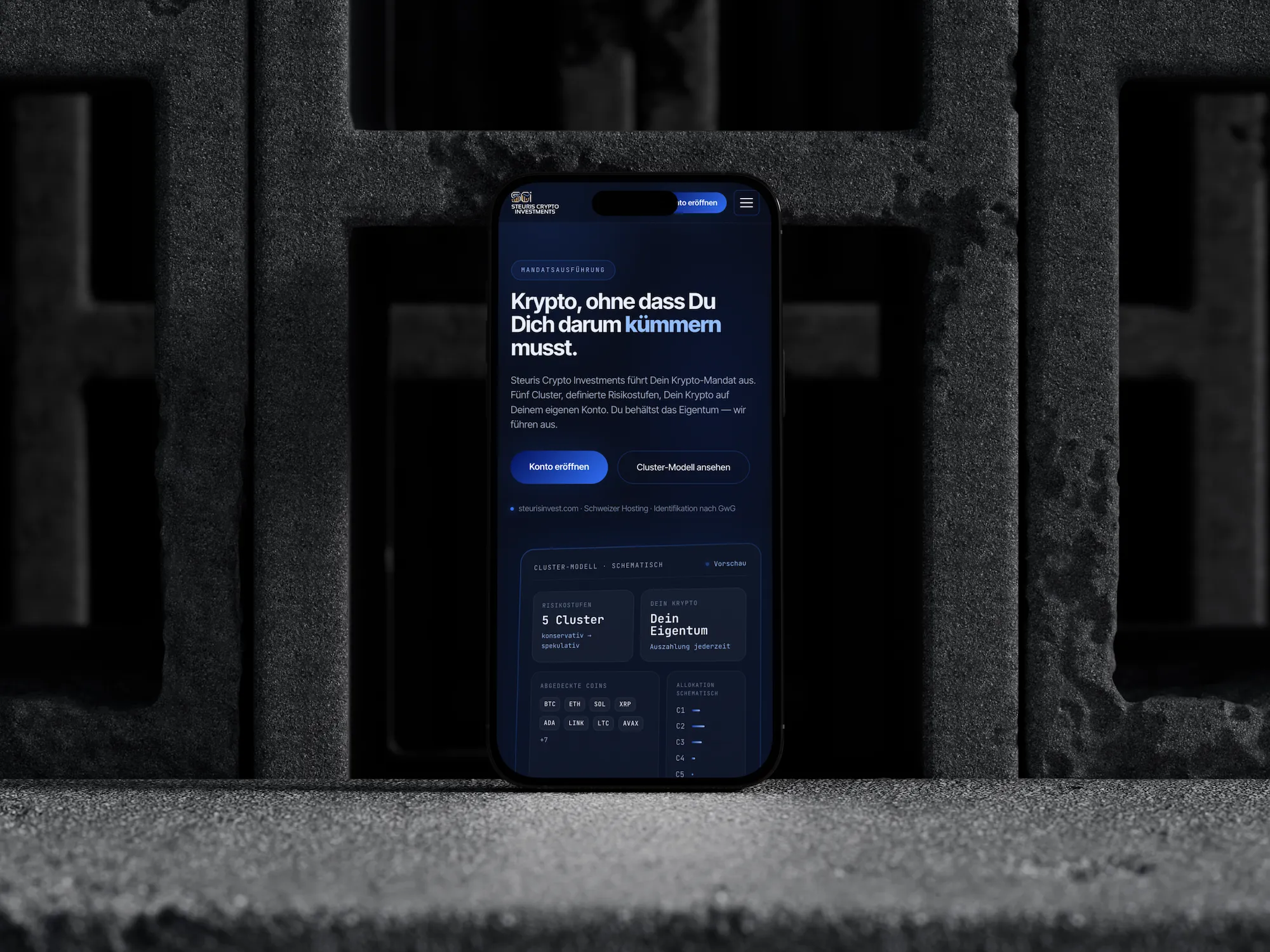
Through a route that collects personal data, an ID document, a liveness check and the source of funds, then goes to review. Access is granted only after the review. It can be run manually or connected to a Swiss verification service — the platform shows both in the same flow. One example: the Steuris Crypto Investments platform.
Does the data have to stay in Switzerland?
For many mandates yes — and then not only the application but the backups too. What matters is not the data centre location alone but whose jurisdiction reaches the operator. That belongs checked before choosing a provider, not after.
May a website show returns?
Past figures yes, with period, source and the note that they say nothing about the future. Promises of future returns or capital preservation are not permitted. Anyone executing mandates without advising has to state that explicitly.
What does a website for financial services cost?
A presence without a client area from CHF 5,500, with an AML onboarding route from CHF 11,000, a platform with portal and custody connection from CHF 16,000. Running costs for verification, hosting and connections go directly through your accounts. Binding fixed price before the project starts.
How long does such a project take?
A presence without a client area takes six to ten weeks. A platform with onboarding, portal and reports needs three to five months — most of it not on design but on review paths, legal documents and connecting existing systems.
How long does it take from briefing to launch?
Typical Swiss SME projects go live in 6-12 weeks. Workshop and concept (2-3 weeks), design prototyping (2-3 weeks), implementation and content (2-4 weeks), QA and launch (1-2 weeks). Larger projects with multilingual scope, shop or government integration need 3-6 months. You receive a binding roadmap with milestones before start.
Can I edit the website myself after launch?
Yes. By default Noevu ships a website you can maintain yourself — usually on Squarespace (drag-and-drop) or a Headless CMS with visual editor (Sanity Studio, Payload, Strapi). At launch you receive video training and a written guide. If you would rather not invest time, Noevu can maintain the site under a service plan.
What happens after go-live? Maintenance, hosting, support?
Noevu offers a service plan from CHF 90/month — includes hosting (Vercel + Cloudflare CDN), automatic backups, security updates, performance monitoring and 2 support hours monthly. Without a plan the site keeps running — you keep full access and can switch providers any time (no vendor lock-in).
Does Noevu translate the website into multiple languages?
Yes. Multilingual sites in DE/FR/IT/EN (also PT, ES, AR, TR on request) are part of the standard repertoire. We use structured translation workflows with correct hreflang tags, locale-specific imagery and clean SEO per language. Translations can be done by your team or by Noevu via professional translators.
Who owns the website, code and content?
You do. Fully. Noevu delivers code, design files and content for unrestricted reuse — no licensing model, no "platform lock-in". If you ever switch agencies, everything goes with you. Hosting, domain and CMS accounts are in your name. This promise is part of every quote.