

What a buyer persona is — and what it is not
A buyer persona is the fictional but data-based description of a concrete customer. It has a name, a job, goals, pain points, media use and ideally a typical quote. The point is not the document itself but a shift in perspective: marketing, design and product decisions are no longer tested against an anonymous gut feeling but against a recognisable human being.
In most marketing blogs, the persona shows up as an Excel profile sheet with ten fields. But that sheet is only the artefact — the value emerges in the hour when a managing director has to call their own customer for the first time and realises they don't know them as well as they thought. That insight changes decisions — the profile sheet alone does not.
A persona that has impact in daily work is three things at once: a research tool, a decision tool and a shared mental model in the team. If one of those is missing, it becomes decoration.
At Noevu, personas are built together with clients in a workshop — not in a template. Many small Swiss SMEs lack clean data: no analytics maturity, no complete CRM, sometimes not even a systematic customer list. That is not a blocker but the starting point. The mere exercise of consistently putting yourselves in your customers' shoes surfaces hypotheses that can later be tested and sharpened against reality.
When personas pay off for an SME — and when they don't
Personas are not useful for every company. With five employees, a clear niche and daily customer contact, owners know their customers personally — a written persona adds little additional insight there. But as soon as several people make marketing, sales or product decisions without all of them having the same customer conversations, the method pays off.
Four recurring triggers have emerged from consulting Swiss SMEs.
When personas pay off
When a persona is effort without payoff
In most cases on the left side, customer knowledge is already there — distributed across the team, in the owner's head, in individual emails. The persona is then the tool that makes this knowledge visible, testable and shareable. During a generational handover or a larger relaunch, the exercise is both stocktaking and realignment — the knowledge is gathered anew, not just consolidated. If you're unsure whether your SME is at the right maturity level, an honest assessment of your digital presence often delivers a quicker answer than a persona workshop itself.
Persona, target group, ICP and Jobs-to-be-Done — what's the difference?
Four terms come up in practice that are often used interchangeably but serve different purposes. Separating them cleanly avoids the most common misunderstanding: that a single method answers all marketing, sales and product questions.
| Answers | Form | When useful | |
|---|---|---|---|
| Target group | Who buys, statistically? | Demographic description of a set | Media planning, reach, ad budget allocation |
| Persona | How does the typical customer think? | Concrete fictional person with name, quote, behaviour | Tone of voice, copy, UX decisions on the website |
| ICP (Ideal Customer Profile) | Which company is the best fit for us? | Company profile: industry, size, budget, triggers | B2B sales, lead qualification, sales focus |
| Jobs-to-be-Done | What job is the customer hiring our product for? | Task description with context and counterforce | Feature decisions, product development, innovation |
The methods complement each other, they do not replace one another. A typical Swiss SME first needs a clean target group (for media planning), then a persona (for tone of voice and website), and with a clear B2B focus also an ICP (for sales). Jobs-to-be-Done is the most useful addition when features have to be prioritised — for example in a product or service roadmap.
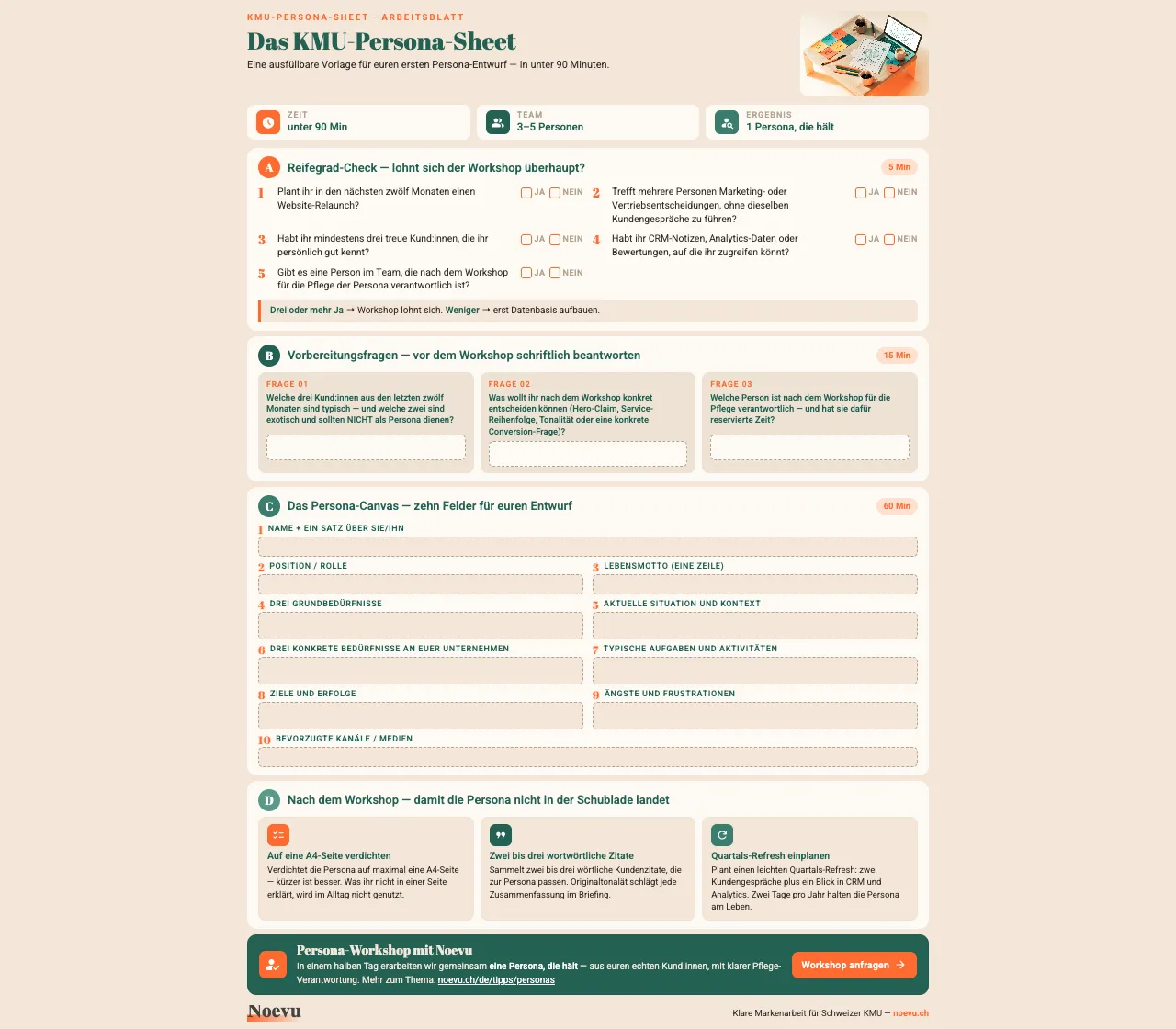
The SME persona sheet to fill in
The compact A4 template for a first persona draft in under 90 minutes — with ten clearly structured fields, preparation questions for customer interviews and an honest maturity check on whether you actually need personas yet. No corporate workshop, no buzzwords.
Thank you. Your download will start shortly.
What needs to be clear before the workshop
A persona workshop without preparation produces what most SMEs end up with in a drawer: a plausible but generic profile. The line between useful and arbitrary lies largely in the preparation — and a second time in the disciplined translation afterwards. Investing one evening in the following questions saves two hours of warm-up in the workshop and avoids the usual loop towards interchangeable mission statements.
Six questions before the workshop

The most valuable persona preparation costs nothing: call three of your most loyal customers and ask why they stay with you. Note the answers verbatim. Those sentences are often closer to a usable persona than any template — they show the language of your customers, not the language of your marketing.
How Noevu builds personas in a UX workshop
The corporate version of a persona process takes three days, involves twenty stakeholders and ends in a twelve-page document. For a Swiss SME with twelve employees, that is simply disproportionate. Noevu therefore uses a compact variant that deliberately limits stakeholders to three to five, finishes within half a day, and makes the result directly usable on the website — instead of for a report.
The typical flow has four steps. First, a preparation call with management, in which the six guiding questions from the previous section are clarified. Second — where possible — two or three short customer conversations conducted by the SME itself, with notes for the workshop. Third, a two- to three-hour workshop with three to five people from the team, in which a concrete persona is condensed from data plus empathy-map quadrants (says, thinks, does, feels). Fourth, the translation into hero claim, navigation, copy and CTA labels — the actual design step that takes two to four weeks separately.
The recurring aha moment often happens in the first hour: when the team reads a concrete customer quote for the first time and realises that their own website does not speak to that quote. From this moment, the best decisions emerge — not from the demographic description.

The method is always the same — the results depend on maturity and data. Three recent examples from Noevu's practice make this concrete. At a Zurich-based security service provider focused on events, the workshop produced three clearly different personas: an event manager in her mid-30s focused on reliability, a production lead who needs crowd management and quick response above all, and a young security professional looking for flexibility and training. From these three persona profiles the website navigation was structured directly — Security Services, Event Services, Academy.
At a Swiss compensation office — a context with a complex public-sector customer journey — three personas and the matching customer journey map were condensed in the workshop together with the internal team. The insight was uncomfortable: the existing website did not answer the very question every persona asks first — "Am I in the right place, and what concretely do I have to do?" At an SME in the lighting expertise space, the data was too thin for solid personas. The workshop produced clearly marked hypothesis profiles with explicit provisional status; they were tested against real enquiries during the first six months after launch and only then condensed into personas.
In all three cases, the workshop alone delivered only half the impact. Preparation and the disciplined translation of the persona insights into hero claim, navigation and copy made the difference — complemented by coming back six months later to test the hypotheses.
The hardest part is not creating the persona, but giving up old assumptions afterwards. Teams cling to statements like "our customers want premium" — even when the interviews show they actually want reliability. A good workshop therefore does not end with the persona, but with a list of old phrasings that have to go. Otherwise the new persona stands next to the old copy — and never becomes visible.
What personas mean for web design and UX
Most persona articles end with the description of the persona. In practice, that is the beginning, not the result. A persona that has value directly influences four areas of the website — and is measurably effective there, not in a PDF.
A good persona shows up concretely in the hero section, navigation, about-us page and CTAs.
Hero section
- Claim addresses the persona's main problem, not your own offering
- Subline shows the how: what is solved differently than at competitors
- First CTA refers to the promise, not to the purchase
Navigation
- Order follows the persona's decision path, not the org chart
- Labels use the persona's language, not internal vocabulary
- The most important information is reachable in two clicks
About us
- Story starts with a problem of the persona, not with the founding year
- Photos show the team at work, not in stiff portraits
- Quotes from the team speak directly to the persona's pain points
CTAs
- Labels match the persona's appetite for risk — consultation rather than purchase
- An invitation to clarify, no sales pressure
- Next step matches the persona's stage in the decision process
Whoever makes the jump from persona to web decisions cleanly ends up with a website that does not sound like every other one. Skip that jump and you have a beautiful persona slide and an interchangeable website. A complementary exercise is Simon Sinek's Golden Circle — a compact method to articulate the why behind persona needs. More on that in Simon Sinek's Golden Circle: what's actually useful for your brand.
What personas mean for SEO and AI search
At first glance, personas and search engine optimisation have nothing to do with each other: empathy on one side, keywords and load time on the other. The connection runs directly nonetheless — through content that emerges from real experience with the persona.
Google has been weighting the acronym E-E-A-T for years: Experience, Expertise, Authoritativeness, Trustworthiness. Translated, this means: content has to come from lived experience, not from generic copy blocks. A website whose team actively uses the persona in briefing and writing almost inevitably formulates around the real questions, in the real language, with the real examples of its customers. That is rewarded — more directly than any keyword research.
With AI-generated search results — AI Overviews, ChatGPT and Perplexity answers — this dynamic intensifies in 2026. AI answers cite sources more often that stand out from interchangeable copy: concrete examples, local references, a recognisable voice. Interchangeable content disappears into the summary "various providers offer similar services". Anyone writing from a clearly defined persona perspective is, by contrast, cited, linked and recognised as a source.
Text generated by a language model sounds, on average, like a thousand similar texts. Personas help leave that middle behind — they force concrete examples, local references and a recognisable voice. That is exactly what both Google's E-E-A-T signals and AI summaries reward.
Common mistakes — and how to avoid them
The following mistakes show up in persona projects so regularly that they can be addressed up front. They share one thing: they do not lie in the method itself, but in how it is handled — and that means they can be avoided reliably.
The most common mistake is the persona without a data base. It is "invented" in a workshop on the basis of gut feeling and assumptions, instead of being derived from customer conversations. The result feels plausible but does not describe the real customer base. The second mistake is persona inflation: five, seven or ten personas, because the team does not want to say no to anyone. In the end, none of them is referenced in daily work. Third — and perhaps the most expensive — the persona as a marketing island: it is created by marketing and never reaches sales, support or product development. Personas only unfold their full impact across departments.
The most expensive variant: inventing the persona in a workshop without ever having held a single customer conversation. The second most expensive: creating five personas instead of one. The slowly most expensive: not updating the persona after six months — and still quoting it in briefings.
Personas with AI in 2026: what works — and what burns money
AI tools promise personas in minutes — ChatGPT, HubSpot Make-My-Persona, Delve.ai, 121WATT. The 2026 market is full of vendors positioning "synthetic personas" as a substitute for research. Current research — among others from ACM and Springer — sees this far more critically and talks about the "synthetic persona fallacy".
The finding is clear: AI-generated personas reflect the training corpus of the models, not the real audience of a Swiss trades SME. The training corpus is predominantly English-language, urban, tech-affine. A Bernese trust office or a Valais family business is missing from it. Anyone adopting an AI persona without scrutiny optimises their website for an audience they don't even have — copy, hero message and service order then aim past the real audience.
AI remains useful as a tool in three clearly bounded roles: first, as a structural aid after real interviews — summarising notes, clustering themes, ordering quotes. Second, as a hypothesis generator before research — formulating assumptions that are then tested in interviews. Third, as a stress test for existing personas — "which assumption in this persona could be wrong?". In all three roles, AI complements human research. It does not replace it.
Persona upkeep: keeping the document alive
In consulting practice, we often see the same pattern: a large share of all personas is no longer referenced in daily work after six months. They don't die because they were bad — they die because no one is responsible for keeping them alive. An outdated persona is more dangerous than none at all: it suggests customer knowledge that no longer holds.
The pragmatic way out is a light quarterly refresh. One person from the team — ideally not from marketing alone — runs two short customer conversations once a quarter, checks CRM and analytics data for anomalies, and adjusts one or two fields of the persona. Once a year a larger review follows: is the persona as a whole still right? Has a new segment shifted enough to justify a second persona? This routine costs about two days of work per year — and reliably prevents the drawer fate.
Conclusion
Buyer personas are neither a marketing salvation nor an outdated concept. They are a sober tool that achieves a lot in the right situation — and creates effort without payoff in the wrong one. The difference rarely lies in the method, almost always in preparation, data base and later upkeep.
For Swiss SMEs, the honest answer is usually: one persona, data-based, condensed in a workshop, consistently referenced in daily work — and updated once a quarter. AI is a welcome structural aid in the process, but not a substitute for three real customer conversations. Take this path seriously and you get a website that knows its customers — not one built for no one in particular.
If, after reading, you're unsure whether your current persona work holds up or whether you even need one yet, that is no setback. It is exactly the right moment for a short conversation about the next concrete steps.

Noevu facilitates the persona process compactly, honestly, and tailored to the day-to-day reality of a Swiss SME — and translates the result directly into website structure, copy and tone of voice.
Frequently Asked Questions
What is a buyer persona, in plain terms?
A buyer persona is the fictional but data-based description of a concrete customer — with name, profession, goals, pain points, media use and a typical quote. It helps test marketing, design and product decisions against a recognisable human being instead of an anonymous gut feeling. In practice it is only valuable if it is built from real customer conversations and actually referenced in daily work. A persona without upkeep becomes a forgotten file within six months.
How many personas does a Swiss SME need?
For most Swiss SMEs with 10 to 50 employees, one to three personas are enough — and when in doubt, fewer rather than more. More personas increase complexity without improving the quality of decisions. An SME that tries to maintain five or seven personas usually maintains none. A single, well-researched main persona beats a whole gallery of interchangeable profiles. Two personas only make sense once clearly different audiences exist in parallel — for example B2B buyers and B2C end customers with their own channels, languages or decision paths.
What is the difference between a buyer persona and a target group?
A target group describes a statistical set: "women aged 35 to 55, in management roles, German-speaking Switzerland". A persona is one concrete person derived from that set: "Sandra, 47, head of HR in a Bernese industrial SME, planning a website relaunch." The target group tells you roughly who you sell to. The persona forces you to keep a specific human in mind when writing copy, prioritising features or designing a hero section. Both have their place — the persona complements the target group, it does not replace it.
Can I build personas with ChatGPT?
Only partially — and never as a replacement for real research. AI tools such as ChatGPT, Delve.ai or HubSpot Make-My-Persona produce plausible but generic personas that mirror the average training corpus. For a Swiss trades SME the result tends towards a US-shaped template, not a real picture of your customers. AI is useful as a structural aid after interviews, as a hypothesis generator before research, or as a stress test for existing personas. AI is unsuitable as a substitute for three to five real customer conversations.
What does a persona workshop cost at a Swiss SME?
The workshop itself usually runs two to three hours with three to five people from the team. Including preparation, facilitation, analysis and a first persona write-up, the effort at Noevu is typically half to one full consulting day. The subsequent translation into hero claim, navigation and copy is separate and takes two to four weeks depending on project scope. Concrete terms are discussed directly in a no-obligation initial call.
How often should a persona be updated?
At least once a year — better quarterly with small updates. Personas decay because markets, customer behaviour and your own offering change. We recommend a light quarterly refresh: one or two customer conversations, a look at CRM and analytics data, and adjustments to the pain points and preferred channels. A larger annual review should also check whether the persona as a whole is still the right one, or whether a new segment has become more relevant.
What is an empathy map and is it needed in addition?
An empathy map is a single-page workshop tool with four quadrants: what the persona says, thinks, does and feels. It complements a classic persona profile with the emotional and behavioural dimension. For most SMEs it is not needed in addition but rather integrated: in the workshop the empathy map serves as a structural aid, and the result feeds into the persona description. Maintaining a separate empathy-map document only pays off when you actively work with service design or customer-journey mapping.