

What Personal Branding really means — and what it doesn't
Personal branding describes the deliberate building of a personal brand. It is not about self-promotion or a perfect LinkedIn profile. It is about how clients, partners, and potential employees perceive a person — and whether that perception matches what they actually stand for.
For owners of a Swiss SME with 10 to 50 employees, one simple reality applies: leadership is the face of the company. Whether on the website, in a client conversation, or at an industry event — the person behind the firm shapes the impression more than any brochure. The difference: some shape this impression deliberately, others leave it to chance.
Personal branding is not an ego project. It is the decision to make expertise and stance visible, so trust is built before any offer lands on the table.
Personal Branding (also called personal brand or self branding) describes the strategic building of a personal brand identity. In the SME context, this includes: professional positioning, visual recognition, visibility on relevant channels, and consistent external communication.
Why the personal brand is a Business asset
Personal branding is not a nice-to-have for influencers. It is a measurable business advantage. Decision-makers demonstrably trust thought leadership content more than classic marketing. In Switzerland, where business relationships are based on personal trust, this factor carries particular weight.
The impact shows in three concrete areas relevant to every SME.
Client acquisition
- Visible founder personalities shorten decision processes for potential clients
- Trust builds before the first conversation — through expert articles, talks, or a convincing portfolio
- Referrals become more specific: not just the firm, but the person behind it gets recommended
Recruiting
- 78 percent of recruiters use social media to find candidates — applicants do the same with employers
- A visible founder attracts unsolicited applications, especially in competitive fields
- Employer branding starts with the leadership's personal brand
Partnerships
- Professional visibility opens doors to collaborations, speaking opportunities, and industry networks
- In Switzerland, local authority counts more than global reach
- Thought leadership positions the company as a preferred partner
Personal brand and Corporate Identity — how they connect
A common misconception: personal branding and corporate identity are separate disciplines. In an SME with 10 to 50 employees, they are inseparable. The founder's personal brand is often the most tangible expression of the company's identity.
In practice, this means: the founder portrait uses the same colour palette as the website. The tone on LinkedIn matches company communications. Talks and expert articles reflect the stance expressed on the firm's website too. Those who think corporate design and personal branding separately risk inconsistency — and inconsistency undermines trust.
Consistent visual identity demonstrably increases recognition. For an SME, this means: investments in corporate identity and personal branding complement each other instead of competing.

Treat your personal brand as part of your corporate identity — not as a separate project. A founder portrait in brand colours, consistent tone, and a website portfolio that matches your firm don't cost more. But they work much more effectively than isolated efforts.
How corporate identity works in detail — from the four pillars to practical website implementation — is covered in the full guide.
The four pillars of a strong Personal Brand
A personal brand does not emerge from a single channel. It builds on four pillars that must work together. If one is missing, the impact remains fragmented. For SME owners, looking at all four pays off — even if not every pillar needs to be equally strong immediately.
| What it covers | Typical measures | Priority for SMEs | |
|---|---|---|---|
| Visual identity | Founder portrait, colour palette, typography, imagery — aligned with corporate design | Professional photo or AI-generated portrait in brand colours. Consistent imagery across all channels | High — immediate recognition |
| Website portfolio | Personal about page, references, case studies, expert articles | Portfolio page with three to five best client results. Founder introduction with stance and expertise | High — primary discovery channel |
| LinkedIn presence | Optimised profile, regular expert posts, network building | Weekly post with personal insight or expert opinion. Profile with clear positioning | Medium — supports website |
| Reputation & referrals | Google reviews, client testimonials, media mentions, talks | Actively gather reviews. Testimonials on the website. Expert talks or industry articles | Medium — builds over time |
The order is no accident. Visual identity and website form the foundation — they are the first contact point for potential clients and partners. LinkedIn and reputation build on that and amplify the effect over time.
Website or LinkedIn — where the investment really pays off
Most personal branding guides start with LinkedIn. That makes sense — LinkedIn is visible, measurable, and easy to maintain. For Swiss SME owners, the order is different.
Your own website is the primary discovery channel. Potential clients, job applicants, and partners search Google first, not LinkedIn. That is where someone decides in seconds whether to get in touch or move on. A compelling about page with portfolio, stance, and clear positioning delivers more than a hundred LinkedIn posts without a website foundation.
LinkedIn is the amplifier, not the base. The most effective combination: expert posts on LinkedIn that point to deeper content on your own website. This creates a cycle — LinkedIn visibility drives visits to your website, and your website converts interest into inquiries.
In practice, a rhythm works best: one LinkedIn post per week with personal insight or expert opinion. Update your website portfolio once a quarter. This combination is realistic for owners managing both leadership and day-to-day operations without a content team.
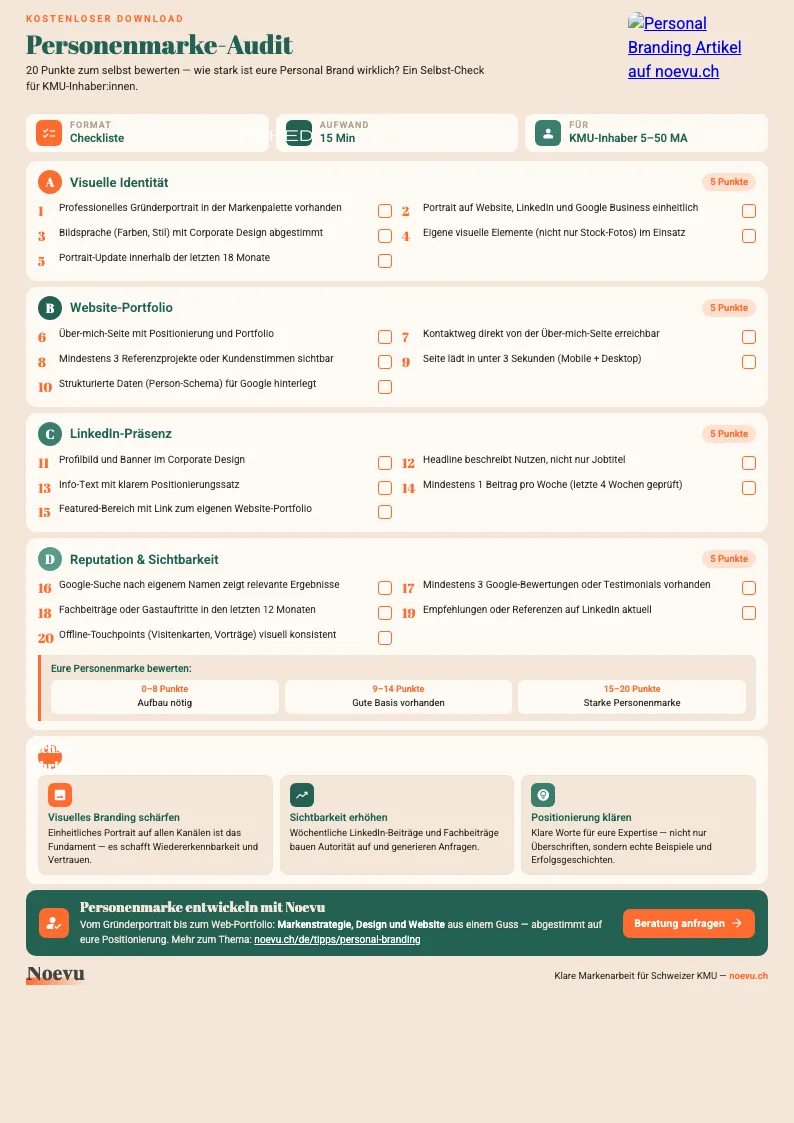
Personal Brand Audit: 20-Point Self-Assessment
The compact checklist for SME owners: visual identity, website portfolio, LinkedIn presence, and reputation — find out in 15 minutes where your personal brand is strong and where it needs work.
Thank you. Your download will start shortly.
Five steps to building your personal brand
Building a personal brand follows no rigid formula. Five steps have proven themselves in practice — not as a linear process, but as guidance for getting started.
1. Clarify positioning: What does the person stand for? What expertise and stance sets them apart from others in the industry? This step requires honest reflection — alone or in conversation with someone who asks the right questions. Those who are uncertain can find direction through the persona approach, applied to yourself.
2. Name your target audience: Whom should the personal brand reach? Potential clients, skilled professionals, partners? The answer shapes tone, channel, and content. A trades SME speaks differently than a consultancy.
3. Create visual foundation: A professional founder portrait in brand colours. Consistent imagery on website and LinkedIn. Here the alignment with corporate design pays dividends — the same colours, the same feel, the same quality level.
4. Establish content rhythm: One LinkedIn post per week. One expert article per quarter on your website. This sounds modest, but it is sustainable. Consistency outweighs frequency — the LinkedIn algorithm rewards regular posts more than sporadic activity.
5. Measure and adjust: Four metrics are enough to start: inquiries linked to the founder, LinkedIn profile views, unsolicited job applications, and Google results for your name. Review quarterly and adjust course.
Quick-start checklist
- Formulate positioning in one sentence (What I do — for whom — why me)
- Create or update founder portrait in brand colours
- About page on your website with stance, expertise, and three references
- Update LinkedIn profile: headline, bio, photo consistency
- Publish first expert post on LinkedIn (personal insight)
- Search your name on Google and document your starting position
AI tools for Personal Branding in 2026
AI is changing personal branding too — but differently than many guides suggest. In some areas, AI tools deliver real value; in others, they do more harm than good.
What works: AI-generated portraits deliver professional results for a fraction of photographer rates. Tools like Ideogram or Midjourney create founder portraits that match brand colours — from about CHF 30 instead of CHF 500 to CHF 1,500 for a traditional shoot. For LinkedIn posts and blog drafts, AI provides solid first versions. Your own voice comes through in revision — AI breaks the blank page fear, but it does not replace personal perspective.
What doesn't work: Having AI generate an entire personal branding strategy. The result is generic and reflects averages, not actual positioning. AI-written content without human revision sounds interchangeable. In a time when AI content is becoming standard, human voice is the differentiator — not the technology itself.
AI tools are strongest as accelerators, not replacements. An AI-generated founder portrait in brand colours saves time and money. But no software answers what the person stands for. The strategic part — positioning, target audience, stance — needs an honest conversation, not a prompt.
Common mistakes when building personal brand
Most personal branding mistakes come not from wrong actions but from wrong order or poor alignment. Five patterns appear particularly often.
LinkedIn without website foundation: Regular LinkedIn posts bring visibility. But when an interested contact clicks through to your website and finds neither a founder portrait nor portfolio, the effect vanishes. The website comes first.
Personal brand disconnected from company: When the founder uses a completely different tone on LinkedIn than on the company website, confusion replaces trust. Personal brand and corporate identity must function as one unit.
Copying competitors: Those who imitate other industry voices lose what makes a personal brand work — authenticity. Your experience, your mistakes, your perspective are worth more than polished standard text.
No measurement: Without metrics, personal branding stays a feeling, not strategy. Checking four basic metrics quarterly — inquiries, profile views, applications, Google results — takes half an hour and gives clear direction.
Too much at once: Website, LinkedIn, podcast, YouTube, newsletter — starting everything simultaneously burns you out. One channel managed consistently delivers more than five channels managed sporadically.
The costliest mistake: building visibility before clarifying positioning. Many SME owners start with LinkedIn posts before they know what they stand for. The result is generic content without a thread — and an audience that doesn't match your target.
Conclusion
Personal branding is not a trend and not an ego project. It is the decision to make your expertise visible — in a way that fits your company and delivers measurable results.
For Swiss SME owners, this concretely means: website is the foundation, LinkedIn the amplifier. Visual identity and corporate identity belong together. AI tools accelerate execution, but they don't replace strategic clarity.
The best time to start building is now. Not with everything at once — with clear positioning and a convincing about page. The rest builds step by step — supported by SEO support, so the name actually gets found.

From founder portrait to web portfolio: brand strategy, design, and website all at once — aligned with your positioning.
Frequently Asked Questions
What is personal branding, simply explained?
Personal branding describes the deliberate building of a personal brand. It is about how others — clients, partners, potential employees — perceive a person and their expertise. For SME owners, this means: communicating your visibility, stance, and professional competence in a way that builds trust before the first conversation happens.
Does an SME owner really need a personal brand?
In companies with 5 to 50 employees, leadership is often the face of the firm. Whether deliberate or not: clients, job applicants, and partners form an impression. The difference lies in whether this impression is left to chance or shaped deliberately. In Switzerland, where business relationships are built on trust, targeted visibility pays off measurably.
How does personal branding differ from corporate identity?
Corporate identity describes the overall appearance of the company — design, communication, behaviour, and culture. Personal branding refers to the person behind it. In an SME, the two are tightly linked: the founder's personal brand is often the most tangible expression of company identity. Ideally they work as a unit — same colour palette, same stance, same tone.
What does building a personal brand cost?
The largest investment is time, not money. A professional founder portrait costs around CHF 300 to CHF 800; AI-generated alternatives start from CHF 30. Strategic positioning with a website portfolio emerges as part of a branding project. Ongoing maintenance — one LinkedIn post per week, regular portfolio updates — requires two to three hours weekly. Specific project costs become clear in an initial free conversation.
Can I build a personal brand with AI tools myself?
Partly. AI tools deliver professional portraits, LinkedIn bio variations, and content drafts quickly. What AI doesn't handle: strategic positioning — what the person stands for, what sets them apart, whom they want to reach. These questions require honest reflection, not software. AI is an efficient starting point, but it doesn't replace the substance behind it.
How do I measure the success of my personal brand?
Four metrics provide guidance: inquiries that explicitly trace back to the founder (email, contact form). LinkedIn profile views and post reach per month. Unsolicited job applications naming the company as an attractive employer. Google search results for your own name — what appears on the first page. Quarterly review is sufficient to start.