

What is Strapi CMS — explained briefly
Strapi is a so-called headless CMS — a system where content management and the visible website are completely separate. You manage texts and images in an admin interface, and that content can be delivered anywhere: website, app, or newsletter. Other headless CMS platforms work similarly.
What makes Strapi distinctive: it is open source. The code is freely available for anyone to use and adapt. For you, this means no license fees for the software itself and no lock-in to a single vendor. You can also run Strapi on your own server — including in Switzerland.
For SMEs, this means in practice: Strapi gives you a great deal of control. That control is real, but it does not come without effort. Technical knowledge is required for setup and ongoing operations.
What Sets Strapi Apart from Other Headless CMS Platforms
There are many headless CMS options available. Strapi stands apart from Sanity or Contentful mainly through open source and self-hosting. It shares both with Payload — compared with Payload, the visual Content-Type Builder makes the difference.
Strapi's Strengths
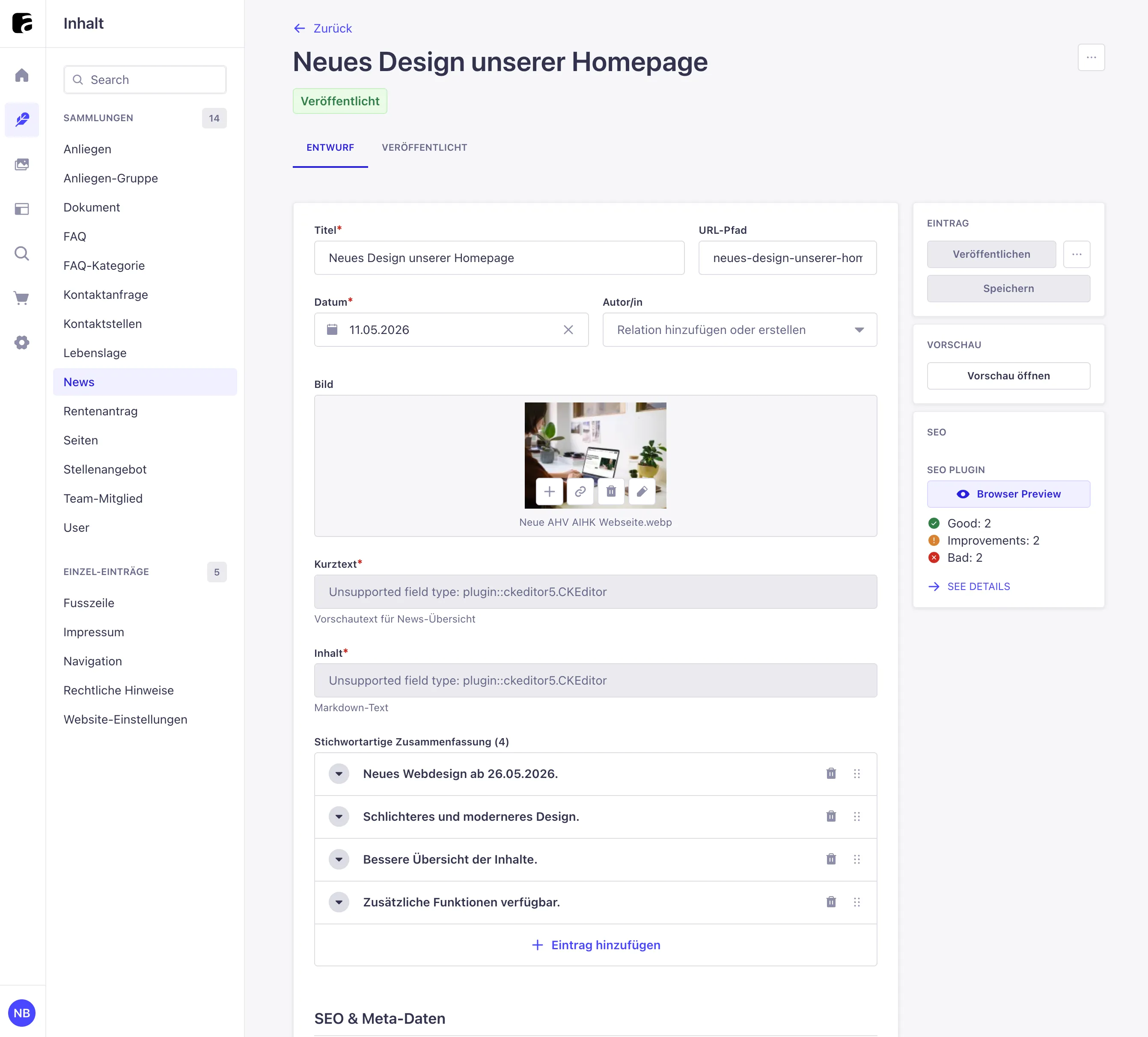
During setup, developers define the content structure visually in the Content-Type Builder, meaning which fields a page or post has. That is faster than writing it all in code. On the live website, your editorial team fills this structure with content. A growing plugin ecosystem extends Strapi with features such as search, SEO fields, or integrations with other services.
Strapi 5: What the Current Version Delivers
Strapi 5 is the current major version and has been stable since 2024. Compared to Strapi 4, it brings noticeable improvements — especially in usability and the technical foundation.
The most important points for SMEs:
- New admin interface: The admin panel has been redesigned and is faster and more streamlined. Day-to-day work for editors becomes easier.
- Document Service API: A new, unified method for developers to retrieve and edit content. For you, this means less technical friction when building the website.
- Drafts and publishing: Content can be saved as a draft and published deliberately — important for traceable approvals.
- Built-in multilingual support: Content in multiple languages is possible without an additional plugin — relevant for Switzerland.
- Roles and permissions: Who can edit what is finely controllable.
Anyone still on Strapi 4 should plan the migration. Upgrading to Strapi 5 is not a straightforward update — some technical fundamentals have changed, which requires developer time.
Data Sovereignty: the Self-Hosting Advantage for Swiss SMEs
This is where Strapi's greatest advantage for Swiss SMEs lies: you can run Strapi on your own server — including at a Swiss provider like Infomaniak or nine.ch. Self-hosting means your content and data stay where you decide, not in the cloud of a foreign vendor.
For the revDSG (revised Swiss Data Protection Act, in force since September 2023), this is a plus. With many cloud services, data resides in the EU or the US. For most SMEs, the EU is unproblematic — Switzerland recognises it as a safe data territory. But in sensitive sectors such as healthcare, finance, or public administration, Swiss hosting is often required or clearly preferred.
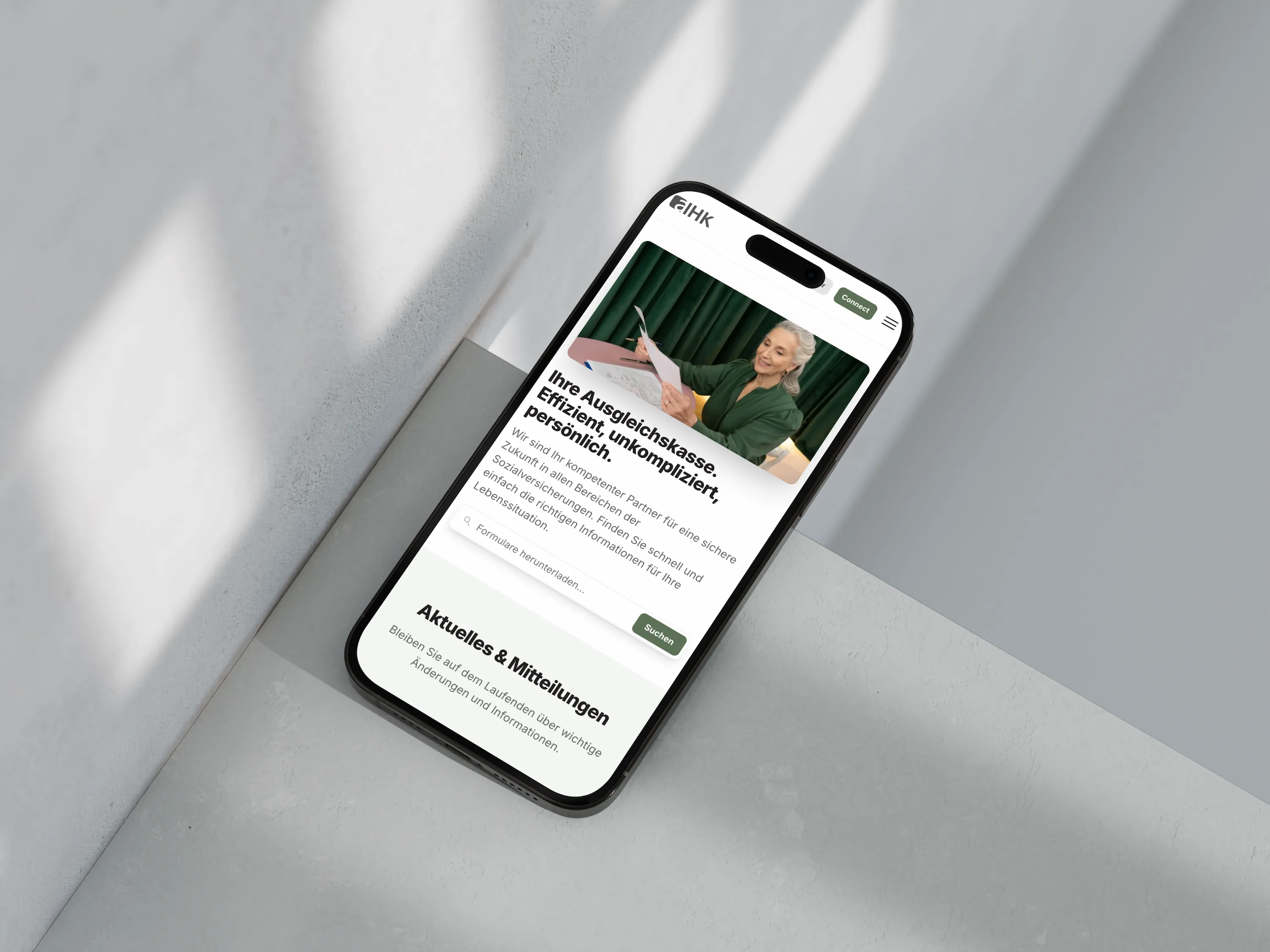
It is precisely in those projects that the value of data sovereignty becomes clear. When rebuilding the website of the AIHK Aargau social insurance fund, Swiss data location was a knock-out criterion. The choice was Strapi 5, self-hosted on a Swiss server instead of a US cloud.
To be honest: self-hosting also means self-responsibility. Updates, security, and server operations are on you or your agency. That control comes at a price — in the form of maintenance.
Swiss data location does not automatically mean "secure." What matters is who maintains the server: a self-hosted system is only as good as its maintenance. Without regular updates, a data protection advantage can quickly become a security risk. Clarify early on who will handle operations long-term.
Strapi Cloud or Self-Hosted?
Strapi can be run in two ways: self-hosted on your own server, or via Strapi Cloud, the vendor's managed offering. Both use the same software — the difference lies in operations, control, and costs.
Self-Hosted
- Full control over server and data location — Swiss hosting possible
- No license or platform fees in the free version
- Operations, updates, and security are your responsibility or your agency's
- Makes sense when data sovereignty matters or a server is already in place
Strapi Cloud
- Strapi handles hosting, updates, and backups
- Faster to get started, less technical operational overhead
- Monthly costs depending on plan and usage
- Data location outside Switzerland — check for sensitive sectors
For SMEs with high data protection requirements, self-hosting on a Swiss server is usually the better fit. Those who want to get started quickly and prefer not to manage operations themselves will find Strapi Cloud easier. Strapi Cloud starts on the Starter plan at around USD 35 per project per month (as of September 2026). Larger plans cost significantly more. Strapi Cloud does not offer a Swiss data location.
Strapi's core is open source and free. But some features that editors often expect from day one cost extra. Version history (restoring earlier states) and the AI features sit in the Growth plan. Self-hosted, it costs around USD 45 per month for three users (as of September 2026). The change log (who changed what, and when) and advanced approval workflows are Enterprise-only. Single sign-on comes with Enterprise, or you add it to Growth. For many SMEs, the free version is sufficient — but check in advance whether you need these convenience features.
Strapi and AI: What Is Realistic Today
Since late 2025, Strapi has its own AI features, bundled as Strapi AI. They are part of the paid Growth plan and run in Strapi Cloud as well as with self-hosting. However, Strapi processes the AI requests on its own infrastructure, not on your server.
What Strapi AI can do:
- Create content structures: From a plain-language description, the AI suggests appropriate fields.
- Alt texts and captions: The media library automatically generates descriptions for images.
- Translations: Content is automatically transferred to other languages when saved.
For your SME, this means: AI-assisted editing with Strapi requires the Growth plan. Every AI request runs through Strapi's infrastructure. If you want to avoid that for sensitive content, connect your own AI services via custom integrations. By comparison, Sanity's Content Agent is currently more mature. German-language quality should be checked in both cases.
When is Strapi the Right Choice?
Strapi is not the right tool for every situation. But there are clear scenarios where it plays to its strengths.
Strapi fits particularly well when:
- Data sovereignty matters — your data should or must stay in Switzerland
- Your team has access to developers, internally or through a Strapi CMS agency
- Editors should be able to manage content independently after the setup is complete
- You want to avoid license fees and stay independent of a single vendor
- The same content appears across multiple channels — website, app, newsletter
A typical scenario: a Swiss SME with 20 employees in healthcare or finance that needs a multilingual website and whose data must remain in Switzerland. Here, Strapi combines data sovereignty with an editor-friendly interface.
Strapi delivers its value where control and data location matter more than the fastest possible start. SMEs with that requirement usually make the more sustainable choice with a self-hosted system. Those who simply need "a website" are often better served by a leaner system.
When is Strapi the Wrong Choice?
Just as important as the strengths is an honest counter-check. Many projects fail not because of the technology, but because of mismatched expectations.
One distinction first, because it is almost always confused: this is about setup and server operations, not about content maintenance. Once Strapi is fully set up, your team manages posts, pages and images on its own, without developers. The points below concern the road to that state and the ongoing technical upkeep.
Strapi is probably the wrong choice when:
- You want to set up and maintain Strapi yourselves without development experience — the setup belongs in experienced hands
- The website is modest in scope — few pages, rarely updated
- Nobody can or will take over server operations
- You want a website builder without agency support that combines hosting, design, and content out of the box
- Speed of launch matters more than control over the data
The points on server operations and a fast start apply to self-hosting. Strapi Cloud takes the server and updates off your hands, but your data then sits outside Switzerland.
A common pattern: a small business wants a modern website with a blog. Content changes rarely, the budget is tight. Here, a leaner system is the smarter choice, because setup and server operations do not pay off at that scale. Ease of use is not the issue. The article on the best WordPress alternative shows which systems are worth considering.
Strapi is often chosen because "open source" sounds like free. But the software is only one part of the equation. Those who choose self-hosting without clarifying ongoing operations will pay later in security vulnerabilities and outdated systems. Clarify support arrangements before you decide.
Strapi Compared: Sanity, Payload & WordPress
Anyone evaluating Strapi usually also looks at Sanity, Payload, or WordPress. The four systems follow different approaches — the right choice depends less on features than on your situation.
| Strapi | Sanity | Payload | WordPress | |
|---|---|---|---|---|
| Hosting | Own server or Strapi Cloud (outside CH) | Cloud (EU) | Own server | Own server |
| Source code open | Fully | Partially | Fully | Fully |
| Free plan | Yes (self-hosted) | Yes (up to 20 users) | Yes (self-hosted) | Yes (software free) |
| Swiss data location possible | – | |||
| Interfaces | REST + GraphQL | Custom language (GROQ) | REST + GraphQL | REST (via plugins) |
| Editorial interface | Visual, mature | Freely configurable (code) | Code-defined | Traditional, plugin-dependent |
| Developer to build | Yes | Yes | Yes | Yes |
| Day-to-day usability | Very good | Good | Very good | Solid, plugin-dependent |
| AI features | Strapi AI in the Growth plan, also self-hosted (alt texts, translations, content structures) | Content Agent (text, images, translations) | In the Enterprise edition, otherwise via plugins | Via plugins (e.g. Jetpack AI) |
| Best for | Data sovereignty + editor-friendly | Multiple channels, design-oriented teams | Developer teams, technical projects | Traditional websites and blogs |
As of 2026. Pricing and features may change.
The most important difference: Strapi, Payload, and WordPress can all be run on your own server — including in Switzerland. With Sanity, data lives in the vendor's cloud. Strapi combines an open, self-hostable foundation with an interface that editors without programming skills can use. There is no objectively best system — only the right fit or the wrong one. Anyone who prefers Payload will find setup and support at the Payload agency.
What Strapi Costs — and What Is Often Overlooked
Strapi's pricing model looks unbeatable at first glance: the software is open source and free. But the license is only a small part of the total picture.
What does not appear on any price list:
- Website development: Strapi delivers only the content management layer — the visible website must be built separately. Initial costs: roughly CHF 12,000–25,000 depending on scope.
- Setup and content structure: Configuring Strapi and structuring content requires technical understanding.
- Hosting and operations: Server costs, updates, and security patches accumulate continuously — with self-hosting, that responsibility is yours.
- Maintenance: Version upgrades such as the jump from Strapi 4 to 5 cost developer time.
Bottom line: the saved license does not mean the system is free. It shifts costs from the license to development and operations.

Do not calculate the license alone — factor in the full package over three years: development, hosting, maintenance, and support. Only then can you see whether Strapi is less expensive than a cloud solution. For projects with a clear data sovereignty requirement, a self-hosted system is often the more cost-effective choice long-term.
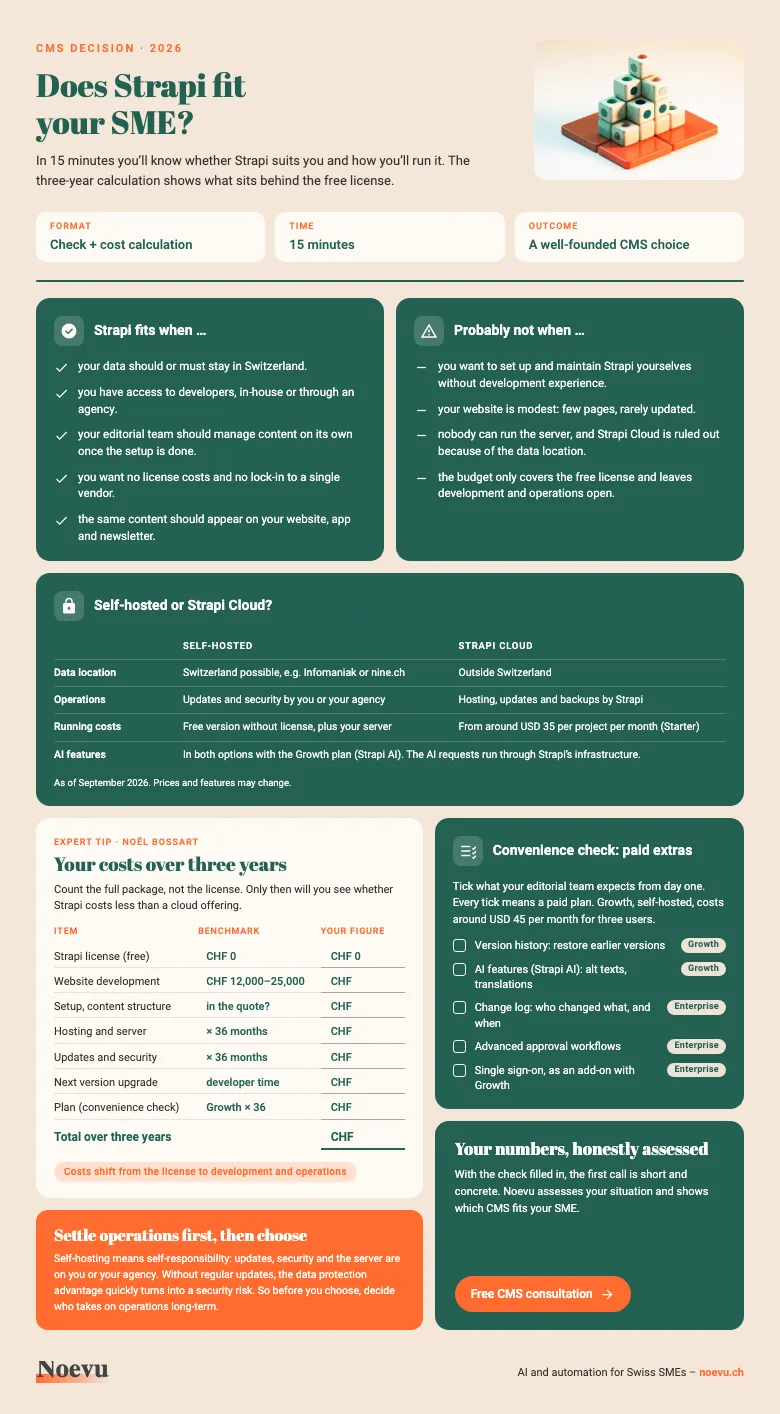
Does Strapi fit your SME? The decision check
The check as a PDF: in 15 minutes you'll know whether Strapi fits and which way of running it suits you. With the worksheet, you also calculate the full package over three years.
Thank you. Your download will start shortly.
How Noevu Thinks About Strapi
Noevu works with modern, self-controllable systems — and Strapi is one of the tools that comes into consideration when data sovereignty and a dedicated server are requirements. What matters is never the system alone, but whether it fits the client's situation.
One example is the relaunch of the AIHK Aargau social insurance fund's website: Swiss data location was non-negotiable. That is why the website runs on Strapi 5, self-hosted in Switzerland rather than in a US cloud.
What Noevu does not recommend: choosing Strapi simply because it sounds "modern" or "free." Those who need a simple website with a blog and occasional support are better served by a leaner system. The honest question is always: how much control do you actually need — and who will operate the system long-term?
Conclusion
Strapi is one of the strongest open headless CMS platforms on the market — and that is simultaneously its strength and its demand. The system rewards teams that need data sovereignty, have the setup professionally handled, and take on server operations long-term. For those teams, Strapi is an excellent choice.
For small, rarely updated websites, Strapi is too much. If nobody is available for server operations, Strapi Cloud remains an option — with data stored outside Switzerland. The barrier sits at setup and upkeep, not at daily content work.
If you are still unsure after reading this, that is not a disadvantage — it is the right moment to discuss the question with someone who knows various systems from practical experience.

In a no-obligation conversation, Noevu analyzes your situation and shows which CMS setup truly fits your business.
Frequently Asked Questions
Is Strapi free?
The Strapi software is open source, and the base version carries no license fee. Costs arise elsewhere: in developing the website, hosting, and ongoing maintenance. Some features cost extra: version history and AI sit in the Growth plan, the change log in the Enterprise plan. For many SMEs, the free version is enough. But check in advance whether your editorial team expects these features from day one.
Do I need developers for Strapi?
For the initial setup and building the website: yes. Strapi and the visible front end need to be set up technically. For day-to-day content management afterwards, no programming skills are required — the admin interface is accessible for editors. Plan for developer support for updates and server operations.
Where is my data stored with Strapi?
You decide that yourself. Because Strapi is self-hostable, you can run it on a server in Switzerland — for example at Infomaniak or nine.ch. This keeps your data in the country, which is a clear advantage under the revDSG (revised Swiss Data Protection Act, in force since September 2023) and for sensitive industries. Alternatively, Strapi Cloud runs the data at the provider's location outside Switzerland.
Strapi Cloud or self-hosted — what is the difference?
Both use the same software. With Strapi Cloud, the vendor handles hosting, updates, and backups for a monthly fee — getting started is quick. With self-hosting, you run Strapi on your own server: more control and Swiss data location, but operations are your responsibility. For high data protection requirements, self-hosting is usually the better fit.
Can I migrate from WordPress to Strapi?
Yes, migration is possible. Content can be exported from WordPress and imported into Strapi. The effort depends on the scope — for 50+ pages with complex layouts, plan for several weeks of project time. It often makes sense to combine the switch with a website relaunch rather than only changing the system.
What changes with Strapi 5 compared to Strapi 4?
Strapi 5 brings a revised admin interface, a new technical foundation for data access (the Document Service API), and improvements to drafts and multilingual support. Upgrading from version 4 to 5 is not a simple update — some fundamentals have changed. Plan for developer time if you are running an existing Strapi 4 project.
Does Strapi offer AI features?
Yes, since late 2025, under the name Strapi AI, in the paid Growth plan. It works in Strapi Cloud as well as with self-hosting. The AI creates content structures, generates alt texts for images, and translates content automatically. Important: the AI requests run through Strapi's infrastructure, not your server. If you want to avoid that, connect your own AI services via custom integrations.
Strapi or Sanity — which fits Swiss SMEs better?
The rule of thumb: Strapi when your data must stay in Switzerland and you want full control. Sanity when EU hosting is enough and you want the more mature AI with the Content Agent. Both require developers for setup. An honest assessment of Sanity is available in a separate article.