

AI data privacy Switzerland: a typical incident and its consequences
An executive assistant wants to summarise a confidential supplier contract quickly. She pastes 40 pages into ChatGPT Free, gets a clean overview in 30 seconds. What she does not see: the contract name, supplier, prices, and clauses now sit on US servers at OpenAI — and may end up in the training data of new models, because that is the default on ChatGPT Free. Sensitive business data inside a model that anyone can query tomorrow.
Or: an NGO worker is writing a report on vulnerable clients. She types: «Polish this paragraph: Mrs M. (52) from Berne, single mother of three, has been homeless for two months...» Her name, situation, and address now sit at a US company.
Both incidents are not exotic edge cases — they are everyday reality in Swiss SMEs, law firms, and NGOs. In most cases nobody is aware of the trail this leaves and the legal consequences it can have. This article shows how to recognise these risks — and how to use AI in your organisation without violating Swiss revDSG or EU GDPR.
What «data-privacy compliant» actually means for AI
Many AI providers advertise GDPR compliance or EU server locations. That sounds reassuring — but it falls short. A server in Frankfurt or Geneva does not help if the company behind it is a US company. US companies are subject to the American CLOUD Act — regardless of where their servers are located. This applies equally to OpenAI, Microsoft, Google, and Amazon.
The decisive question is therefore not «where is the server?» — but rather: «Which law governs the company processing my data?»
Once you understand that, you can quickly tell «safe» from «unsafe» AI use — and decide consciously which data is allowed to flow through which system.
The CLOUD Act — the underestimated risk
The CLOUD Act (Clarifying Lawful Overseas Use of Data Act) is a US federal law from 2018. It empowers US law enforcement to demand data access from US companies — regardless of where the data is stored.
What this means in practice: a US company that stores data on EU servers must still provide access to a US authority. It is not required to inform you or the affected individuals about this.
This is not a hypothetical scenario. US authorities actively use this capability. For Swiss SMEs with data protection obligations toward customers, employees, or authorities, this is a real legal risk — even if it rarely becomes visible in everyday operations.
A Data Processing Agreement (DPA) with a US provider reduces your compliance risk on paper. But it does not protect against government US data access. The DPA governs what the provider may do with your data — not what it must do on US government instruction.
Does an EU subsidiary protect against the CLOUD Act?
A common counterargument: Microsoft operates Microsoft Ireland, Google has Google Ireland Limited, Amazon runs Amazon EU SARL. Aren't these European companies under European law?
No — not under the CLOUD Act. The law explicitly applies to US companies and all entities they control. «Control» means the parent can direct the subsidiary. That is definitionally true of subsidiaries.
A US authority obtains an order against Microsoft Corp — not Microsoft Ireland. Microsoft Corp then directs Microsoft Ireland to produce the data. The parent has both the legal obligation and the technical means to enforce compliance. Failing to do so risks contempt of court. Server location and the EU registration of the subsidiary change nothing about this logic.
Can the EU subsidiary refuse US data access?
Theoretically yes — and here lies a genuine, unresolved legal conflict. GDPR Art. 48 states that data transfers to third countries based on foreign government orders must go through MLAT channels or recognised agreements — not direct compulsion. An EU subsidiary therefore has a legal basis to refuse.
Three reasons why this provides no safe harbour in practice:
The US court compels the parent — not the subsidiary. The order is directed at Microsoft Corp. The parent bears the obligation to comply and the risk of refusal.
There is no EU-US CLOUD Act agreement. The law includes a «qualifying foreign government» clause: if a country has signed a bilateral CLOUD Act agreement with the US, providers can challenge orders that conflict with that country's law. The UK signed such an agreement in 2022. The EU has not. Without this agreement, there is no formalised path to block US orders.
The conflict falls back on the company. Complying with the CLOUD Act violates GDPR Art. 48. Refusing risks contempt of court for the parent. Microsoft and AWS attempt to create «EU Sovereign Cloud» architectures that technically prevent US staff from accessing EU data. No court has recognised this as a legal barrier.
Data residency ≠ data sovereignty. «Data residency» refers to where data is physically stored. «Data sovereignty» refers to who ultimately holds legal control. EU subsidiaries guarantee the former. Only the absence of a US parent company in the control chain eliminates the CLOUD Act.
Three risk tiers at a glance
Not every AI solution carries the same risk. Three tiers are enough to structure the decision — depending on what data you process and what compliance requirements apply.
The only criterion that matters is the legal entity of the contracting provider: US companies fall under the CLOUD Act, EU companies do not. Server location is secondary — an «EU data residency» option offered by a US provider (AWS Bedrock EU, Azure OpenAI EU, OpenAI Enterprise EU) does not change the jurisdiction.
| Tier 1: US providers | Tier 2: EU gateway | Tier 3: EU/CH self-hosted | |
|---|---|---|---|
| Legal entity | US company | EU or UK company | EU/CH company |
| Server location | USA or EU residency | EU | EU/Switzerland |
| CLOUD Act risk (provider) | High | None (NL) / Low (UK) | None |
| CLOUD Act risk (model provider) | High | None with EU model / High with US model | None |
| Known examples | OpenAI, Anthropic, Google, AWS Bedrock EU, Azure OpenAI EU | EUrouter (NL), Requesty (UK) | Mistral, Infomaniak, Scaleway, Apertus |
| DPA available | Yes | Yes | Yes |
| For sensitive data | Not recommended | Only with deliberate model selection | Recommended |
An «EU data residency» option from a US provider (AWS Bedrock EU, Azure OpenAI EU) does not change CLOUD Act exposure — the contracting entity remains US-incorporated. For Tier 2, the gateway itself is outside US jurisdiction, but the downstream model call may still trigger US law — see Tier 2 section. As of April 2026.
Tier 1: US SaaS direct — when is this acceptable?
Direct US providers like OpenAI, Anthropic, or Google are not prohibited per se. What matters is which data you process.
Acceptable for: non-personal data (publicly available information, generic texts), internal use without personal data, or one-time tests without data persistence.
Not acceptable for: customer data (names, email, purchase history), employee data (applications, salary information), health or financial data, and confidential documents with business secrets.
Many SMEs use ChatGPT daily — often for tasks where Tier 1 is actually problematic. The risk is real, even if it rarely becomes immediately apparent.
Several US providers advertise EU data residency: OpenAI Enterprise with EU hosting, AWS Bedrock with EU inference profiles (eu-central-1, eu-west-1) for Claude or Titan, Microsoft Azure OpenAI Service with an EU deployment in Frankfurt or Sweden. The data then stays on EU servers — but the contracting entity remains a US company. The CLOUD Act still applies. EU data storage reduces the risk marginally; it does not eliminate it. Note this when reviewing your DPA: a US provider with an EU region is legally Tier 1, not its own tier.
Tier 2: EU gateways as middle ground
Tier 2 are gateways: European companies that do not run any models themselves, but forward your request to various model providers. The gateway is an intermediary layer. The privacy outcome therefore depends on whom the gateway passes your data to.
Two well-known examples: EUrouter (registered in Amsterdam) and Requesty (registered in London). Neither is itself subject to the US CLOUD Act. Requesty has a small residual exposure because the United Kingdom signed a 2022 agreement with the US on data access. Both will pass your request, depending on your choice, either to a European model provider (e.g. Mistral from France) or to a US platform with European servers (AWS, Microsoft).
Two outcomes depending on the route:
(a) Gateway → European model provider. Your data stays in Europe end-to-end. No US company in the chain. Privacy effect roughly equivalent to Tier 3 — just with two European companies in the data flow instead of one.
(b) Gateway → US cloud platform with EU servers. The model runs in Frankfurt or Stockholm — but Amazon or Microsoft remains the contracting processor under US law. CLOUD Act applies again. No advantage over going direct to a US provider.
Tier 2 only pays off if you deliberately choose a European model provider underneath the gateway. Anyone using Claude or GPT-5 through an EU gateway accepts US law anyway and is no better off legally than going direct to the US provider.
For gateway and cloud providers, look for ISO 27001 (information security management) and SOC 2 Type II. They do not replace a legal assessment — but they prove that access controls, incident handling, and internal processes have been externally audited. For sensitive data, at least one of these certifications is the entry ticket. Always request the current audit report (not just the marketing claim).
Tier 3: European providers running on their own servers
Tier 3 are providers registered in the EU or Switzerland and running their AI models on their own servers in Europe. From contract to processing, a single company sees your data — no intermediaries, no US sub-contractors, no downstream US model providers.
Which language models the provider uses — proprietary ones (like Mistral) or open ones (LLaMA, Mixtral, Qwen) — is secondary for data privacy. Models are software. What matters is who actually processes your data.
The CLOUD Act does not apply here. EU and Swiss data protection law applies in full. This makes Tier 3 the safest option for personal and sensitive data.
Mistral AI — France
Infomaniak AI Tools — Switzerland
Scaleway Generative APIs — France
Apertus — Switzerland (in development)
Checklist: What to clarify before deploying AI
Before you deploy an AI service in production, fundamental questions should be clarified. This applies regardless of the provider — revDSG and GDPR require demonstrable decisions, not good intentions. A brief consultation helps find the right starting point.
Before you start
What revDSG concretely requires from you
Switzerland's revised Data Protection Act (revDSG), in force since September 2023, places concrete requirements on AI use. Three of them are particularly relevant for Swiss SMEs.
Information obligation. If you process personal data with AI, data subjects must be informed — actively and comprehensibly, not just in the fine print of your privacy policy.
Legal basis. Every processing operation requires a basis: consent, contract, or legitimate interest. With AI systems this is often poorly documented — especially when data flows to third-party providers.
Third-country transfer. If data is transferred to countries without equivalent protection (USA), additional safeguards are required. Standard Contractual Clauses (SCCs) are one option — but may not be sufficient for US providers due to the CLOUD Act. The Federal Data Protection Commissioner (FDPIC) has made clear: revDSG is enforced with the same instruments as GDPR in the EU — including fines.

Start with the processing register. Document which AI tools you use, what data flows, and on what legal basis. This is not a bureaucratic exercise — it is the foundation on which you can demonstrate, when it matters, that you made a careful decision. One hour of effort saves many hours of explanation to the FDPIC.
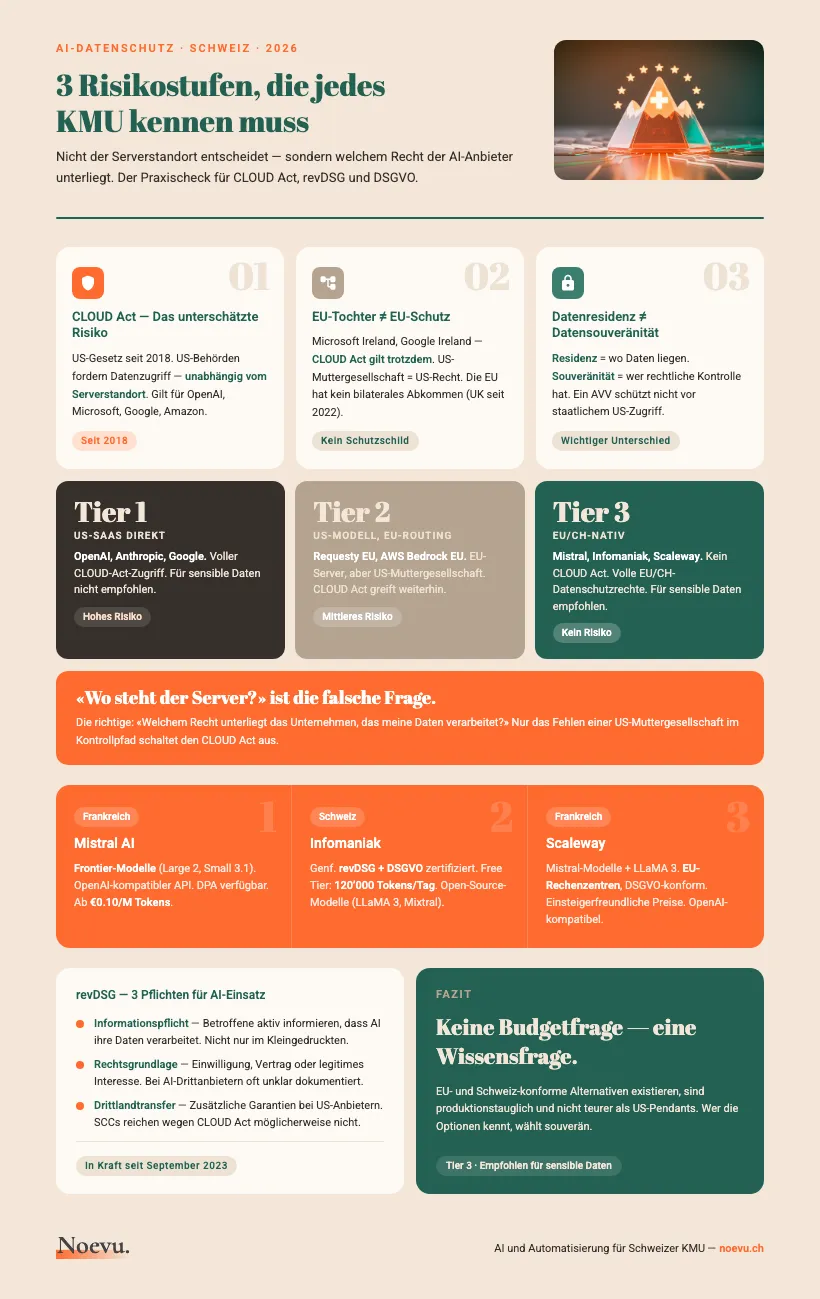
Infographic: 3 Risk Tiers for AI Data Privacy
Thank you. Your download will start shortly.
Conclusion: Compliance is not a certificate statement
«GDPR-compliant» and «EU server» on a vendor dashboard mean little without examining the CLOUD Act. The decisive question is: which law governs the company processing your data — not: where is the server.
For Swiss SMEs without a dedicated legal department: Tier 3 is the safe choice for sensitive data. Mistral (France) offers its own frontier models without CLOUD Act risk. Infomaniak (Switzerland) offers maximum local control for standard tasks — single-party data chain included.
Tier 2 (EU gateways: EUrouter, Requesty) makes sense when you want EU/CH jurisdiction at the provider level but need frontier models like Claude or GPT-5 — paired with EU-deployed endpoints.
Tier 1 (US providers, with or without EU data residency) is pragmatically defensible for everyday tasks without personal data — draft texts, internal summaries, research.
The good news: EU- and Swiss-compliant alternatives exist, are production-ready, and are no more expensive than their US counterparts. The decision is not a budget question — it is a knowledge question. Whoever knows the options can choose confidently. And anyone who needs support with AI integration can find it without compromising on data privacy.

Which provider fits your setup and what exactly you need to document — that can be clarified in a short conversation. No jargon, tailored to your situation.