

What is a landing page — and what sets it apart from a website
A landing page is a page with exactly one goal. No menu, no distraction, no «Also check this out.» Visitors to a landing page should do one thing: fill out a form, request an offer, buy a product, register for an event. Everything else is left out — on purpose.
The difference from a regular website is fundamental. A website is a destination: navigation, about us, services, case studies, contact. The landing page is a decision moment. It receives visitors from a specific source — an ad campaign, a newsletter, a LinkedIn post — and leads them straight to the next step.
In practice, there are many in-between forms: an offer page without navigation, a campaign page with reduced header, a product page with a strong CTA. All of these fall under the term landing page. What they share: they're built around a conversion goal, not brand building or general information.
A landing page is not a homepage and not a website replacement. It complements an existing web presence for specific campaigns and goals — it doesn't replace it. If you don't have a clear website yet and plan to «start with a landing page,» you're not solving the real problem.
When does a landing page actually pay off?
A landing page makes sense when a clear traffic source exists to drive visitors to it — and when those visitors should take a specific action. Without both conditions, it's effort without outcome. With them, it's a focused tool that converts significantly better than a generic website.
From work with Swiss SMEs, four situations stand out where a landing page makes a real difference.
When a landing page makes sense
When a landing page comes too early
When the landing page is the wrong choice?
The most common mistake Noevu sees in consulting: an SME builds a landing page as a website replacement. The idea sounds logical — fast, focused, low cost. The problem: a landing page has no navigation, no depth, no way to get to know a brand. Someone who clicks from a Google Ad and doesn't buy immediately has no second way in. They leave the page — and usually don't come back.
A second classic misconception: «We'll build a landing page and see what happens.» What happens is: nothing. Because nobody finds the page. A landing page without a traffic source is a storefront with no street in front of it.
And third: multiple goals on one page. If you want to explain, persuade, and convert all at once, you destroy focus. Visitors don't know what to do. The conversion rate drops.
The landing page as a quick fix for a missing website: it happens often, and it almost always ends the same way. Cheap upfront, no results down the road, because trust and context are missing. Before a landing page is built, you need an answer to: Where do the visitors come from — and what should they do next?
Setup and conversion logic: The elements that actually matter
A well-built landing page follows simple logic: it builds trust until the visitor is ready to act. Each element has a clear job. What's missing or weak tanks the conversion rate.
Important: there's no universal «best landing page.» What works for a B2B inquiry fails at direct sale. What works for a known company needs more trust-building from an unknown seller. The overview below shows what almost always applies — regardless of the offer.
The six elements of a converting landing page
- Headline: the one statement that needs to stick in the first glance — concrete, benefit-focused, no buzzwords. «More inquiries in 30 days» beats «Your digital partner for growth»
- Hero: an image or short video that visually delivers on the promise — not a generic stock photo
- Social proof: testimonials, reviews, logos, or numbers visible right away — ideally above the fold on first load
- Call-to-action: one action, one button, no choice. Multiple CTAs dilute focus
- Form fields: every additional form field costs conversions — multiple conversion studies show this consistently. Rule of thumb: as few fields as necessary to qualify the inquiry
- Trust: HTTPS, clear sender, privacy notice, recognizable logos — especially important for SMEs without brand awareness
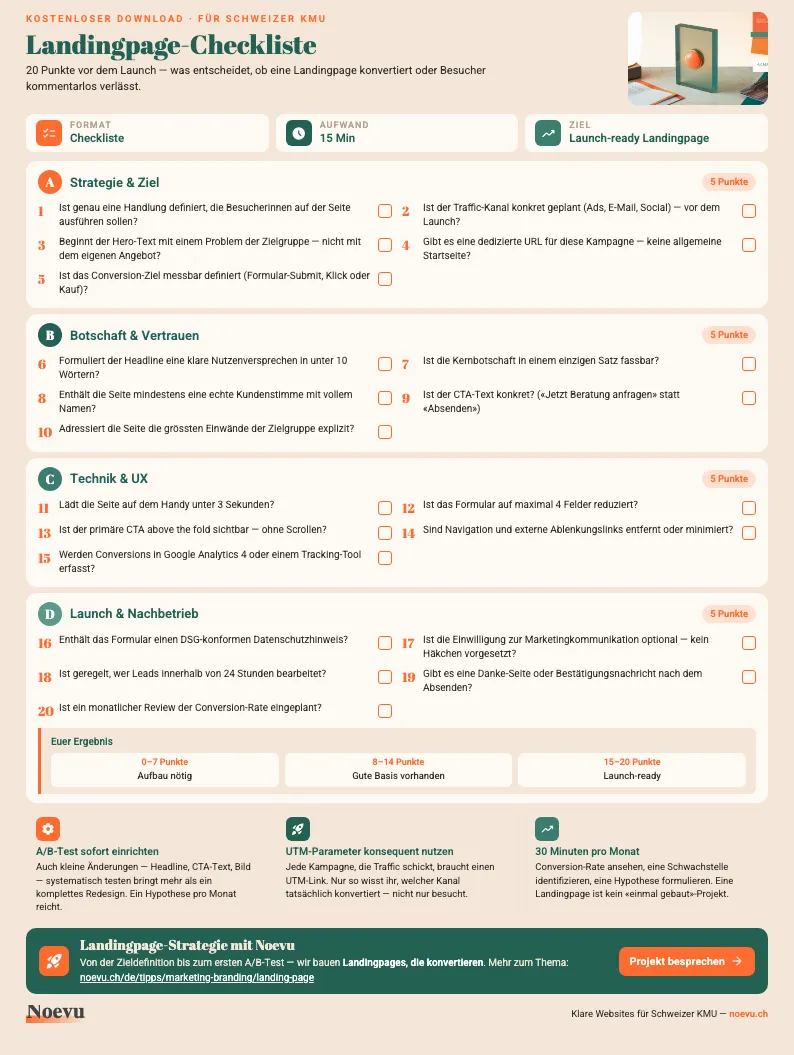
Landing Page Checklist: 20 Points Before You Launch
What decides whether a landing page converts or drives visitors away silently? This checklist covers all four areas: strategy, messaging, technical setup, and legal requirements — 20 concrete points to check off before launch.
Thank you. Your download will start shortly.
Design and UX: Why trust must be visible on a landing page
On a landing page, design is not an aesthetics problem — it's a trust problem. Visitors decide in seconds whether to stay or go. That decision isn't based mainly on the offer — it's based on first visual impression: Is this legitimate? Does this match what I saw in the ad?
For Swiss SMEs without brand awareness, that first impression is especially critical. When people don't know a Swiss business, they judge by the design first. And a design that looks cheap or unfinished creates the opposite of trust — even if the offer behind it is strong.
Practically, that means: consistency between ad and landing page — someone who clicks a LinkedIn ad and lands on a page with different tone or different visual style bounces immediately. Clear visual hierarchy — what should be read first must be optically dominant. Readable typography, plenty of white space, no cluttered pages. And: a privacy notice on the form that complies with Swiss data protection law and clearly shows what happens to the data.

The strongest trust signal on a landing page is often the most specific: a real customer quote with full name and company beats a generic «Our customers are happy» by a mile. Three genuine reviews with names carry more weight than ten stars with no context. If you have only one trust anchor — make it specific.
What a landing page means for SEO
Landing pages and search engine optimization only fit together under certain conditions. A classic conversion landing page for paid traffic is short, has no navigation, and little text — exactly what search engines don't reward for rankings. For most SMEs: landing pages are built for paid traffic, not organic search.
That doesn't mean landing pages and SEO are fundamentally incompatible. A landing page with clear keyword focus, strong metadata, fast loading (Core Web Vitals), and internal linking can absolutely build organic traffic — especially for long-tail keywords with clear purchase intent. But these pages look different from classic conversion landing pages: more content depth, better structure, stronger internal linking.
The table below shows how SEO logic differs depending on your traffic goal.
| Paid Campaign | Organic Search | |
|---|---|---|
| Main goal | Immediate conversion — form, purchase, signup | Build search ranking — long-term visibility |
| Content length | Short, focused — only what's needed for decision | More depth — 800–2,000 words for rankings |
| Optimization lever | A/B tests, conversion rate, form fields | Keywords, metadata, internal links, Core Web Vitals |
| Lifespan | Campaign duration — archived afterward | Long-term if regularly maintained |
| Key metric | Cost per lead, ROAS, conversion rate | Organic traffic, rankings, bounce rate |
For most Swiss SMEs, the cleanest approach is: a landing page for paid traffic that converts fast. Separate blog or service pages for organic rankings. Optimizing both at once usually hurts both goals.
AI tools for landing pages 2026: What's possible — and what's not
AI builders for landing pages are real and usable in 2026. Framer AI generates a complete landing page from a text prompt — layout, text, color scheme — in minutes. Builder.io and Unbounce Smart Copy bring text suggestions and A/B testing variants straight into the editor. This is technically impressive and saves real time.
What these tools don't deliver: strategy. They can't answer «What's my conversion goal?», «Who's my target audience?», or «What message works for this campaign?». If you haven't answered these questions, AI tools give you a nice-looking but strategically empty page.
Noevu uses AI builders as a starting point — not an end product. A Framer AI draft can show in minutes whether a layout approach works before investing time in refinement. But it always needs content and strategy work afterward: real text, real social proof elements, correct legal notices, technical setup.
If you decide on an AI tool: start by evaluating AI tools for Swiss SMEs — what truly fits depends heavily on your technical setup.
What a landing page costs — and what question comes first
Before the price question can be answered meaningfully, another comes first: What should the landing page achieve — and for whom? This question determines how much strategy work is needed, whether a template is enough or custom design is necessary, and whether copywriting, A/B testing, and analytics integration need to be planned.
Simple landing pages with a template builder — Squarespace, Webflow, Carrd — can be set up for CHF 300–800 if you do the work. A detailed breakdown of when Squarespace and when Webflow is the better foundation is in the article Squarespace vs. Webflow. Professionally conceived, written, and designed, the typical range in Switzerland is CHF 1,500–5,000. This depends on offer complexity, integration needs, and whether A/B testing infrastructure is built.
What really makes the difference between «cheap» and «expensive» is not setting up the page — it's the strategy work beforehand: sharpening target audience, formulating message, clarifying traffic source, defining conversion goal. This work takes time. Skip it and you save short-term and lose long-term. Invest it and you don't just have a landing page — you have a campaign that works.
In closing
A landing page is not a quality marker and not a quick fix. It's a focused tool for a specific job — and very effective when that job is clear. Misused, it creates effort without outcome: a nice-looking page that nobody finds, or that gets found but doesn't drive decision.
For Swiss SMEs, the honest assessment is: don't start with «How should the landing page look?», start with «Where do our visitors come from — and what should they do on this page?». If that question has a clear answer, the rest — setup, design, copy, tool — is solvable. If it doesn't, even beautiful design won't help.
If you're still unsure after reading this whether a landing page is right for your campaign or whether another approach makes more sense, that's not a failure — it's the right moment for a quick conversation without sales pressure. Often improving the website systematically beats building another landing page.

Noevu helps you figure out which format works for your situation — and builds a landing page that converts if that's the right move.
Frequently Asked Questions
What's the difference between a landing page and a homepage?
A homepage is the entry point to a website with multiple goals: navigation, brand presence, overview. A landing page, by contrast, has exactly one goal — collect an email address, request an offer, buy a product, register for an event. When someone lands on a landing page, they should see only one possible action. That's why landing pages typically have no main navigation and no external links. The homepage says: «Welcome, look around.» The landing page says: «Here's what this is about — and here's what you do next.»
How much traffic do I need for a landing page?
For meaningful analysis, you need at least 100, ideally 500 visitors per month — otherwise conversion rates aren't statistically reliable. You can use the landing page with less traffic, but shouldn't make optimization decisions on a small data set. Paid traffic (Google Ads, LinkedIn) delivers measurable quantities faster than organic search. That's why most SMEs launch landing pages alongside a paid campaign.
How long does it take to build a landing page?
A simple landing page with a clear goal can be live in two to five days — from briefing to launch. A professional landing page with strategy, copywriting, design, and technical setup typically takes one to two weeks. The most time-consuming part is almost never the technology — it's sharpening the core message: What should this page say, to whom, and why now? Skip that step and you build fast — but often the wrong thing.
What does a professional landing page cost in Switzerland?
Simple landing pages with template builders (Squarespace, Webflow, Carrd) run CHF 300–800 depending on your effort. A professionally conceived and designed landing page with copywriting and setup typically costs CHF 1,500–5,000 in Switzerland — depending on complexity, integrations, and whether A/B testing is included. Noevu discusses specific terms in the first conversation; the scope depends heavily on your campaign goal and existing website infrastructure.
Can you optimize a landing page for SEO?
Yes — but with limits. A classic conversion landing page for paid traffic is short, has no navigation, and little text — that's not enough for top search rankings. To rank organically, you need more content depth, internal links, and clear keyword strategy. Optimizing for both at once is difficult: what works for conversions often weakens SEO depth — and vice versa. For most SMEs: paid traffic for the conversion landing page, separate blog posts or service pages for organic rankings.
Which AI tools work best for landing pages?
Framer AI, Builder.io, and Unbounce Smart Copy are the strongest options in 2026. Framer AI generates a complete landing page from a prompt — layout, text, style — good as a starting point, but always needs content refinement. Unbounce brings A/B testing, traffic distribution, and smart traffic built in. Builder.io is stronger for technical teams and CMS integrations. For Swiss SMEs without developer resources, Framer AI or a Squarespace template is the lowest-friction entry — as long as the conversion strategy is clear before you open the tool.
When does a Swiss SME not need a landing page?
When there's no clear traffic source to drive visitors to it. A landing page without visitors is effort without outcome. And if the real problem is an unclear core message or a weak website, a landing page won't solve that — it just makes it more visible. Finally: if there's no budget for paid traffic in the short term and organic reach is too low, that energy is better spent on a page that will stay visible long-term.