

CMS Headless Open Source: What is a Headless CMS — a brief explanation
A traditional CMS like WordPress combines two things in one system: managing content in the backend and outputting it on the website. That works well — as long as a single website is the only goal.
A headless CMS decouples these two concerns. It focuses exclusively on storing and delivering content via an API. The frontend — your website, app, or any other digital channel — fetches the content and renders it freely. «Headless» literally means without a head. The «head» — what users see — is separated from the system and developed independently.
At first glance, this sounds technical. The practical consequences are concrete: faster loading, a smaller attack surface, multichannel capability, and less maintenance overhead in the long run. Whether these benefits matter for your business depends on what you expect from your digital infrastructure.
What CMS systems are there — an overview
The term «CMS» covers very different system types today. The first step is not choosing a specific product, but understanding which category fits your situation. The following overview shows the four most important types — with concrete examples and honest assessment.
| Monolithic | Website Builder | Headless CMS | Git-based | |
|---|---|---|---|---|
| Examples | WordPress, Drupal | Squarespace, Wix | Strapi, Payload, Sanity | Keystatic, Tina CMS |
| Architecture | Backend + frontend coupled | Template-based, SaaS | API-first, decoupled | Content as files in repo |
| Technical effort | Low to medium | Very low | High | Medium |
| Flexibility | Medium — plugin-dependent | Low — template-bound | High — any framework possible | High — no server needed |
| Setup costs | CHF 3,000–12,000 | from ~CHF 14/mo. | CHF 8,000–30,000 | CHF 5,000–15,000 |
| Data sovereignty | Full (self-hosted) | Limited (SaaS) | Full (self-hosted) | Full (in repo) |
An often-overlooked point: a frontend almost always has to be built — including with a monolithic system, where it is simply entangled with the backend. Only template builders like Squarespace or ready-made WordPress themes avoid dedicated frontend development. The fact that headless cleanly separates content and presentation, rather than interweaving them, is therefore an advantage rather than extra effort.
For many Swiss SMEs, the decision is less a technical question than a strategic one: how much flexibility do you need today — and how much will you need in two to three years? The free CMS check gives you a structured assessment in a few minutes.
Note: Website builder and cloud service prices converted to CHF (as of March 2026).
When is a headless CMS worthwhile — and when is it not?
A headless CMS is not a universal improvement over traditional systems. It is a different architecture — with clear advantages and equally clear prerequisites. Honest advice starts by naming both.
Headless CMS pays off when...
- Content needs to be delivered across multiple channels — website, app, newsletter, or digital signage
- Loading speed is business-critical and load times under two seconds are required
- A development team or agency will be available long-term
- The budget allows CHF 10,000 or more for the initial project
- The website is expected to grow and take on new channels in the coming years
Headless CMS is too much when...
- A simple website as a digital business card is sufficient
- Content should be managed independently, without technical support
- The total budget is under CHF 10,000
- Fast implementation matters more than long-term flexibility
- No clear technical ownership exists

The detailed comparison — with cost overview, checklist, and concrete decision support — is provided in the complete headless CMS guide.
Headless CMS open source — the key CMS providers in 2026
The headless CMS market is growing by double digits each year — and open-source solutions are clearly gaining the upper hand. Strapi, Payload, and Directus now deliver enterprise-level features that SaaS platforms had exclusive access to just a few years ago. The decisive advantage: full data control, no vendor dependency, no licence costs.
The four most important open-source options at a glance:
Strapi is the market leader. The Node.js-based system offers REST and GraphQL APIs, over 72,000 GitHub stars (as of May 2026), a mature plugin ecosystem, and broad community support. Recommended for teams that want a proven solution with wide integration support. Free self-hosted, cloud from ~CHF 99/mo.
Payload targets TypeScript-native teams. Since version 3, it can be used directly as a Next.js plugin — CMS and frontend in one codebase. MIT licence, full type safety, notably faster GraphQL performance than many competing systems, per Payload's own benchmarks. Free self-hosted, cloud from ~CHF 35/mo.
Directus stands out for its particularly well-designed admin interface: granular roles and permissions, live previews, publication workflows. Best for projects where the editorial team has high requirements for the user interface.
Keystatic is the lightest option: git-based, no server or database, no ongoing costs. Content is managed as files directly in the repository. Perfect for static websites with Astro or Next.js where a full CMS is not needed.
A detailed assessment of Sanity — the only cloud system Noevu recommends in specific project contexts — is available in the article Sanity CMS for Swiss SMEs.
The two leading open-source systems get their own deep dives: Payload CMS and Strapi — each with an honest read on when it fits a Swiss SME.
What a headless CMS means for SEO
A headless CMS is neither automatically good nor bad for SEO. What matters is how cleanly frontend and content work together — and whether SEO is part of the architecture from day one.
The advantages are measurable: statically generated pages with CDN delivery directly improve Core Web Vitals. Clean code without plugin overhead, fast mobile load times, and full control over meta tags and structured data — these are real differences compared to a poorly maintained WordPress.
The challenge: with headless, you set up redirects, XML sitemaps, canonical URLs, and hreflang tags yourself — that requires deliberate engineering from day one. SEO problems almost always arise where responsibilities are unclear or SEO is treated as an optional add-on.
What to clarify before deciding
Before evaluating a headless CMS, some honest questions are worth asking. Clear answers save a lot of money and frustration later.
Checklist before the CMS decision:
- Who develops and maintains the frontend long-term?
- Who models the content structures — and who adjusts them when needed?
- How often does content actually change — daily, weekly, rarely?
- Do editors need to preview the page before publishing?
- Is there a realistic maintenance budget for the next two to three years?
- Are additional channels planned — app, intranet, digital signage?
Anyone with clear answers to four or more of these questions is well positioned for a CMS evaluation. Anyone still unsure often finds more clarity in a conversation with an experienced agency than in yet another comparison article. For a no-obligation initial consultation, Noevu is here to help.
If you're planning a new website and don't yet know which platform fits your situation, the website development service page provides an overview of Noevu's approach.
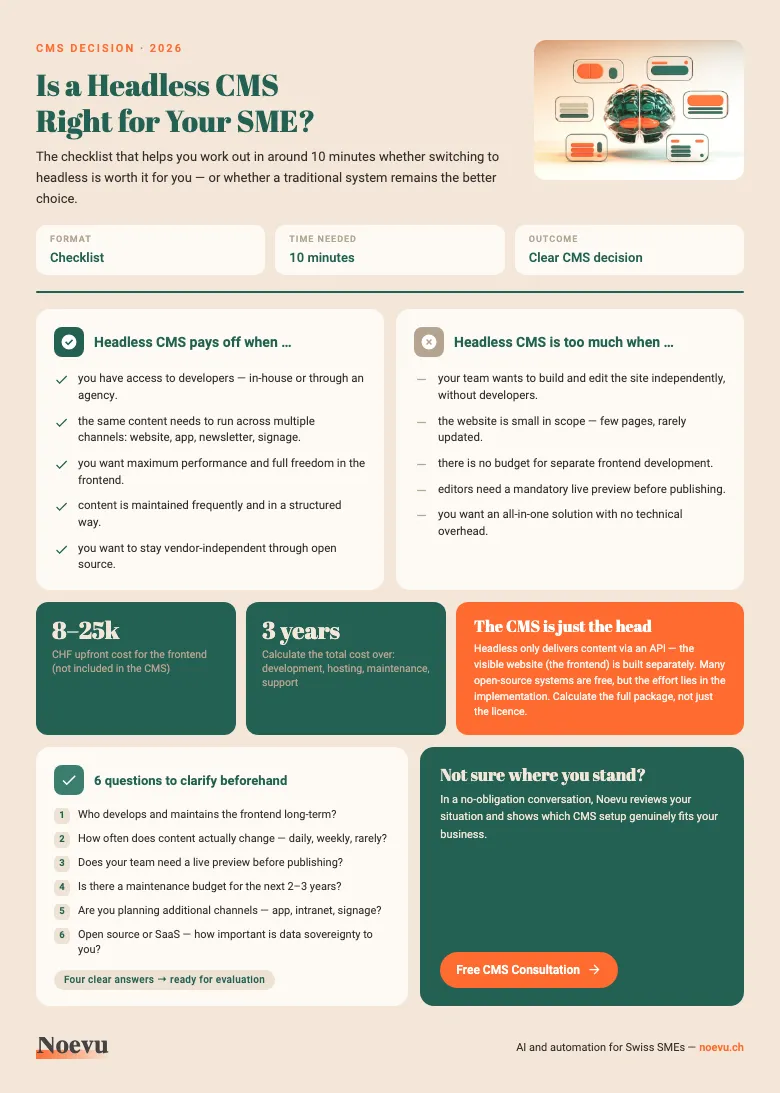
Headless CMS Decision Checklist: Is Headless Right for Your SME?
The checklist as a PDF: when headless is the right fit and when it isn't, the real costs behind the licence, and the six questions to clarify upfront — a clear CMS decision in around 10 minutes.
Thank you. Your download will start shortly.
Conclusion: Content management for the years ahead
The shift towards headless CMS is not a trend — it is a structural response to the reality of modern content distribution. Content no longer lives on a single website. It appears in apps, newsletters, intranets, and on digital displays. Traditional CMS systems were not designed for this world.
That does not mean every SME needs to switch to headless today. For simple websites, small teams, and tight budgets, traditional systems or website builders remain the more pragmatic solution — and will continue to be. The key question is not what is technically superior, but what fits your specific situation.
Open-source systems like Strapi, Payload, and Directus have significantly lowered the entry barrier in recent years. AI-assisted development lowers it further. Headless projects that once required six to eight weeks of development time are now achievable in four to five weeks.
If you are still unsure after reading this, that is not a weakness — it is the right signal to get a second opinion. The detailed headless CMS guide provides deeper decision support.

In a no-obligation conversation, Noevu analyses your current CMS situation and gives a clear assessment of whether headless fits your requirements.
Frequently Asked Questions
What is a headless CMS?
A headless CMS is a content management system without a fixed frontend. Content is stored in a structured way and made available via an API. The presentation layer — your website, app, or any other channel — is developed separately and fetches content from the API. «Headless» refers to the missing presentation layer: the system handles content only, not appearance.
What CMS systems are available?
There are four main types: Monolithic CMS like WordPress or Drupal couple backend and frontend in one system. Website builders like Squarespace or Wix offer template-based solutions with minimal technical requirements. Headless CMS like Strapi, Payload, or Sanity fully separate content and presentation. Git-based systems like Keystatic store content as files directly in the repository — no server or database required.
How much does an open-source headless CMS cost?
The licence is free — Strapi, Payload, and Directus are open source under the MIT licence. Project costs come from setup, content modelling, and frontend development: typically CHF 8,000–30,000 upfront. Add CHF 20–100/mo. for self-hosted infrastructure. Compared to traditional CMS, initial costs are higher but ongoing costs often lower — fewer plugin updates, less security maintenance.
Do you need developers for a headless CMS?
For setup and frontend development: yes. For day-to-day content management: no. The admin interfaces of Strapi, Payload, and Directus are usable by non-technical staff. The typical model for Swiss SMEs: an agency sets up and maintains the system, the internal team manages content independently.
Is headless CMS better for SEO?
The potential is higher — faster load times, clean code, full control over meta tags and structured data. The challenge: SEO fundamentals like redirects, sitemaps, and schema markup must be implemented manually. With WordPress, plugins like Yoast handle this automatically. Headless provides a better technical foundation but requires deliberate engineering from day one.