
What the Google Partner status really is
The Google Partner programme launched in 2013 and identifies agencies that meet certain thresholds in Google Ads. It is a performance and volume programme for ad campaigns — not a general quality seal for digital services. Three conditions have to be met on an ongoing basis, otherwise the badge disappears: a minimum revenue in the managed Google Ads account, a minimum optimization score and a minimum share of certified staff.
Important to understand: the programme covers Google Ads only. It evaluates neither SEO competence nor web design, neither content strategy nor UX. Other Google services such as the Google Business Profile are also outside its scope. Reading the badge as a general quality seal confuses a specific performance measurement with overall agency quality — a confusion that regularly leads to bad provider decisions.
In 2016 Google extended the programme with the Premier status. Premier Partners are the top three percent of participating agencies in each country. In the DACH market the status is often advertised as «Google Premium Partner» — the official term remains Premier Partner.
When the badge is a useful signal for your SME
The Partner badge has an honest use — if you read it in the right context. It is a reasonable filter in exactly one scenario: you are looking for an agency to manage your Google Ads campaigns exclusively, you have a clearly defined ad budget, and you want to make sure the provider works with the tool regularly.
In these four situations the badge is a meaningful additional signal:
When the badge is a good signal
In these cases the badge tells you something factual: the agency manages enough ad spend to clear the threshold, mostly follows Google's optimization recommendations, and has certified staff on the team. That is a precondition, not proof of quality — but it is a reasonable starting filter.
When the badge says nothing useful to you
In most other situations the badge tends to mislead. If you are looking for an agency for a web project, a brand overhaul or an SEO initiative, the Google Partner logo gives you no usable signal at all. Worse: the mix-up costs time and money, because providers are picked whose core competence lies in an entirely different field.
Typical situations in which the badge does not make your decision easier but harder:
When the badge says nothing to you
- You need a new website or a relaunch — the programme rates neither design nor code nor performance
- You are investing in SEO and organic visibility — search engine optimization is explicitly not part of the certification
- You have an ad budget below around CHF 1,500 per month — Partner agencies are geared toward larger accounts, smaller budgets slip in priority
- You are looking for strategic advice on conversion, funnel or business model — the badge rates campaigns, not strategy
- You want to look at several channels in an integrated way (SEO, content, ads, email) — a Partner agency is focused on one channel
A recurring pattern in advisory conversations: an SME is looking for a «web agency with Google Partner status» because that sounds trustworthy. The result is often an agency that does manage ad spend, but whose websites perform average — and whose answer to every question is to put more money into ads. The selection then follows a criterion that has little to do with the actual problem.
What the requirements actually measure — and what they do not
Anyone who wants to read the badge in context should know the three thresholds Google applies. The numbers are measured in the agency's managed manager account — not in each individual client account. So an agency reaches the badge through aggregated behaviour across all clients.
| Threshold | What it measures | |
|---|---|---|
| Ad spend | USD 10,000 in 90 days | Volume across all clients in the manager account |
| Optimization score | At least 70 % | Share of Google recommendations implemented |
| Certified staff | At least 50 % | Account strategists with current Skillshop certification |
What these three thresholds do not measure: whether the campaigns actually deliver business outcomes, whether the advice is honest, whether the recommendations fit the client's situation, whether the agency also says no when no is the right answer. The ad-spend threshold is also defined in US dollars — calibrated to the global ad market, not to Swiss SME budgets. A Swiss agency with a few small clients — say, five accounts at CHF 300 per month — narrowly misses the threshold in 90 days, even though it works cleanly for each individual client.
Google Premier Partner: top 3 % — what that means in practice
The Premier status is not a second tier of certification but a relative ranking position. Each January, Google identifies the top three percent of participating agencies per country. It evaluates growth among existing clients, new client acquisition, retention, product diversity in the managed accounts and total annual ad spend.
What that means in practice: Premier Partners tend to have larger client accounts, more clients overall and work with more different Google products at once — search, display, video, shopping. They get earlier access to beta features and a dedicated Google contact. For a Swiss SME with a clearly bounded ad budget, this extra is rarely decisive. For a growing e-commerce company with a multi-channel strategy, it can make a difference.
A detail that is rarely mentioned: Premier status can be lost after the January reassessment without the agency having to communicate that actively. Anyone using the badge as a basis for decisions should verify the current status with the provider — directly in Google's public Partner directory, not just on the agency website.
Optimization score: whose interests does it serve?
The optimization score is the most inconspicuous but most important threshold. Google uses it to measure how consistently an agency adopts the automatically generated recommendations in the ad account — and those are often recommendations that strengthen Google's own products: Performance Max instead of individual campaign types, Broad Match instead of tight keyword sets, Smart Bidding instead of manual bids.
In plain terms: anyone who wants to keep the score stably above 70 percent regularly accepts suggestions that shift the ad spend into Google's preferred, automated formats. Sometimes that is in the client's interest — sometimes it is not. An agency that gets the best out of a small, locally rooted Swiss trade business may deliberately decide against Performance Max and instead curate tight search campaigns. That lowers the optimization score — and can put the Partner status at risk.
Over the past years Google has gradually pushed the recommendation logic toward automated formats — Performance Max, Broad Match, Smart Bidding. The optimization score therefore increasingly measures how readily an agency follows that automation. That is not inherently wrong — but it is a particular stance, not a neutral quality metric.
An agency with an optimization score of 95 percent either consistently follows Google's automated strategy — or has largely handed over control. Both readings are possible and say something about the agency's stance. In a selection conversation, it is worth asking which recommendations the agency deliberately does not implement — and why.
For web design, SEO and UX the badge means nothing
This H2 deserves its own clarification, because this is where the most consequential mix-up happens. The Google Partner programme evaluates paid advertising only. Web design, frontend performance, conversion optimization, brand strategy, usability, accessibility — none of these fields feed into the certification.
For search engine optimization this matters even more. SEO is a craft of its own with its own logic: technical cleanliness, depth of content, link structure, page-experience signals, semantic clarity. A Google Partner agency may handle these disciplines well — or not at all. The badge is a poor proxy here. Anyone buying SEO should ask for case studies, see rankings of existing client sites, and check the technical cleanliness of those sites independently.
The same goes for UX and conversion optimization. A landing page that turns ad traffic into paying customers is a design problem, not an ad-spend problem. An agency that only does ads keeps optimising the campaign further — and overlooks the fact that the conversion hurdle sits on the landing page itself. When a landing page is really worth it is a separate topic the Partner badge does not answer.
What you should look at instead
Anyone looking for a digital partner should treat the badge as a single, weak signal and instead ask questions that test the fit for your situation. The following list has proven workable in advisory conversations with Swiss SMEs.
Seven questions that say more than the badge

The most important of the seven questions is the one about account ownership. If the agency sets up the Google Ads account in its own name, ending the relationship will cost you not only access but also the entire optimization history — all the data Google has learned for your industry, your region, your seasonality. Insist on the account running in your name with the agency added as an admin. Anyone who does not agree to this is not selling you a service — they are selling you a dependency.
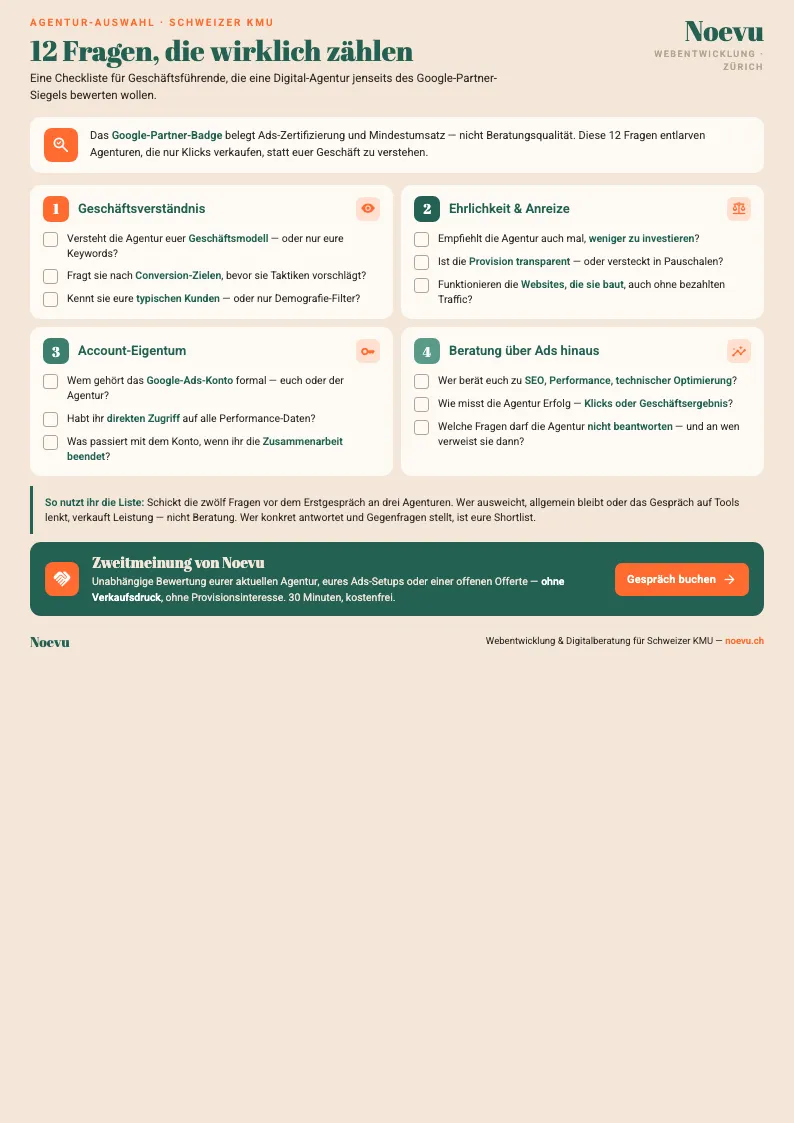
Agency selection checklist for Swiss SMEs
Twelve questions in four categories — business understanding, honesty and incentives, account ownership, advice beyond ads. One A4 page, printable, ready to use for your next selection conversation.
Vielen Dank. Der Download startet gleich.
How Noevu handles Google Ads — and why the badge is missing here
Noevu is not a Google Partner. There is a factual reason for this: Google Ads management is not part of the core offering. Noevu builds websites, develops AI-supported tools, advises on UX and conversion. When a client needs a pure ads agency, Noevu refers them to specialised providers — without commission, without entanglement.
On top of that there is a deliberate stance: anyone who wants to build visibility over the long term is usually better served by SEO, AEO and GEO than by a pure ads budget. Organic reach takes longer to kick in — three to six months is realistic, more for competitive topics. The effect lasts considerably longer in return: content that stays visible in search results is still found when the marketing budget is cut. Paid campaigns keep working only as long as the budget keeps running. This is not an argument against ads — it is an argument for a clear division of labour: ads for fast, clearly measurable activation; SEO, AEO and GEO for the long-term build-up of your own reach that belongs to you.
Skipping the Partner badge is also a statement on the selection question: the badge is not a universal quality measure. For web projects, branding and SEO it simply is not informative. An honest answer to «Do you have the Google Partner badge?» is therefore sometimes: «No, because that is not actually your problem.» This stance is rarer than it should be — and it does cost the occasional deal. Anyone who recommends tools that do not fit the problem harms the client more in the long run than someone who declines a project.
Conclusion
The Google Partner badge is not worthless — it is just very specific. It confirms that an agency manages a certain volume of Google Ads spend, largely follows Google's optimization recommendations and employs certified staff. Within that frame, it is a reasonable starting filter when you specifically need Ads competence.
For everything else — web design, SEO, UX, strategy, advice beyond campaigns — the badge says nothing. Mixing up these two levels regularly leads to provider choices that do not match your need: specialised ads agencies sold as general web partners. There is no objectively best agency — only fitting or non-fitting ones. Reading the badge as one signal among many leads to better decisions than turning it into the main criterion.
If you are unsure which capabilities you actually need for your project, a short, non-binding conversation is often the fastest way to clarify — even if the right partner at the end is not Noevu. A badge says nothing about how a brand shows up in AI answers; that is decided by AI visibility.

Noevu helps you map out which capabilities you actually need for your project — and which badges do not decide that question.
Frequently Asked Questions
What does the Google Partner badge actually mean?
The badge confirms that an agency meets three conditions: it has managed at least USD 10,000 in ad spend through its own Google management account over the past ninety days, keeps an optimization score of at least 70 percent in that account, and employs certified Google Ads strategists. It is a performance and volume measurement for Google Ads accounts — not a general quality seal for web design, SEO or strategic consulting. The requirements are checked daily, so the badge can also disappear again.
What is the difference between a Google Partner and a Google Premier Partner?
Premier status goes to the top three percent of participating agencies in each country. Google evaluates factors such as growth among existing clients, new client acquisition, retention, product diversity in the accounts and annual ad spend once a year. Premier is less a second tier of certification than a relative ranking position. The positions are reassigned in January — an agency can drop from Premier back to standard without anyone outside noticing until the directory is updated.
Does Google Partner mean good SEO or good web design?
No. The programme covers Google Ads only — paid search, display, video and shopping campaigns. Search engine optimization, website performance, content strategy, UX design or technical consulting are explicitly outside its scope. A Google Partner agency may build excellent websites — or not. The badge says nothing about that. If you are looking for a web partner, you should apply different criteria: references, business understanding, performance of existing client sites, honesty in recommendations.
What does a Google Partner agency cost in Switzerland?
Campaign management fees vary a lot — typical Swiss arrangements are monthly retainers in the low to mid four-figure range, or a percentage of ad spend (usually ten to twenty percent). The badge itself makes an agency neither cheaper nor more expensive. It only signals that the agency manages enough spend to clear the threshold — clients with ad budgets below roughly CHF 1,500 per month often slip down the priority list at such agencies. For smaller budgets, specialised solo providers are sometimes the better choice.
How many Google Partners are there in Switzerland?
Google does not publish an official country breakdown. Public-directory research suggests that several hundred agencies in the DACH region carry the badge, with a considerably smaller share based in Switzerland. The Premier top-three-percent quota applies per country — so Premier is harder for a Swiss agency to reach than for one in a larger ad market. That makes the Swiss Premier badge relatively more valuable, but does not change the underlying limitation: it measures Google Ads volume, not web competence.