

Create an Online Shop (Onlineshop erstellen Schweiz) — The Guide for Swiss SMEs
CHF 15.8 billion — that's the size of the Swiss online retail market in 2025, up 6% year-on-year (Handelsverband.swiss, March 2026). At the same time, foreign platforms are pushing into the market: Temu alone crossed CHF 1 billion in Swiss revenue in 2025 (+43% YoY). For Swiss SMEs, this means: if you want to sell online, you need to differentiate through quality, service, and a professional shopping experience.
This guide gives you everything you need to make the right decision — whether you build your online shop yourself or have it professionally built by an experienced agency. From platform selection to realistic costs to the legal requirements in Switzerland.
The Swiss E-Commerce Market — Why Now Is the Right Time
The numbers speak clearly: the Swiss e-commerce market reached a turnover of CHF 15.8 billion in 2025 — up 6% year-on-year (Handelsverband.swiss, March 2026). The online share of non-food retail stands at around 19%. Domestic retailers account for the bulk of revenue.
Particularly notable: more than half of all online purchases are now made via smartphones. TWINT has established itself as the dominant payment method with a 70.2% market share in distance selling — in 2025, the app processed 901 million transactions, up 17% YoY. If you're planning an online shop for Switzerland, mobile-first and TWINT are non-negotiable.
The strongest growth is coming from abroad: Temu crossed the CHF 1 billion mark in Swiss revenue in 2025 (around +43% YoY), while foreign purchases overall grew 8%. Swiss retailers differentiate themselves through professional web design, personal service, and the trust that a local provider brings.
DIY or Hire an Agency?
The first big decision with an online shop: build it yourself or have it professionally implemented? Both paths have their merits — but the consequences for quality, time investment, and long-term success differ significantly.
| DIY | Agency | |
|---|---|---|
| Setup costs | CHF 0–500 | CHF 3,200–20,000+ |
| Time investment | 40–100+ hours | 2–8 weeks (external) |
| Technical know-how | Self-taught | Not required |
| Design quality | Template-based | Custom-made |
| Payment integration | Set up yourself | Included |
| Ongoing maintenance | Your responsibility | Often included |
For small projects with a limited budget — such as a side income with a few products — a website builder like Wix or Shopify may suffice. But as soon as the online shop is meant to be your main revenue source or you have specific requirements (Bexio integration, multiple payment providers, multilingual), investing in professional implementation pays off.
The most common mistake: starting the shop yourself, giving up in frustration after weeks, and then hiring an agency anyway. That costs double — once for the invested time, once for the agency fee. If you know from the start that the shop needs to be professional, going directly with an agency often saves money and stress.
When a Standalone Shop Is the Wrong Choice
Not every business needs its own online shop. And not every timing is right. There are situations where you achieve more with less effort and risk.
Marketplaces as a starting point: If you first want to test whether your products work online, platforms like Galaxus, Etsy or Amazon are the lower-risk path. You pay commission but save the entire shop infrastructure and benefit from existing reach.
Too few products: With 5 products, a standalone shop rarely pays off. An order form on your existing website or a simple link to a payment provider is often enough.
No operating concept: A shop needs ongoing maintenance — processing orders, updating inventory, answering customer enquiries. If nobody on the team takes on this task, the shop quickly becomes a burden rather than a revenue source.
No solid website yet: Before investing in e-commerce, the foundation should be in place: a professional website that builds trust. A shop on a weak website doesn't sell — it confuses.
Shop Systems Compared — Shopify, WooCommerce, Shopware & More
Your choice of shop system determines your capabilities for the next few years. Four platforms dominate the Swiss market — each with clear strengths and weaknesses. Here are the key differences at a glance:
| Shopify | WooCommerce | Shopware | Wix | |
|---|---|---|---|---|
| Monthly costs | from CHF 30 | CHF 10–50 (hosting) | CHF 0 + hosting | from CHF 40 |
| Setup (agency) | CHF 3,000–8,000 | CHF 3,000–10,000 | CHF 5,000–15,000 | CHF 2,000–5,000 |
| TWINT integration | Native (since 2025) | Via plugin | Via plugin | Not native |
| Swiss hosting | No (global CDN) | Possible | Possible | No |
| Scalability | Good | Very good | Excellent | Limited |
| Ideal for | Quick start | Full control | DACH mid-market | Small shops |
Prices as of May 2026. Shopify prices in USD, converted to CHF here.


What Does an Online Shop Cost in Switzerland?
The honest answer to "What does an online shop cost?" depends on three factors: shop size, integration complexity, and whether you do it yourself or hire an agency. In Switzerland, the average agency hourly rate is CHF 165 per hour. Here are the typical price ranges:
Small shop (~50 products)
- CHF 3,200–9,800 (agency)
- Template-based design
- Standard checkout
- 1 payment provider
- Basic SEO setup
Medium shop (100–500 products)
- CHF 8,000–20,000 (agency)
- Custom design matching your CI
- Bexio integration
- Multi-payment (TWINT, credit card)
- Multilingual (DE/FR/IT)
Large shop (ERP integration)
- CHF 20,000–50,000+ (agency)
- Custom design
- ERP/PIM integration
- B2B features & customer portal
- Advanced SEO & analytics
What You Should Clarify Before Starting
Many shops fail not because of the technology but because of poor preparation. Before choosing a platform or hiring an agency, you should honestly think through these points. The clearer you are here, the cheaper and faster the project will be.
Checklist before launching your shop
Swiss Payment Methods — TWINT Is a Must
TWINT has become the most important payment method in Swiss e-commerce — with a market share of 70.2% in distance selling, over 6 million active users, and 901 million transactions processed in 2025 (+17% YoY). TWINT is now accepted by 86% of all Swiss online shops. If you run an online shop in Switzerland, TWINT is essential.
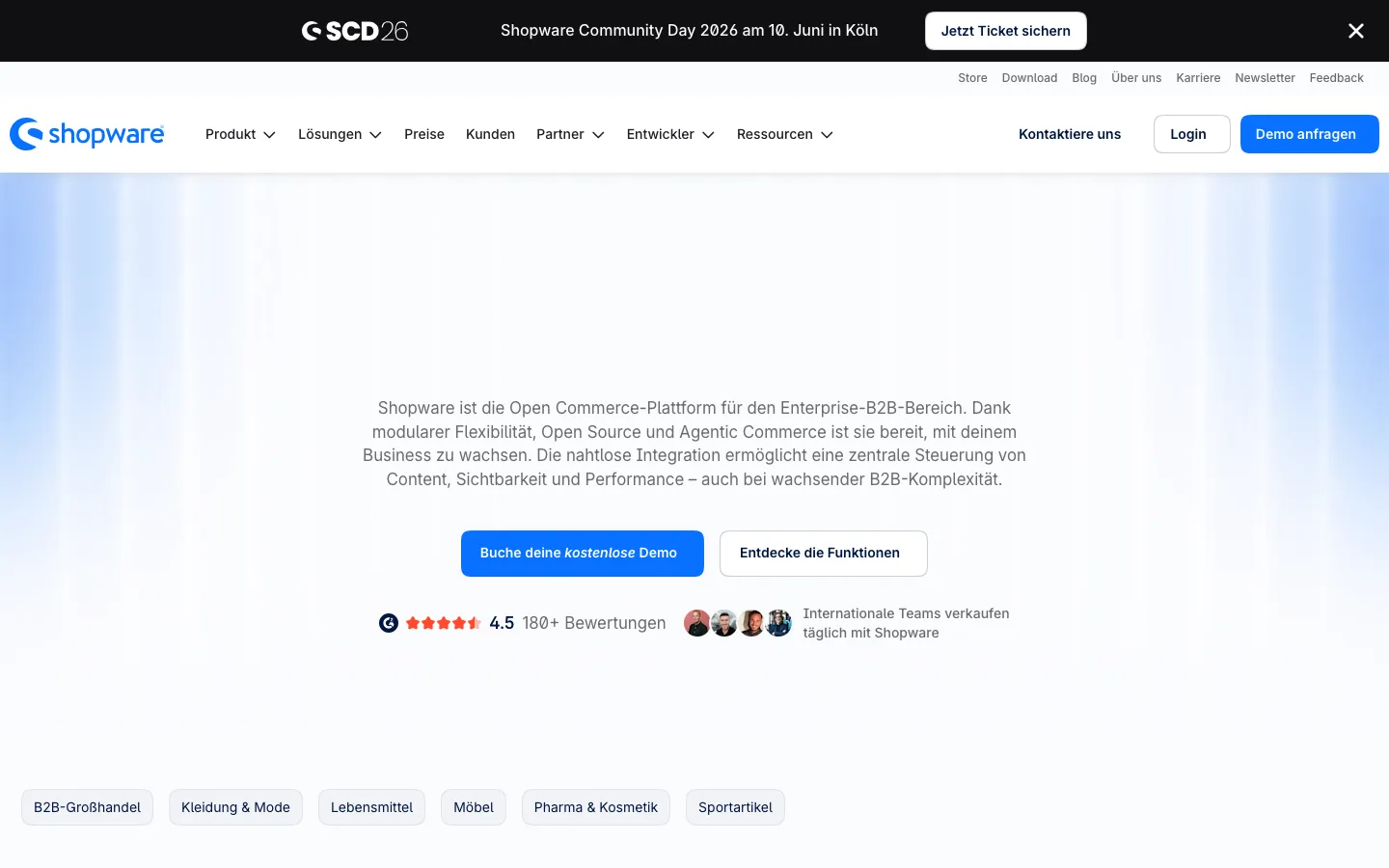
The good news: since June 2025, TWINT is directly integrated into Shopify Payments — no third-party plugin needed. For WooCommerce and Shopware, integration works through payment providers like Saferpay, Datatrans, or Mollie.
In addition to TWINT, several payment methods are essential for a Swiss online shop. Credit cards (Visa, Mastercard) are the international standard, while PostFinance matters for older demographics and B2B. Invoice payment stays popular, especially with first-time buyers, and Apple Pay / Google Pay increasingly win over younger shoppers.
The trend is also moving toward Buy Now Pay Later (BNPL) — Swiss BNPL volume is projected to grow at roughly 17% per year through 2031 (Research & Markets, 2026). For larger cart values, BNPL can noticeably boost conversion rates.
Legal Requirements — More Liberal Than the EU, but Not Without Obligations
A surprising insight for many: Switzerland is significantly more liberal than the EU when it comes to online shop regulations. No mandatory cookie banners, no statutory right of withdrawal, and data protection rules that allow more flexibility than the GDPR. Still, there are clear obligations.
Legal notice (Impressum): Mandatory since 2012 for all commercial websites. Required information: company name, physical address (no P.O. box), email, and phone number.
Privacy policy (nDSG): Switzerland's new data protection act has been in force since September 2023. Importantly: unlike the GDPR, in Switzerland you almost never need explicit consent for data processing. What isn't prohibited is permitted.
No right of withdrawal: Unlike the EU, Switzerland has no statutory 14-day right of withdrawal in distance selling. Many shops offer it voluntarily — as a trust signal and competitive advantage. A political initiative for a mandatory right of withdrawal is currently under consultation.
VAT: Only mandatory from CHF 100,000 annual turnover worldwide. Standard rate: 8.1%. Prices must be displayed including VAT for end customers.
Terms & conditions: Not legally required, but strongly recommended. Professional drafting costs a one-time CHF 500 to 1,000.
| Switzerland | EU | |
|---|---|---|
| Right of withdrawal | No statutory right | 14-day mandatory |
| Data protection consent | Almost never needed (nDSG) | Cookie consent mandatory (GDPR) |
| Cookie banners | Not mandatory | Mandatory |
| Legal notice | Mandatory since 2012 | Mandatory |
| VAT obligation | From CHF 100,000 turnover | From EUR 0 (many countries) |
Successful Online Shops — What Sets Them Apart From the Competition
An online shop that truly sells differs from one that merely exists across several dimensions. The most important success factors for Swiss e-commerce:
Technical Foundations
Conversion Optimization
AI in E-Commerce — What Swiss Retailers Are Already Using
Artificial intelligence is transforming Swiss e-commerce faster than expected. According to the Online Retailer Survey 2025 by ZHAW/FHNW (October 2025, n=643), 83% of Swiss online retailers already use AI for text creation and translations. 66% use AI for product descriptions, and 48% for product images.
The benefits are measurable: AI-powered personalization boosts revenue by up to 40% and conversion rates by up to 369%. The trend is moving away from historical data toward real-time personalization — so-called Edge AI that analyzes behavior directly during browsing.
At the same time, 90% of Swiss retailers report difficulties with AI integration — lacking know-how, insufficient time, and budget constraints are the most common hurdles. This is where an agency with AI expertise can make all the difference.
How to Find the Right Agency for Your Online Shop
Choosing the right agency determines the success of your online shop project. Not every web agency has the specific e-commerce expertise needed for a successful Swiss online shop. Here's what to look for:
Conclusion
The Swiss e-commerce market offers enormous potential — but it's becoming more demanding. Mobile-first, TWINT integration, nDSG compliance, and AI-powered personalization are no longer optional — they're essential. A professional online shop that doesn't just look good but actually converts requires partners with the right mix of technical know-how and Swiss market understanding.
The investment pays off: with the right shop system, a well-thought-out technical architecture, and an agency that understands the industry, nothing stands in the way of success in Swiss e-commerce. Start with a no-obligation conversation — identifying the right solution takes less time than you'd expect.

A no-obligation conversation maps the requirements and identifies which e-commerce solution best fits the business.
Frequently Asked Questions
How much does it cost to have an online shop built?
Costs vary significantly depending on shop size and complexity. A small shop with ~50 products costs CHF 3,200–9,800 through a Swiss agency. Medium shops (100–500 products) range from CHF 8,000–20,000. Large projects with ERP integration start at CHF 20,000. The average agency hourly rate in Switzerland is CHF 165. On top of that, monthly platform costs of CHF 10–80 apply.
Which e-commerce platform is best for Swiss SMEs?
For most Swiss SMEs, Shopify is the most pragmatic choice — with native TWINT integration since 2025 and low setup effort. WooCommerce is ideal for SMEs that want full control and Swiss hosting. Shopware is the best option for mid-sized DACH businesses with complex B2B requirements.
Do I need TWINT in my online shop?
Absolutely. TWINT has over 6 million active users, a 70.2% market share in Swiss distance selling, and processed roughly 901 million transactions in 2025 (+17% YoY). Without TWINT, you'll lose a significant portion of potential Swiss customers. On Shopify, TWINT has been natively integrated since June 2025. For WooCommerce and Shopware, integration works through payment providers like Saferpay or Datatrans.
What legal requirements apply to online shops in Switzerland?
The key obligations: Legal notice (mandatory since 2012), privacy policy under the nDSG (since September 2023), VAT registration from CHF 100,000 annual turnover, and price transparency (prices incl. VAT). Surprising to many: there is no statutory right of withdrawal and no mandatory cookie banners as in the EU.
How long does it take to build a professional online shop?
Depending on scope: A small shop (template + standard checkout) can be completed in 2–4 weeks. Medium projects with custom design and payment integration take 4–8 weeks. Complex shops with ERP integration and B2B features take 8–16 weeks. AI-powered development can shorten these timelines.
Can I build my online shop myself?
In principle, yes — platforms like Shopify and Wix allow a DIY start from CHF 30/month. However, 40–100+ hours of personal effort is realistic, and the result remains template-based. As soon as the shop is meant to become your main revenue source or has specific requirements (TWINT, Bexio integration, multilingual), professional implementation pays off.
What should I consider when creating an online shop?
The most important points: Mobile-first design (more than half of all purchases are mobile), TWINT integration as a must, SSL encryption, nDSG-compliant privacy policy, fast loading times for strong SEO, professional product photography, and a simple checkout process with a maximum of 3 steps.