
What is the Golden Circle — briefly explained
Simon Sinek's Golden Circle is a mental model from 2009. Three concentric circles order how an organisation communicates and what defines it. At the core sits the Why: the reason the company exists — beyond revenue. Around it lies the How: the particular way this Why is delivered. On the outside stands the What: the concrete products, services or offerings.
Sinek's central thesis: people don't buy what you do, they buy why you do it. Strong brands therefore communicate from the inside out — from the Why to the How to the What. Weak brands do it the other way around and end up interchangeable.
That sounds simple. In practice, precisely this order is the hardest exercise for Swiss SMEs. Most websites start with the What ("We offer A, B and C") and never reach the Why.

The Golden Circle is a communication and ordering framework, not a marketing trick. It forces a clear sequence of identity, stance and offering — and exposes gaps in your own thinking. Very useful as a structural tool, overrated as a promise of salvation.
When the Golden Circle actually helps
The Golden Circle doesn't create value everywhere. It helps when an organisation internally senses what it stands for but can't yet phrase it precisely. Typical situations from consulting practice with Swiss SMEs:
Situations where the method works well
In all five cases, the Why is already there — in the founder's head, in the team's decisions, in the way customers get addressed. The Golden Circle is then the tool that makes it conscious and communicable. A solid audit of your digital presence is usually the sensible next step afterwards.
When the Golden Circle is the wrong tool
At least as important as the use cases is an honest look at the limits. The Golden Circle is popular — but not uncontested, and the wrong instrument in some situations.
The scientific foundation is thinner than it looks. Sinek argues the Why speaks to the limbic brain and the What to the neocortex. Modern neuroscience does not split the brain that cleanly. The evidence for "Why-first = more success" is anecdotal: Apple, Wright Brothers, Martin Luther King. Counter-examples of successful but Why-poor companies rarely get discussed.
The bigger danger is purpose-washing. A Why on the About page that no daily behaviour follows damages the brand more than it helps. Employees notice the gap first, customers shortly after. And cargo-cult purpose — copying formulations from successful brands — produces a landscape of interchangeable mission statements where nobody recognises anything.
A Why without behaviour is a wall sticker. Copied purpose wording ("Changing the world every day through …") sounds the same everywhere because it is the same everywhere. And a workshop attended only by marketing produces a Why that the operations team won't recognise on Monday.
Why, How, What — the three levels with a concrete example
To make the Golden Circle tangible, a Swiss SME example works better than Apple. Imagine a small fiduciary office in Zürich: twelve people, steady caseload, an existing website listing services. The owner senses that the firm feels different from how it presents itself.
| Level | Guiding question | Example answer — fiduciary office | Where it shows up on the website | |
|---|---|---|---|---|
| Why | Why does the company exist — beyond revenue? | So owners understand their numbers again. | So their decisions become calmer. | Hero claim, About page, tone of all copy |
| How | How exactly does the company deliver that? | Personal guidance instead of case numbers. | Explanatory conversations instead of jargon. | Service pages, process visualisation, testimonials |
| What | What exactly does the company offer? | Bookkeeping, taxes, payroll, advisory. | Classical fiduciary services for SMEs. | Service pages, FAQ, pricing |
The order matters. Starting with the What ("Services: bookkeeping, taxes, payroll") makes you sound like every other fiduciary office. Starting with the Why ("So your numbers become calm again") lets the How and the What follow almost automatically. The homepage then begins with a stance rather than a service list — and that's the difference between interchangeable and recognisable.
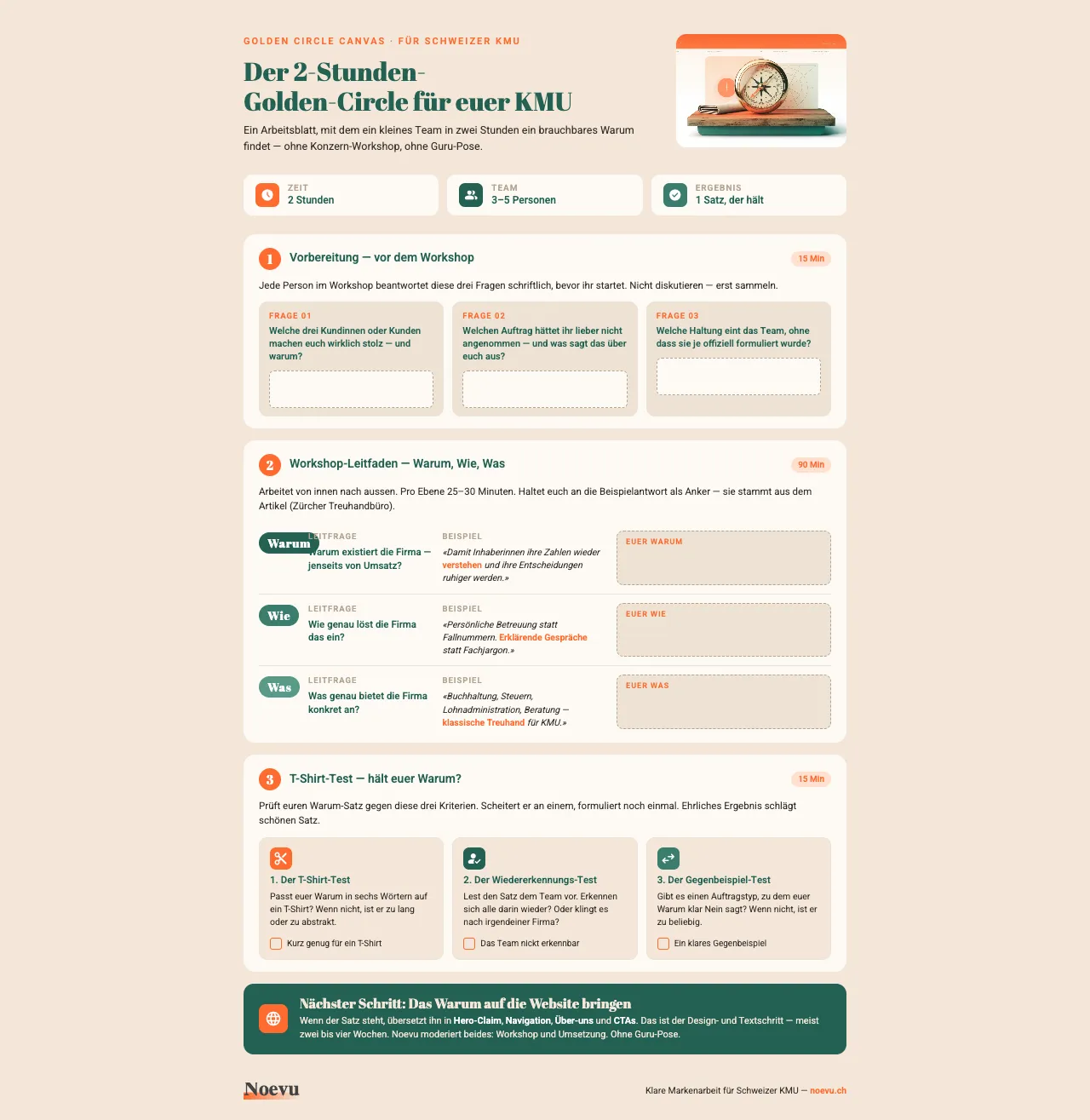
The two-hour Golden Circle for your SME
The compact worksheet that lets a team of three to five people find a usable Why in two hours — with preparation questions, a Why-How-What canvas and the T-shirt test. No corporate workshop, no guru posing.
Thank you. Your download will start shortly.
What to clarify before the workshop
A good Golden Circle workshop stands or falls by preparation. Spend an evening on the following questions beforehand and you save two hours of warm-up time in the workshop and avoid the usual loop toward generic mission statements.
Six questions to answer before the workshop
You won't find the Why in PowerPoint — you'll find it in customer conversations. Call two of your most loyal clients before the workshop and ask them why they stayed with you. The answers almost always sit closer to the Why than to the service description — and they are the best starting point for the workshop.
How the Why becomes visible on a website
This is where theory meets craft. Most Golden Circle articles end at the Why sentence. In practice, that sentence is the beginning, not the result. The real work starts where the Why gets translated into concrete design and UX decisions.
A good website makes the Why felt in four places without ever saying it explicitly: the hero section, the navigation, the About page and the calls to action.
Hero section
- The claim states the Why in one sentence — not the service
- The subline shows the How: what you do differently from others
- The first CTA relates to the promise, not the purchase
Navigation
- The order of menu items follows the Why, not the org chart
- About stands early, not at the end
- Service names speak the stance, not only the category
About
- The story starts with a problem, not a founding year
- Photos show the team at work, not in stiff portraits
- Team quotes make the Why tangible
CTAs
- Labels speak the stance: "Book a calm conversation" instead of "Request a quote"
- An invitation to clarify instead of a push to buy
- No sales pressure in the button text
This approach has proven itself repeatedly in Noevu's projects. At Unitas Services in Zürich the Why "personal approach instead of uniform" was translated directly from the workshop into hero, team photos and contact forms. At the Davatz law firm "approachable stance" became an About page that opens with a question rather than a partnership biography. For the NGO Zukunft für Kibambili the entire homepage was built around the Why — the mission moves to the front instead of hiding in the About page. Donors recognise the stance before they even scroll.
What the Why means for SEO and GEO in the AI era
Search engine optimisation is often treated as a purely technical topic: keywords, load time, structured data. That's only half the story. The other half concerns stance — and therefore the Why.
Google has for years weighted the acronym E-E-A-T: Experience, Expertise, Authoritativeness, Trustworthiness. Translated: content has to come from lived experience, not generic text snippets. A website that radiates its Why naturally produces that kind of content. A website that only lists services does not.
AI-generated search results — so-called AI Overviews and ChatGPT answers — sharpen this dynamic. The models summarise whoever writes convincingly and recognisably. Interchangeable content vanishes into the summary "various providers offer similar services". Clear Why-based positioning, by contrast, gets quoted, linked and cited as a source.
A Why written by a language model always sounds like somebody else's Why — because on average it's stitched together from a thousand similar companies. AI speeds up the wording but does not find the Why. That remains human work: conversations, listening, condensing. Only after that can AI help polish.
Swiss brands that live their Why consistently
The usual example list in Golden Circle articles runs out quickly: Apple, Nike, Patagonia. For a Zürich fiduciary office or a workshop in Bern, none of that transfers. More useful are Swiss brands whose Why forms a clear line across product, communication and website.
Migros
- Why: «Wir setzen uns für eine lebenswerte Schweiz für alle ein» — Vision 2035, adopted in 2025 by the delegates' assembly of the Migros cooperative federation ("We stand for a Switzerland worth living in, for everyone")
- The Kulturprozent has been anchored in the statutes since 1957 — over CHF 140 million a year into culture, education and social projects, independent of retail performance
- The What (retail, Klubschule, cultural venues) follows from the Why of a cooperative that Gottlieb Duttweiler handed over to the population in 1940
Patek Philippe
- Why: «You never actually own a Patek Philippe. You merely look after it for the next generation» — Generations campaign, running continuously since 1996
- Family independence across generations: no luxury-conglomerate takeover, all movement parts produced in-house in Geneva — the secondary-market value confirms the promise
- The What (mechanical watches from five figures upward) is a consequence of the Why of stewardship across generations, not of price positioning
Victorinox
- Why: quality and longevity as a stance, not a claim
- The Swiss cross is a logical consequence of that stance, not decoration
- Products last for generations — and the website speaks precisely to that durability
The key lesson from these examples: there is no objectively best Why — only one that fits you and holds up over years. A Why that sounds strong in the first half-year and means nothing in the second is worse than none. More anchors for Swiss SME brand work can be found in Noevu's overview of suitable platforms and in the practical consulting process.
How Noevu applies the Golden Circle in SME projects
The enterprise version of the Golden Circle process runs three days, involves twenty stakeholders and ends in a 14-page brand book. For a Swiss SME with twelve employees that's simply the wrong size. Noevu therefore works with a compact variant that finishes in half a day and can be used on the website directly.
The process runs in four clear steps. First, a preparatory conversation with the leadership team to clarify the six guiding questions from the section above. Second, a two-hour workshop with three to five people from the team — not marketing alone, but also a voice from operations or advisory. Third, distillation into a single sentence that passes the T-shirt test: if it fits on a T-shirt, it also fits on the homepage. Fourth, translation into hero claim, navigation, About page and CTA labels. This is the actual design and copy step and usually takes two to four weeks.
Noevu treats the Golden Circle as a structural tool, not a ritual. If the Why sounds interchangeable after the workshop, it is interchangeable. In that case, we drop it rather than rescue it — and work more precisely in a second round. An honest result beats a pretty workshop experience.
The hardest part isn't finding the Why — it's letting go of the old wording afterwards. Teams cling to beloved claims even when they no longer fit. A good workshop therefore doesn't end with the new result but with a list of old copy that has to go. Otherwise the new Why sits next to the old What — and stays invisible.
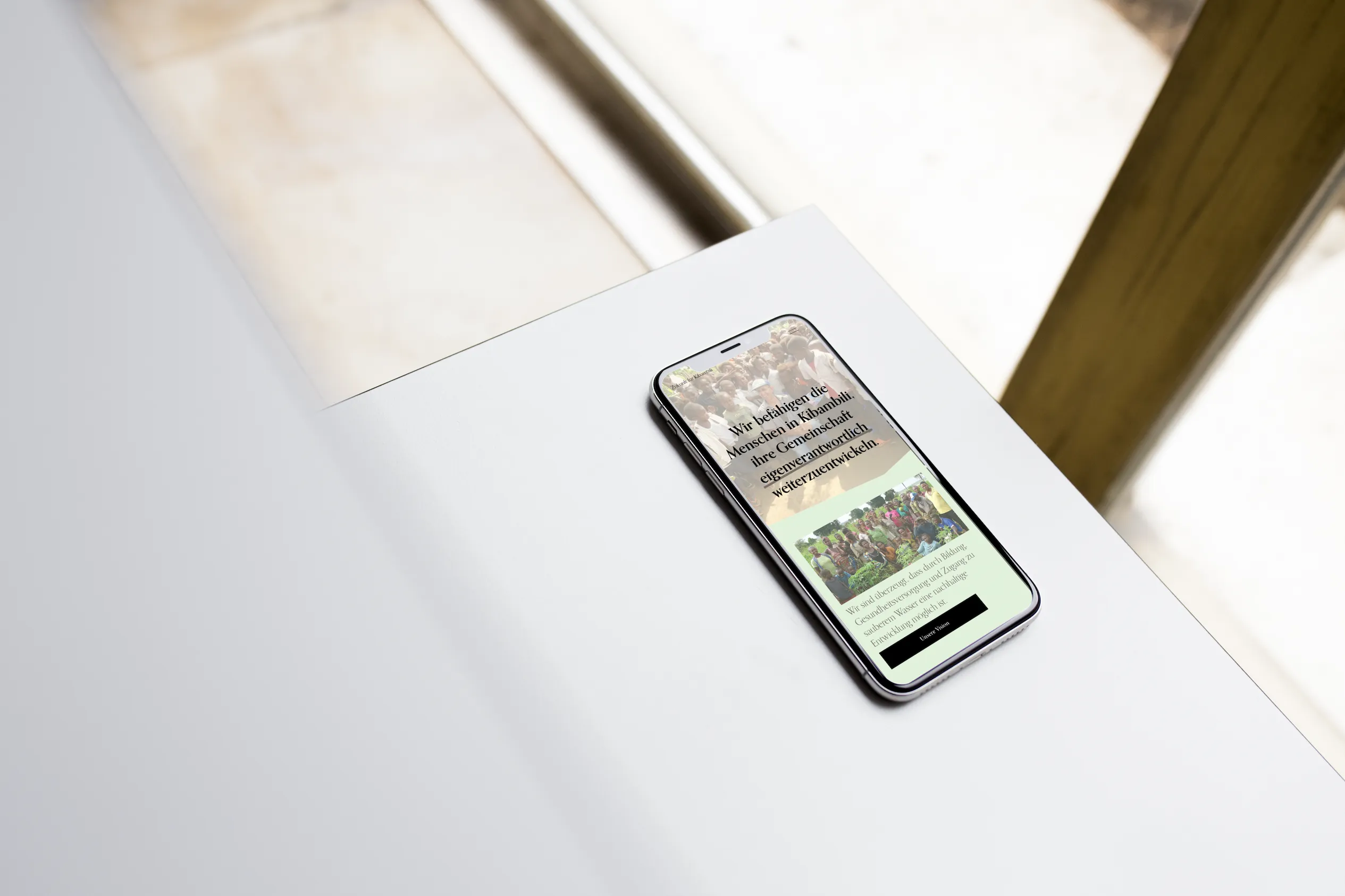
For the NGO "Zukunft für Kibambili" the homepage was built around the Why — the mission moves to the front, clearly and understandably. The project report shows the Golden Circle in practice.
Conclusion
Simon Sinek's Golden Circle is neither the holy grail of brand work nor pure marketing talk. It is a clever structural tool that enforces a clear order: Why before How before What. Anyone who takes that order seriously and carries it through to hero claim, navigation and CTAs ends up with a website that doesn't sound like everyone else's.
The method has limits. The neuroscience behind it is simplified, the evidence is anecdotal, and the risk of purpose-washing is real. None of this rules the method out — it just calls for sobriety. No manifesto, no wall stickers, no borrowed purpose wording. Instead: an honest sentence that fits the company's daily life. And one that actually shapes decisions there.
If you're unsure after reading whether your current Why holds up, that's not a drawback. It's exactly the right moment to start asking questions.
Noevu facilitates the Golden Circle process compactly, honestly and without guru posing — and translates the result directly into a website that makes your Why visible.
Frequently Asked Questions
What is the Golden Circle, simply explained?
The Golden Circle is a mental model by Simon Sinek, published in 2009. Three concentric circles order how an organisation communicates and what defines it: the innermost Why (the reason to exist), around it the How (the particular way of delivering that Why), and on the outside the What (concrete products or services). The core thesis: people don't buy what you do, they buy why you do it. For Swiss SMEs, the Golden Circle works best as a structure for a positioning conversation — not as a wall sticker.
How do I find the Why of my company?
The fastest route runs through three questions: What would you still be doing even if it barely made financial sense? Which customers genuinely make you proud — and why? What would disappear from your industry if your company stopped existing tomorrow? You need good answers from three to five people on the team, not a full offsite. One sentence at the end is enough. If it's honest, employees and customers recognise it — if not, it sounds interchangeable.
Does the Golden Circle also work for small SMEs?
Yes — especially well, because small teams still feel their Why but rarely know how to phrase it precisely. The corporate version with stakeholder interviews and a three-day workshop doesn't fit. Instead: two hours, three to five people, three guiding questions, one sentence as output. The test: does that sentence fit on a team member's T-shirt and on the homepage of your website? If yes, you have something useful. If not, the sentence is too long or too abstract.
What are the valid criticisms of the Golden Circle?
Three objections are well supported. First, the neuroscience basis (limbic brain vs. neocortex) is heavily simplified and not clearly confirmed by current research. Second, Sinek's examples (Apple, Wright Brothers, Martin Luther King) are selected anecdotally — no controlled studies show that "Why-first" companies are systematically more successful. Third, the hype creates purpose-washing: mission statements without behaviour behind them. As a clear structural tool for communication the Golden Circle remains useful — as a neuroscientific theory it does not.
How long does a Golden Circle workshop for an SME take?
At Noevu, typically two hours. Three to five people from the leadership team and one operational area are enough. Longer formats are only worthwhile when brand core, visual language and tonality need to be worked out in addition. A pure Golden Circle workshop that ends in a single sentence doesn't need a full day. What takes longer is translating that sentence into website structure, copy and CTAs — typically another two to four weeks depending on scope.