
AI in everyday life at Swiss SMEs: More than just writing emails
Article content
The most important facts in brief
AI is more than just writing emails: it improves processes, quality, and speed.
Start small: 1–2 use cases, quick impact, clear ROI.
Using data: structuring knowledge, reducing errors, sharing knowledge.
Automate: Reduce routine work, relieve the team, delight customers.
Secure & compliant: Swiss standards, data protection, and control.
Can AI solve everyday SME problems?
In our daily work, we noticed that Bexio does not offer integrated batch document downloads, and with Kontera, automatic document retrieval is only available with more expensive subscriptions. Instead of accepting higher costs or working manually, we asked ourselves: Can artificial intelligence help here?
The answer is yes—and we even used AI tools to develop the solution. Not a single line of code was written manually; even this blog article was created with the help of AI.
Where do we start with AI?
Small tools often have a big impact. We have developed two Python scripts that solve a typical SME problem:
Tool 1: Automatic document downloader Retrieves all documents from Bexio via API—no more manual clicking required. Using AI, we converted an existing open-source application with Microsoft technology into a platform-independent script in seconds—and improved it.
Tool 2: Intelligent document analyzer Google Gemini reads every invoice and receipt, recognizes the date, supplier, and type, and automatically names the files appropriately.
The result:
Instead of Scan_2023_X.pdf it means 2023-10-12 - Swisscom - Bill - Internet.pdf.
What are the areas of application for AI in our SME?
This example shows what artificial intelligence can do for Swiss SMEs today—without any major revolutions:
document management
Automatic sorting and naming of documents
Recognition of invoice contents and types
Preparation for audit-proof archiving
process automation
API integrations without programming knowledge
Automated data preparation
Intelligent file management
development aid
Code creation even without technical expertise
Problem solving through AI-supported analysis
Rapid prototyping
Why is this relevant for Swiss SMEs?
Many SMEs shy away from AI solutions because they think they are too complex or too expensive. Our example shows the opposite:
Easy to implement: With the right tools, specific problems can be solved without in-depth technical knowledge.
Cost-effective: Instead of purchasing expensive subscriptions, you can develop your own solutions.
Practical: It's not about groundbreaking innovations, but rather small improvements that make everyday work easier.
The AI tool stack for SMEs:
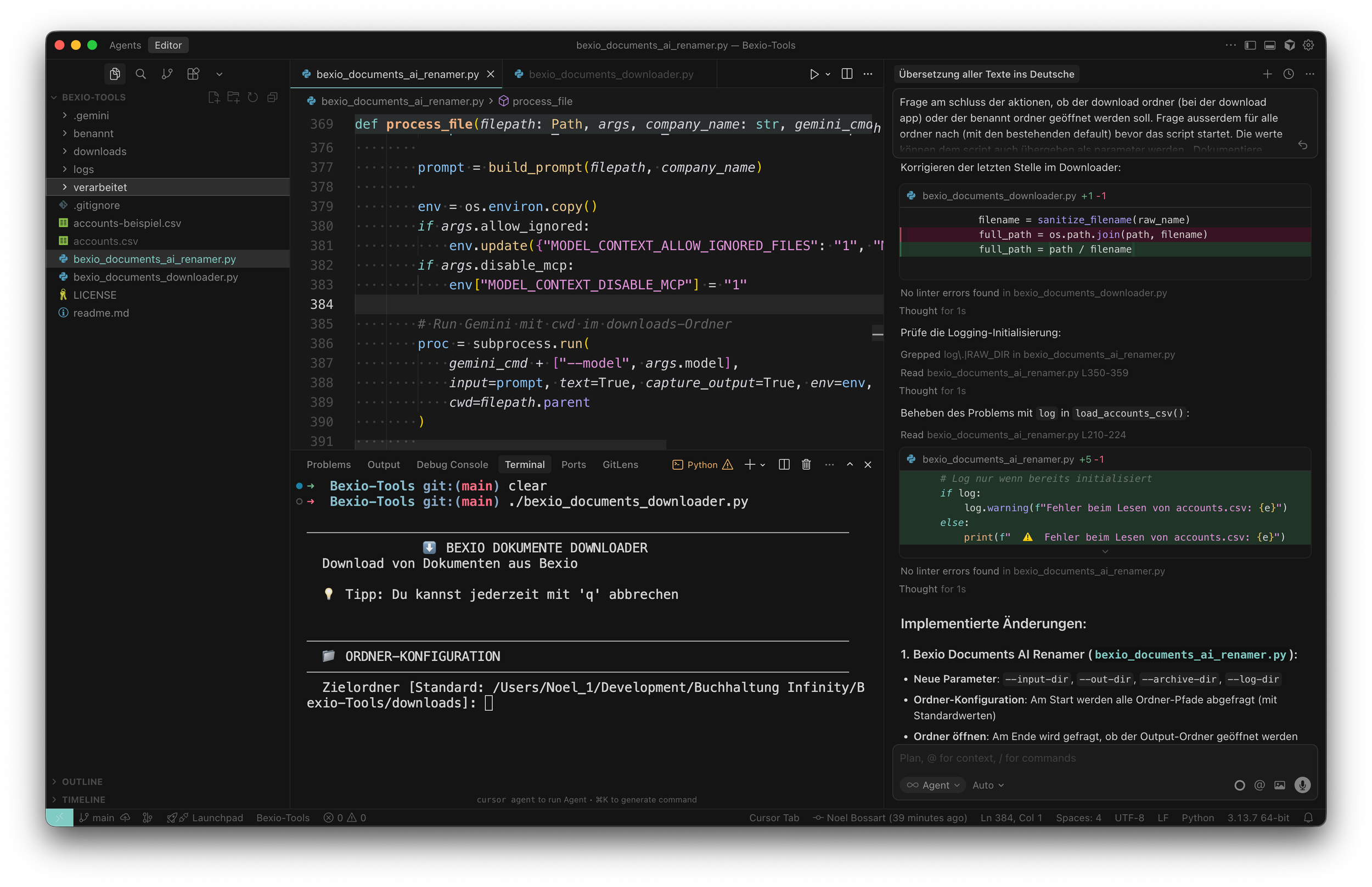
We used a combination of different AI assistants:
Google AI Studio, Windsurf, Visual Studio Code with Gemini Extension, and Cursor for script creation
Slide browser for the blog post
Ideogram for the blog image
Gemini CLI for analyzing files and images
These tools are now accessible and affordable for every Swiss SME.
From problem to solution in 5 steps:
If you are an SME facing a challenge, it can usually be solved with AI in five steps.
Identify the problem: Where do we lose time in our daily lives?
Examine AI possibilities: Can AI help here?
Selecting tools: Which AI assistants are suitable?
Developing solutions: Creating prototypes with the help of AI
Test and optimize: Adapt and improve the solution
Experience it for yourself
Visit our project at github.com/Noevu/bexio-tools
You can download the tools, try them out, and experience for yourself how artificial intelligence can also provide valuable services in your SME.

Ready for AI in your SME?
Do you also see potential for artificial intelligence in your company, but don't know where to start? We support Swiss SMEs in harnessing the full potential of AI:
AI training for companies and employees: Practical workshops on introducing AI tools into everyday work
AI potential analysis: Systematic analysis of your business processes to identify potential applications for AI
Concrete AI implementation: Implementing AI solutions in your processes—from idea to application
FAQ: Frequently asked questions about AI use in SMEs:
-
AI links your knowledge, automates routines, and makes processes measurably faster. Typical effects: fewer media breaks, consistent quality, shorter turnaround times. Examples: draft offers from templates and price data, support responses with references to your guidelines, automatic meeting minutes. Result: you work in a more focused manner and deliver more reliably.
-
Start with a small, clear use case, e.g., quote creation or support FAQ. Define the goal, data source, and success criteria (time savings, error rate). Build an MVP in 2–4 weeks, test with a pilot team, iterate in short cycles. Important: clear rules, feedback loop, and early visible quick wins to get the team on board.
-
The costs depend on the scope and integration. It makes sense to start small (workshops + MVP) and measure the ROI of the process. Typical levers: 20–40% less time spent on routine tasks, less post-processing, faster response times. Calculate openly: hours saved × hourly rate, plus quality and revenue effects. This will allow you to quickly see whether you should scale up.
-
Use existing content: offers, emails, guidelines, product information, project documents. Organize it so that it is easily accessible (folders/tags), define versions, and clarify access rights. It doesn't have to be perfect at first—the main thing is that the most important sources are structured and up to date. Supplement with short FAQs so that the system prioritizes clear answers.
-
Start without risk with "side workflows" (documents, email drafts). Then connect your tools via API or automation: CRM/ERP, DMS, tickets, calendars. Introduce guardrails (templates, approvals, logs). Roll out gradually: pilot, team, department. This way, you remain in control and the impact increases step by step.
-
Demonstrate the concrete benefits in everyday life, not the technology. Provide brief, practical training (dos and don'ts, examples), provide templates, and define who is responsible. Select a pilot team, collect feedback, and improve processes. Visibly recognize successes. Important: AI provides support—you remain in charge of decisions.
-
Risks are manageable: incorrect responses (hallucinations), data leakage, vendor dependency. Countermeasures: verified sources, approval processes, access controls, audit trails, CH/EU hosting. Defines no-go data, monitors usage, and regularly evaluates benefits vs. risks. This ensures that AI remains a tool, not a risk.